
4th century (legendary)·Feast October 22
St. Cordula of Cologne
Legendary Companion of Saint Ursula and Martyr of Cologne
Overview
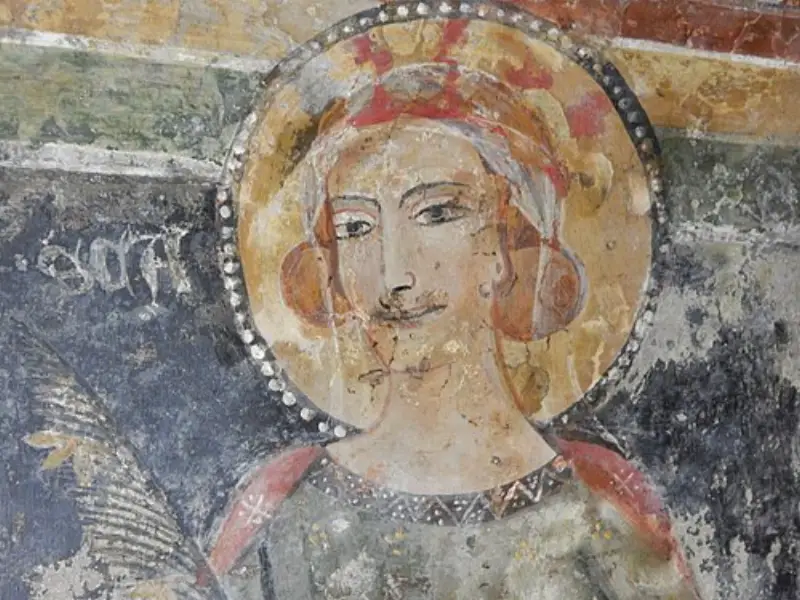
Cordula of Cologne is an apocryphal saint of the Ursuline legend, venerated for centuries as one of the companions of Saint Ursula though nothing certain is known of her. According to the medieval story, she made the voyage in Ursula's band from Brittany to Cologne during the fourth century, and there the maidens met massacre at the hands of Hunnic invaders. Cordula hid herself to escape their fate, but, stung by conscience, emerged the following day and was killed in her turn - a late martyrdom that made her, for later writers, a model for conquering human hesitation. Her cult took shape in the twelfth century, when a nun of Heerse named Helentrudis reported a dream visitation from a young woman who called herself Cordula, a companion of Ursula. Remains identified as hers were found in 1278 and enshrined by the Knights Hospitallers at Cologne. Her feast was kept on October 22, and her veneration spread through monastic Europe, especially among women's convents; but doubts about the historicity of the Cologne legend led to her removal from the Roman Martyrology after the reform of 1969.
The Complete Life
The Martyr Who Hesitated
Everything told about Cordula belongs to legend rather than history, and the tradition itself classifies her as apocryphal. The medieval folklore that produced the story of Saint Ursula and her eleven thousand virgins gave Cordula a distinctive role within it: she was one of the companions who, according to the tale, came from Brittany over to Cologne during the fourth century, and there the entire company was slaughtered by Hunnic invaders. Cordula's part in the story is the most human. Afraid, she went into hiding and so escaped the massacre that claimed her companions. But her conscience would not let her rest. On the day after the massacre she came out of hiding and presented herself for the death she had avoided, and was killed. Later interpreters found in this strange double ending the saint's real meaning: in overcoming her fear and joining her companions in martyrdom, Cordula stood as an example of facing down and conquering human hesitation. Official Catholic judgment on the wider narrative is blunt - the story of Ursula and her companions is entirely fabulous, and not even their names are known - so the tale must be read as devotional literature rather than chronicle, however much truth it may carry about fear and courage.
§ Biography
A Saint Made by a Dream
Cordula's recognition as a saint was the work of a dream. Around the middle of the twelfth century, Helentrudis, a nun of the convent of Heerse, claimed that a young woman had visited her in her sleep, told her she was a companion of Saint Ursula, and gave her name as Cordula. From that vision, veneration of Cordula as a saint began. Physical confirmation followed in 1278, when her alleged body was found in the vineyard of the commandery of Saint John of the Knights Hospitallers at Cologne after one of the knights also experienced a nightly visitation from her; the remains were moved - perhaps by Albertus Magnus in person - into the commandery's chapel and buried there. The cult spread rapidly beyond Cologne, reaching Osnabruck, Valenciennes, Marchiennes, and Tortosa, carried chiefly by monastic communities; in the thirteenth century the Dominicans promoted it through relics and through hagiographic productions often sung during Matins in the refectory. It flourished particularly within women's orders and convents: a relic of Cordula reached Wienhausen Abbey, the Cammin Casket held another portion of her body, and the Convent of Jesus at Aveiro in Portugal kept her statue and perhaps a relic.
§ Veneration
After the Suppression
Though her cult was suppressed, Cordula never quite left the imagination. Artists had long found in her the most poignant figure of the Cologne legend - the martyr who hesitated, fled, and returned - and a late fifteenth-century panel depicted the Martyrdom of Saint Cordula before the City of Cologne. The stage claimed her too: in Andrea Salvadori's opera La regina Sant'Orsola she appears as Saint Ursula's confidant, the secondary female role of the work, a part first filled by Francesca Caccini, one of the pioneering women composers of the early Baroque. Her afterlife extends even to popular music: the Czech singer Aneta Langerova included a song named for her, Svata Kordula, on her album Na Radosti. These echoes are scattered across countries and centuries - an Italian opera, a Florentine singer at its premiere, a Czech pop record - and they show how a saint whose bones were never verified and whose story was officially declared fabulous could nonetheless remain a living presence in European culture, carried less by liturgy than by art, music, and the sheer narrative power of her brief, late-arriving martyrdom on the day after the massacre.
§ In popular culture
Timeline
- 1150
Helentrudis, a nun of Heerse, tells of a dream visitation from a companion of Ursula giving her name as Cordula; veneration begins.
§ Veneration
- 1278
Remains said to be hers are found in the Hospitallers' vineyard at Cologne after a knight's own dream, and buried in the commandery chapel.
§ Veneration
- 1961
Her name still stands in the Martyrologium Romanum of this year.
§ Veneration
- 1969
Her cult is suppressed and she is dropped from the Roman Martyrology amid doubts about her historicity.
§ Introduction
- 2004
The revised Martyrologium Romanum of this year lists only Ursula and unnamed companions, omitting Cordula.
§ Veneration
In Their Own Words
is entirely fabulous: nothing, not even their names, is known about the virgin saints who were killed at Cologne at some uncertain time
The Record
- Canonization
- Never formally canonized; venerated from a twelfth-century vision until her cult was suppressed in 1969
Prayer
Bibliography
Show 10 sources
- Borrelli, Andrea. "Santa Cordula". SantiBeati
- Baring-Gould, Sabine (1877). The Lives of the Saints
- Harness, Kelley (15 February 2006). Echoes of Women's Voices: Music, Art, and Female Patronage in Early Modern Florence. University of Chicago Press. ISBN 978-0-226-31659-8
- Hoefner, Kristin (9 August 2023). "Observant Reform and Dominican Church Interiors". In Observant Reforms and Cultural Production in Europe. Radboud University Press. ISBN 978-94-93296-08-4
- Militzer, Klaus (5 July 2017). "The Hospitaller Fraternity of St John at SS Johan and Cordula of Cologne". In The Military Orders Volume III: History and Heritage. Routledge. ISBN 978-1-351-54253-1
- Montgomery, Scott Bradford (2010). St. Ursula and the Eleven Thousand Virgins of Cologne. Peter Lang. ISBN 978-3-03911-852-6
- O'Connell, Canon J.B., ed. (1962). The Roman Martyrology. Angelus Press
- Calendarium Romanum (1969), p. 143
- Martirologio Romano. Libreria Editrice Vaticana (2004), p. 585
- Langerová, Aneta. "Svatá Kordula". www.langerovaaneta.cz
Profile text adapted from the Wikipedia article, licensed CC BY-SA 4.0.
Pray with this saint every day
Save St. Cordula of Cologne to your favorites, read the full profile, and get feast-day reminders in the Saints app.
Get the Saints AppFree on the App Store for iPhone and iPad