
4th century - c. 460·Feast December 12
St. Corentin of Quimper
First Bishop of Quimper and Founding Saint of Brittany
Overview
Corentin of Quimper - Corentinus, Kaourintin in Breton - was a hermit who became the first bishop of Quimper and stands among the seven founding saints of Brittany. Cornouaille saw his birth in the fourth century; he settled as a hermit at Plomodiern, near the mountain of Ménez-Hom, where legend gave him a miraculous fish: each day the fish appeared in a fountain, a piece could be cut from it for food, and the flesh regrew. His reputation for holiness reached King Gradlon, who, on founding the diocese of Quimper, called Corentin to be its first bishop and sent him to Tours, where Martin would consecrate him; Guénolé, who founded Landévennec Abbey, and Tudy went along as his disciples. Gradlon likewise bestowed on him a palace on the site where Quimper Cathedral now stands. Corentin died around 460 and was buried before the altar of the cathedral. In the Breton legend of Ys he appears as the saint who warned King Gradlon of his daughter Dahut's sin and witnessed the drowning of the city. He is patron of Cornouaille and of seafood, and his feast is kept on December 12.
The Complete Life
The Hermit and the Fish
Corentin's life is known through texts compiled centuries after his death, above all the Vita de saint Corentin, which Dom Plaine put into writing around 1220-1235 and which was later revised after a work known as The Ancient Life of Saint Corentin came to light; the Aiquin song also recalls him. According to Albert le Grand, he was born in the region called Cornouaille armoricaine, in the westernmost peninsula of Gaul, in the fourth century. He chose the eremitical life early, settling at Plomodiern, adjacent to Ménez-Hom, and his devotion to the people around him was such that his reputation for selflessness spread across France and, through the scriptures and word of mouth, through Europe as well. Legend supplied the detail that fixed his image forever. Near his dwelling a miraculous fish presented itself to Corentin in a fountain; the hermit would cut a small piece from it to feed himself, and the piece would regrow - an endless, self-renewing meal for a man otherwise living on the herbs and roots he found in the forest. However the story is read, it marks Corentin from the beginning as a saint of the waters, tied to the tides and fisheries of the Breton coast.
§ History and tradition
Chosen by King Gradlon
The turning point came through a king. Gradlon's resolve to establish the diocese of Quimper brought him to summon the hermit of Plomodiern and ask him to become the city's first bishop. To give the new bishop legitimate orders, Gradlon sent him to the city of Tours, there to be consecrated by Martin of Tours, the most revered bishop of Gaul; Corentin made the journey accompanied by his disciples, among them Guénolé, who would found the abbey of Landévennec, and Tudy. The king did not leave his bishop dependent on charity: he granted him a palace on the very ground where the cathedral of Quimper rises today, binding the new episcopate to the site it would occupy for the next fifteen centuries. Corentin's consecration placed him among the founding generation of the Breton church. Tradition counts him with Tugdual of Tréguier, Paterne of Vannes, Samson of Dol, Pol of Léon, Malo, and Brieuc as one of the Seven Saints - monks out of Wales and Cornwall who carried the Christian faith into Armorica and established its earliest bishoprics during the fifth and sixth centuries.
§ History and tradition
Shepherd of a New Church
As first bishop of Quimper, Corentin stood at the head of a church in formation, governing a see that tradition credits King Gradlon with founding and leading the people of Cornouaille toward Christianity. His task belongs to the great age of Breton evangelization, when the Seven Saints planted the first bishoprics across the peninsula, and when the pilgrimage road known as the Tro Breiz - the tour of Brittany - would one day link their cities in a single circuit of devotion. The sources preserve his work more in image than in record, but the images are telling. The bishop who had fed on the miraculous fish of Plomodiern now fed a diocese, and the generosity that had made his hermitage famous became the style of his episcopate. His selflessness had been renowned across France; as bishop he directed it toward the people of Quimper. That a hermit could be made a bishop at a king's request, consecrated by Martin of Tours, and installed in a palace beside his future cathedral is the tradition's way of saying that the Breton church joined ascetic holiness and episcopal order from its very origins, with the desert and the cathedral sharing one roof.
§ History and tradition
Burial at the Heart of Quimper
Corentin died around the year 460 at Quimper, the see he had governed as its first bishop. His burial place was chosen at the heart of the city he served: before the altar of the cathedral of Quimper, on the ground where King Gradlon had once granted him a palace. There his tomb became the center of his cult, and the cathedral kept the memory of the saint beneath its altars through every rebuilding of the centuries. His memory also traveled outward. In 1201 King Philippe Auguste dedicated an abbey to him near Mantes, called Saint Corentin Abbey, carrying his name deep into the royal domain far from Brittany. And in Cornwall, across the Channel, Saint Corentine's Church at Cury is dedicated to him - evidence that his cult moved along the same sea routes that had brought the founding saints from Wales and Cornwall to Armorica in the first place. His feast was fixed on December 12 and is kept in both the Catholic and Eastern Orthodox churches, so that the hermit bishop of Quimper is commemorated wherever Breton and Cornish Christians remember their common origins.
§ History and tradition
The Saint at the Fall of Ys
In the Breton legend of the drowned city of Ys, Corentin plays the part of conscience. In the tale he watches the city of Ys perish and cautions Gradlon about the wrongdoing of the king's daughter Dahut, named Ahes in some tellings. The tales vary about Dahut - in some she descends from fairies sent to beguile the king into ruin, elsewhere she is a princess whom the devil seduced into undoing the floodgates - yet the versions agree on the outline: Gradlon and Dahut escape the cataclysm on horseback by magic, are met on the way by Corentin (Guénolé in certain tellings), and his rebuke of Dahut's excess brings her down into the water, where she turns into a morgen or siren. The story gave Corentin a symbolic weight beyond chronicle. The Celts were receiving the faith just as Rome fell, and the pity Corentin shows Gradlon after the disaster stands for the cultural passage from the old estuarine world of dikes, tides, and alternating plots of cereals and shellfish to the new Christian order. When the wandering king, lost and hungry, stumbles upon the hermitage, Corentin offers him a morsel of the miraculous regenerating fish - the gift of Christianity made visible in the food of the sea.
§ Legend of Ys
The Fish and the Pilgrim Road
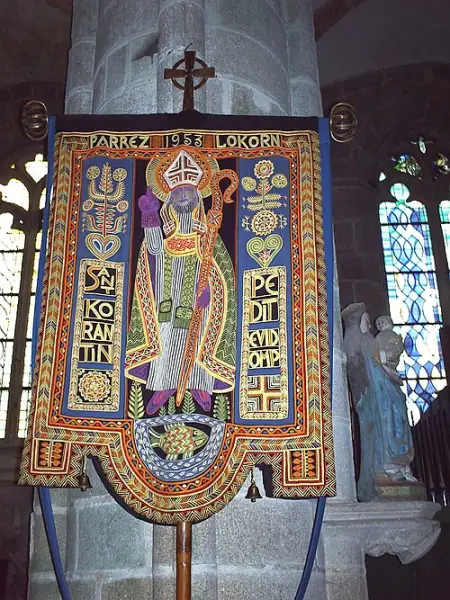
Corentin's emblem in art is the fish, whole or halved, which he holds in his hand or which rests at his feet, sometimes beside a fountain - a standing reminder of the miraculous fish of Plomodiern and of the piece the saint shared in the legends. The attribute makes him unmistakable in Breton churches, and it fits a saint who remains, unusually, the patron of seafood as well as the patron of Cornouaille. His likeness rides on the banner of Locronan's parish church, and an icon painted in the twentieth century for the Saint Anne Orthodox Association of Brittany shows him with his fish, a sign that his cult lives on in the Eastern church as well as the Latin one. As one of the Seven Founder Saints he remains a fixed station of the Tro Breiz, the Catholic pilgrimage that connects the cities of Brittany's seven legendary saints and continues to draw walkers across the peninsula. Few regional saints of France combine so many roles - hermit, bishop, legend's conscience, patron of fishermen and of all who live from the sea - yet for the people of Cornouaille they are all one figure: Corentin, first bishop of Quimper.
§ Iconography
Timeline
- 460
Died at Quimper around this year and was buried before the altar of the cathedral.
§ History and tradition
- 1201
King Philippe Auguste dedicated an abbey to him near Mantes, called Saint Corentin Abbey.
§ History and tradition
- 1220
Dom Plaine composed the Vita de saint Corentin, the principal account of his life, around 1220-1235.
§ History and tradition
The Record
- Patron of
- Cornouaille·seafood
- Symbols
- fish·episcopal attire
- Canonization
- Pre-congregation; venerated as one of the seven founding saints of Brittany
Prayer
Bibliography
Show 6 sources
- Fawtier-Jones, E. C. "La vita ancienne de saint Corentin". Mémoires de la Société d'histoire et d'archéologie de Bretagne, volume 6 (1925), p. 8
- Bourgès, André-Yves. "À propos de la Vita de saint Corentin" (2008)
- Bourgès, André-Yves. "La chanson d'Aiquin et saint Corentin, Hagiohistoriographie médiévale" (2009)
- "Les Sept Saints Fondateurs de la Bretagne : Saint Corentin"
- Doble, G. H. (1962). The Saints of Cornwall: part 2. Truro: Dean and Chapter, pp. 45-53
- Le Roux, Françoise and Guyonvarc'h, Christian-J. The Legend of the City of Is. Éditions Ouest-France, May 2000, pp. 78-86
Profile text adapted from the Wikipedia article, licensed CC BY-SA 4.0.
Pray with this saint every day
Save St. Corentin of Quimper to your favorites, read the full profile, and get feast-day reminders in the Saints app.
Get the Saints AppFree on the App Store for iPhone and iPad