
831 – 908·Feast September 14
St. Cormac mac Cuilennáin
Bishop-King of Munster and Learned Sage
Overview
Cormac mac Cuilennáin was an Irish bishop who reigned as king of Munster from about 902 until his death in battle in 908. Born into a lesser line of the Eóganacht Chaisil, the Cashel division of Munster's ruling house, he had no royal ancestors for generations and was probably put forward as a compromise candidate acceptable to rival Munster factions. He was a bishop before and during his reign and was remembered as a celibate. The annals record campaigns in Connacht and Mide in 907, a victory over the high king Flann Sinna at Mag Lena, and a fleet sent up the River Shannon on his orders that captured Clonmacnoise. In 908 he led a Munster army against Leinster and fell at the battle of Belach Mugna, near Bellaghmoon in modern County Kildare, breaking his neck in a fall from his horse before being beheaded. Flann Sinna, on receiving his head, honoured the slain bishop and rebuked his killers. Cormac was soon regarded as a saint, and his burial place at Dísert Díarmata, now Castledermot, was said to produce omens and miracles. Tradition credits him with the Sanas Cormaic glossary and other scholarly works.
The Complete Life
A Minor Branch of a Great Dynasty
The Ireland into which Cormac was born around the year 831 was a patchwork of small kingdoms, perhaps a hundred and fifty of them, each averaging some five hundred square kilometres and a few thousand inhabitants. Above these local powers stood the five great provincial kingships of Connacht, Leinster, Ulster, Meath, and Munster, and it was from the Uí Néill, northern and southern alike, that Ireland's successive high kings came, their power an ever plainer fact of eighth- and ninth-century politics. In Cormac's day Flann Sinna, a prince of Clann Cholmáin among the southern Uí Néill, wore the high crown, and Norse-Gael rulers had also established themselves along the coasts during the Viking Age. Cormac's own kin, the Eóganacht Chaisil, formed the Cashel division of that dominant clan, yet his family stood far down its order of rank. By the genealogists' count he stood eleven generations below Óengus mac Nad Froích, and not one of the men between them had ever ruled at Cashel. The Annals of the Four Masters state that he was tutored by Snedgus of Dísert Díarmata, the monastery now known as Castledermot. Later stories that he had been betrothed to Gormlaith, daughter of Flann Sinna, are judged by modern historians to be later inventions.
§ Background
Bishop and Celibate King
Before he ever wore a crown, Cormac belonged wholly to the Church. There is no doubt that he was a bishop before and while he governed Munster, though it is no longer certain which see he held; some writers have connected him with Emly rather than Cashel. The Annals of Innisfallen, noting the start of his reign, describe him as a noble bishop and a celibate, and later traditions that he renounced a marriage or betrothal, whatever their historical worth, preserve the memory of a man who had chosen the unmarried ascetic life. His election to the kingship came in circumstances of violence. Finguine Cenn nGécan, the previous king, met a violent end: the Annals of Ulster accuse his own associates of treacherous killing, while the Annals of Innisfallen blame the Cenél Conaill Chaisil, a branch of the Cashel Eóganachta. Cormac, like other ninth-century kings of Munster who were simultaneously bishops and abbots, was very probably a compromise candidate, a churchman whose personal sanctity and learning made him acceptable to rival factions within the province. The pairing of crozier and kingship, unusual elsewhere, was an established pattern in Munster, and in Cormac it produced one of its most remarkable exemplars.
§ King and bishop
Restoring the Power of Munster
As king, Cormac appears to have tried to recover the old authority of the Munster kings over their eastern neighbours in Leinster, and perhaps to have aspired to a position of chief kingship in Ireland itself. Most of what was set down survives from northern scribes who favoured the Uí Néill, and it paints a deceptively diminished picture of Eóganacht power and pretension. The southern Annals of Innisfallen preserve a different picture. They report campaigns in 907, when Cormac operated in Connacht and in Mide, the heartland of the southern Uí Néill, and where Flann Sinna himself was defeated at Mag Lena. In the same year the annals record a fleet operating on the River Shannon on Cormac's orders, which captured the great monastery of Clonmacnoise, while a separate hosting against the Osraige and the men of Connacht carried off the hostages of Connacht. These operations show a ruler capable of projecting force far beyond his own province, by land and by water, against the most powerful king in Ireland. Whatever his ambitions, Cormac combined the offices of bishop and war leader in an age when such a combination troubled no one in Munster, and the annalists who narrated his campaigns did not think it inconsistent with his holiness.
§ King and bishop
The Rule of a Scholar Ascetic
The spiritual character of Cormac is preserved chiefly in the works attributed to him and in the verdict of the annalists. The Rule of Cormac, which tradition places under his name, insists on humility, on ascetic training, and on the reading of Scripture, a programme that matches everything else recorded of him. The Annals of the Four Masters, in lamenting his death, gathered the offices of his life into a single sentence: at once king, bishop, anchorite, scribe, and an extraordinary master of Irish letters. The Fragmentary Annals of Ireland, compiled from earlier material, praise him in still warmer terms: learned in Irish and in Latin alike, a chief bishop of unblemished purity and devotion, wonderworking in his chastity and prayer, versed in governance and in every branch of wisdom, learning, and science, a master of poetry and of study, and foremost in charity and in every virtue. Chastity, prayer, and learning form the triad on which his reputation rests. Even the accounts of his death show a man prepared for martyrdom, telling his foster-son to flee and commending his spirit to God with the words of Psalm 30 as he fell.
§ Saint and scholar
The Battle of Belach Mugna
In 908 Cormac and Flaithbertach mac Inmainén, his chief councillor and abbot of Scattery Island, gathered an army to campaign against Leinster, whose king Cerball mac Muirecáin was the son-in-law and staunch ally of Flann Sinna. As the Munstermen mustered, Flaithbertach's horse stumbled and threw him, an omen many took as fatal. A negotiated settlement was proposed, with tribute and hostages from Leinster, and Cormac was willing to accept it, but Flaithbertach won him over to battle, though the king was convinced the field would cost him his life. When word came that Flann and the Uí Néill were marching to Cerball's aid, men began to desert, yet Cormac marched on and met the Leinster and Uí Néill forces at Belach Mugna, near Bellaghmoon in the south of modern County Kildare. His army, weak and in disorder, quickly broke. A manuscript in the Royal Library of Belgium relates that Cormac's horse slipped in a track of blood and fell backwards, breaking his back and neck; as he fell he commended his spirit to God. His enemies then thrust spears into his body and severed his head. The head was carried to Flann Sinna, who kissed it, rebuked the killers, and carried the consecrated head three times around him.
§ Cath Belach Mugna
Saint and Martyr
Cormac was reckoned a saint on the evidence of his own times, with clear recognition already by the eleventh century. The Fragmentary Annals of Ireland record his burial at Dísert Díarmata, today's Castledermot in County Kildare, where he was venerated, and report that wonders and portents continued to come from his remains. Later tradition located his shrine at Castledermot and credited it with wonder-working. The violent circumstances of his death meant that he was understood in the categories the Irish Church applied to clerics killed by violence: martyrdom was the usual term for such a death, and the medieval texts speak of him as the true martyr whose head the high king carried in honour. His cult, never formally processed through modern canonization, belongs to the great company of pre-congregation saints whose veneration rests on continuous local memory and the testimony of the annals. He is commemorated in the Catholic tradition on September 14, and modern devotion has spread beyond Ireland, as the existence of contemporary Orthodox icons of Cormac attests. A panel on the North Cross at Ahenny, County Tipperary, depicting a funeral procession, has sometimes been thought to show his own.
§ Saint and scholar
The Scholar's Afterlife
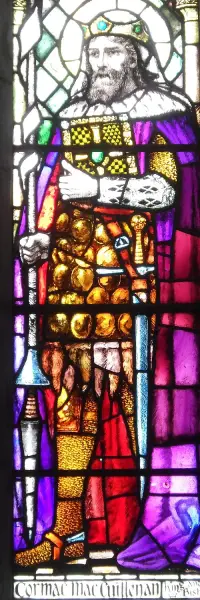
Cormac's fame as a scholar proved as durable as his fame as a saint. A variety of works came to be associated with his name, above all the Sanas Cormaic, a glossary of difficult Irish words composed in the manner of Isidore of Seville. The core of that document dates from around Cormac's own time and may be connected with him in some way, though scholars doubt whether even the original list of entries was his own compilation. The vanished Psalter of Cashel and the Lebor na Cert, known as the Book of Rights, were also laid at his door, although the versions of these works that survive are probably products of the early twelfth century, in the time of Muirchertach Ua Briain. Liam Breatnach has also attributed the poem Amra Senáin to Cormac. His memory was kept alive in Irish art and literature: stained-glass windows in St Patrick's Cathedral in Dublin and in Emly commemorate the king-bishop, and the funeral procession carved on the North Cross at Ahenny is sometimes supposed to represent his own. Historians continue to study him as the outstanding example of the bishop-kings of Munster, a figure whom the annalists could hail without irony as sovereign of the two provinces that together made up Munster in his day.
§ Saint and scholar
Timeline
- 831
Born in Ireland into a minor branch of the Eóganacht Chaisil, the Cashel line of Munster's ruling clan.
§ Introduction
- 885
Snedgus, the wise man of Dísert Díarmata who tutored the young Cormac, dies, per the Annals of the Four Masters.
§ Annals of the Four Masters
- 896
The Four Masters record a change of kings at Cashel, Cormac son of Cuilennán replacing Cennghégain (Finguine).
§ Annals of the Four Masters
- 902
Chosen king of Munster after Finguine Cenn nGécan's violent death; the annals style him a noble bishop and celibate.
§ King and bishop
- 907
Campaigns in Connacht and Mide, defeats Flann Sinna at Mag Lena, and sends a Shannon fleet that takes Clonmacnoise.
§ King and bishop
- 13 Sep 908
Falls at the battle of Belach Mugna: thrown from his horse and beheaded, his head is honored by Flann Sinna.
§ Cath Belach Mugna
- 1000
Honored as a saint from this era; his grave at Dísert Díarmata is said to give omens and miracles.
§ Saint and scholar
In Their Own Words
It was an evil deed," he said, "to cut off the holy bishop's head; I shall honour it, and not crush it.
In manus tuas, Domine, commendo spiritum meum.
A scholar in Irish and in Latin, the wholly pious and pure chief bishop, miraculous in chastity and in prayer, a sage in government, in all wisdom, knowledge and science.
The Record
- Major works
- Sanas Cormaic (Cormac's Glossary)·The Rule of Cormac·Psalter of Cashel (now lost)·Lebor na Cert (the Book of Rights)·Amra Senáin
- Canonization
- Pre-congregation; reckoned a saint by contemporary evidence from the 11th century
Prayer
Bibliography
Show 6 sources
- Byrne, Francis John (1973), Irish Kings and High-Kings, London: Batsford, ISBN 0-7134-5882-8
- Ó Cróinín, Dáibhí (1995), Early Medieval Ireland: 400–1200, London: Longman, ISBN 0-582-01565-0
- Russell, Paul (2004). "Cormac mac Cuilennáin (d. 908)". Oxford Dictionary of National Biography. Oxford: Oxford University Press. doi:10.1093/ref:odnb/6319
- Wiley, Dan M. (2005), "Cath Belaig Mugna", The Cycles of the Kings
- Hughes, Kathleen (1972), Early Christian Ireland: Introduction to the Sources, The Sources of History, London: Hodder & Stoughton, ISBN 0-340-16145-0
- Ní Mhaonaigh, Máire, Cormac mac Cuilennáin: king, bishop, and 'wondrous sage', Zeitschrift für celtische Philologie 58 (2011): 108–128
Profile text adapted from the Wikipedia article, licensed CC BY-SA 4.0.
Pray with this saint every day
Save St. Cormac mac Cuilennáin to your favorites, read the full profile, and get feast-day reminders in the Saints app.
Get the Saints AppFree on the App Store for iPhone and iPad