
fl. 1st century AD·Feast October 20
St. Cornelius the Centurion
First Gentile Convert to the Christian Faith
Overview
Cornelius was a Roman centurion of the first century whom the Acts of the Apostles presents as the first Gentile to be received into the Christian faith, a distinction he shares in competing traditions with the Ethiopian eunuch. He belonged to the Cohors II Italica Civium Romanorum and was stationed at Caesarea Maritima, the capital of the Roman province of Iudaea, and he may have come from the gens Cornelia, one of the prominent families of Rome. Scripture depicts him as a God-fearing man who prayed constantly and was rich in almsgiving. In answer to his prayers an angel directed him to send for Simon Peter, who was staying in Joppa; Peter, prepared by his own vision of the sheet let down from heaven, came to Caesarea and preached Christ to the household. While Peter was still speaking the Holy Spirit fell upon all the Gentile hearers, and Peter commanded that they be baptized. That event forced the infant Church to decide, at the Council of Jerusalem, that Gentiles could become Christians without conforming to the Mosaic Law. Some traditions hold that Cornelius later served as first bishop of Caesarea, or as bishop of Scepsis in Mysia, and he is honoured on the calendars of East and West alike.
The Complete Life
The God-Fearing Centurion
Cornelius appears in the New Testament as a centurion of the Cohors II Italica Civium Romanorum, the unit the Vulgate calls the Cohors Italica, posted to Caesarea Maritima, the administrative capital of Roman Iudaea. The title of centurion placed him in command within a professional army, and his Roman name points to descent from the gens Cornelia, among the most distinguished houses of the Republic and early Empire. Yet the account in Acts is less interested in his rank than in his character: he is described as a God-fearing man, one of those Gentile adherents of synagogue religion who worshipped the God of Israel without becoming Jews. Such conversions belong to the long religious history of Judea, which since the conquest of Alexander the Great had lain within the Hellenic orbit, so that Greek and Jewish thinkers had exchanged knowledge and a measure of syncretism had developed; under the Hellenized Romans, and apart from the Zealots, tolerance prevailed, and Roman worship could even identify the supreme God with Caelus. Within that world Cornelius stood out for a piety of practice rather than theory: he prayed constantly to the God of Israel, and his life overflowed with good works and almsgiving.
§ Biblical account
Two Visions at Caesarea
The conversion of Cornelius came about through a pair of visions, one given to the soldier and one to the Apostle. As Cornelius prayed, an angel of God told him that his prayers had been heard and instructed him to send men of his household to Joppa, to find Simon Peter, who was lodging with a tanner named Simon. Meanwhile Peter, praying on a rooftop, saw all manner of beasts and fowl lowered from heaven in a sheet, and heard a voice command him to eat; when he objected that some of the creatures were unclean under the Mosaic Law, the voice answered that he must not call unclean what God has cleansed. When Cornelius's messengers arrived, Peter understood the meaning of his vision and went with them to Caesarea. There the centurion fell at Peter's feet, and Peter raised him up. The two men shared their visions, Peter told of the ministry and Resurrection of Jesus, and while he was still speaking the Holy Spirit descended on the whole gathering. The Jewish believers were astonished that uncircumcised Gentiles were speaking in tongues and praising God, and Peter then directed that Cornelius and all about him, his kinsmen and close friends, should receive baptism.
§ Biblical account
Honoured by East and West
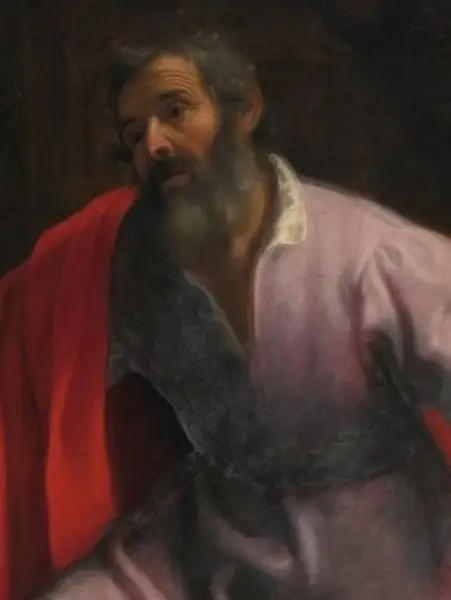
Cornelius was never the subject of a formal canonization process; his cult belongs to the earliest stratum of Christian veneration, attached to a man the Book of Acts itself records as the first-fruits of the Gentile world. He is honoured across the whole spectrum of ancient churches. On the new Martyrologium Romanum his feast falls on October 20, and the Catholic Church also commemorates him on February 2; the Eastern Orthodox Church keeps his memory on September 13; the Episcopal Church in the United States marks February 4; and the Armenian Apostolic Church remembers him on the Tuesday after the third Sunday of Advent. Eastern tradition gives him the further title of hieromartyr, and the liturgical commemorations of the Orthodox and Coptic churches recall his departure in the Lord. In sacred art he is shown in Roman military garb, as in the seventeenth-century Vision of the Centurion Cornelius by Zanobi Rosi, and painters such as Gerbrand van den Eeckhout depicted the angel's appearance to him, a scene now in the Walters Art Museum. Few figures of the apostolic age are commemorated so widely across separated communions, a testimony to the universality of the door his baptism opened.
§ Legacy
The Door Opened to the Gentiles
The significance of Cornelius for Christian history can hardly be overstated. The Church was first formed around the disciples and followers of Jesus, men of Galilee and Judea, every one of them circumcised and living under the Law of Moses. That Cornelius and his household had been received compelled the leaders of the young movement to confront the question of whether Gentiles could enter without becoming Jews, a debate that culminated in the Council of Jerusalem, recounted in Acts 15, with its decision to admit Gentile believers without the requirement of circumcision. The baptism of Cornelius thus stands, with the conversion of the Ethiopian eunuch, as a founding event of the Church's catholicity. Later tradition remembered him as a bishop, some holding that he became the first bishop of Caesarea, others that he was bishop of Scepsis in Mysia. His name continued to be given to children into modern times, the Greek-French philosopher Cornelius Castoriadis being named after him, and in the United States the Episcopal Church maintained a stone chapel dedicated to him on Governors Island in New York Harbor while the island was a military installation, consecrated in 1906 and later entrusted to the Coast Guard.
§ Significance
Timeline
- 19 Oct 1906
A stone chapel dedicated to him was consecrated on Governors Island, New York, then a military installation of the Episcopal Church.
§ Legacy
- 1986
The Episcopal Church turned the Governors Island chapel over to the Coast Guard, as reported by The New York Times.
§ Legacy
In Their Own Words
What is it, lord?
Four days ago I was fasting until this hour; and at the ninth hour I prayed in my house, and behold, a man stood before me in bright clothing ... So I sent to you immediately, and you have done well to come. Now therefore, we are all present before God, to hear all the things commanded you by God.
The Record
- Symbols
- Roman military garb
- Canonization
- Pre-congregation; venerated from antiquity in the Catholic, Orthodox, Anglican, and Armenian traditions
Prayer
Bibliography
Show 6 sources
- Bromiley, Geoffrey W., International Standard Bible Encyclopedia, Wm. B. Eerdmans Publishing, 1979, p. 297
- Bechtel, Florentine. "Cornelius." The Catholic Encyclopedia. Vol. 4. New York: Robert Appleton Company, 1908
- Dunn, James D. G. (2009). Beginning from Jerusalem: Christianity in the Making. Vol. 2. Grand Rapids, Michigan: Eerdmans. p. 446. ISBN 978-0-8028-3932-9
- Stagnaro, Angelo (February 2, 2017). "What Do We Know About St. Cornelius the Centurion?". National Catholic Register. EWTN News, Inc
- "Hieromartyr Cornelius the Centurion", Orthodox Church in America
- Pieter W. van der Horst, God-fearers (theosebeis) (2015), Oxford Classical Dictionary
Profile text adapted from the Wikipedia article, licensed CC BY-SA 4.0.
Pray with this saint every day
Save St. Cornelius the Centurion to your favorites, read the full profile, and get feast-day reminders in the Saints app.
Get the Saints AppFree on the App Store for iPhone and iPad