
died 773 or 794·Feast October 14
St. Cosmas of Maiuma
Hymnographer, Monk, and Bishop of Gaza
Overview
Cosmas of Maiuma, called also Cosmas Hagiopolites, Cosmas of Jerusalem, Cosmas the Melodist, or Cosmas the Poet, was a bishop and one of the principal hymnographers of the Christian East. Born in Damascus in the eighth century, he was orphaned young and adopted by Sergius, the father of John of Damascus, becoming John's foster-brother. Both boys were taught by an elderly Calabrian monk named also Cosmas, whose freedom from Saracen slavery John's father had secured. Both young men went from Damascus to Jerusalem and received the monastic habit at the lavra of Sabbas the Sanctified, where together they joined the Church's defence against the heresy of iconoclasm. In 743 Cosmas left the monastery when he was appointed Bishop of Maiuma, the port of ancient Gaza, and he outlived John by many years, dying in great old age, either in 773 or 794. His fame rests on his sacred poetry: with John of Damascus he is considered the finest representative of the later Greek classical hymnography, whose most characteristic form is the canon. He wrote the solemn canons for Lazarus Saturday and Palm Sunday, the Triodes of Holy Week, the first canon of the Nativity, and his masterpiece, the Canon for Christmas Day, together with the beloved refrain More honourable than the cherubim.
The Complete Life
An Orphan of Damascus
Cosmas was born in Damascus, in the eighth century, into a city under Arab rule where Christian families like his own lived as a minority within the Umayyad world. He was orphaned at a young age, and his future was determined by an act of charity: Sergius, father of the future John of Damascus, took the orphan in, and Cosmas grew up as John's foster-brother in the household of one of Damascus's leading Christian families. Their instructor was an aged monk from Calabria who bore the same name, remembered as Cosmas the Monk to tell him apart from his pupil; John's father had bought his freedom out of Saracen slavery. From this monk the boys received the classical learning of the Greek Church, and from him, perhaps, came the younger Cosmas's lifelong love of sacred poetry, for the elder Cosmas was himself a hymn writer. The household that raised him thus joined the highest culture of Hellenic Christianity to the experience of Christian life under Islam, and its two adopted sons would become, with Andrew of Crete, the crowning figures of Byzantine hymnography. That the orphan became one of the Church's greatest singers is the founding fact of his story, and no account of his life neglects it.
§ Life
Monk of the Holy City
When the two young men came of age they left Damascus for Jerusalem, the Holy City that gave Cosmas one of his names, Hagiopolites. There each took the monastic habit at the lavra of Sabbas the Sanctified, in the desert outside the city, entering the great Palestinian tradition of desert monasticism that had shaped the theology of the Jerusalem church for centuries. The lavra of St Sabbas was no quiet retreat from controversy: it was the intellectual stronghold of orthodox Christianity in the East, and in the crisis of the iconoclast controversy the two foster-brothers took up its cause. Side by side, John and Cosmas joined the defence of the Church against iconoclasm, the imperial campaign to strip the sacred images away, lending their pens to the theological argument that the incarnation of Christ had sanctified matter itself. The monastery was also where Cosmas's vocation as a poet matured, within the liturgy of the Church of Jerusalem, for which his hymns were originally composed. In 743 he left the desert for the episcopate, called from the monastic cell to the bishop's throne, an exchange of habits that Byzantine Christianity made often and that in his case joined the poet to the pastor.
§ Life
Bishop of Maiuma
In 743 Cosmas was appointed Bishop of Maiuma, the port of ancient Gaza, one of the chief sees of Palestine. From the monastery of St Sabbas he passed to the government of a church on the edge of the desert, a harbour town serving the caravan city of Gaza, where the bishop stood as father to his people and teacher of the faith. His episcopate belonged to the long generation in which the Byzantine East wrestled with iconoclasm, and Cosmas brought to it the authority of the Jerusalem monasteries. John of Damascus, his foster-brother and lifelong fellow-labourer, predeceased him by a long span; Cosmas died at Maiuma in extreme old age, in 773 or, by some accounts, 794. In learned prose he composed commentaries, or scholia, expounding the poems of Gregory of Nazianzus, the Theologian whose verse stands at the head of Greek Christian poetry. His episcopal office and his literary work were of a piece: the bishop who expounded Gregory in prose adorned the Church's liturgy in verse, and the two names of Gregory and Cosmas remain linked in the canon of the Nativity, which the bishop built upon a Nativity sermon of the Theologian himself.
§ Works
A Vessel of Divine Grace
Orthodox writers have called him a vessel of divine grace, and have named him the very glory of the Church — two titles honouring a life poured out in the liturgy. His spirituality was the spirituality of the Byzantine rite itself: the belief that doctrine, when it is sung, enters the heart more deeply than when it is argued, and that the poet's task is to put the faith of the creeds into melodies the whole people can carry. The artistic liturgical chants known as canons, the most characteristic creations of later Greek classical hymnography, were his chosen form, and in them he wove the events of salvation history into the cycle of the Church's year. His deep attachment to the Mother of God, expressed in the refrain More honourable than the cherubim, which Orthodoxy sings at Matins, at the Divine Liturgy, and in the Church's other services to this day, made him one of the chief voices of Marian devotion in the East. He was a monk before he was a bishop, and the humility of the desert never left his verse; the spoils of his learning were placed, in the words of his admirers, at the service of the Church's prayer, so that his hymns became not monuments to himself but the Church's own voice.
§ Works
Honoured in East and West
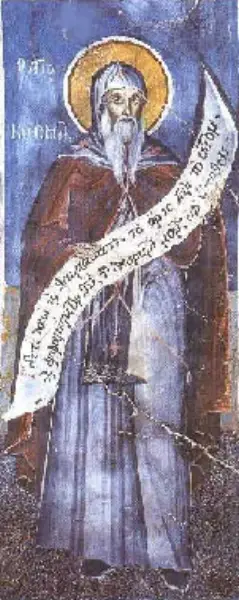
Cosmas was never the object of a formal canonization process; the holiness of his life and the enduring use of his hymns raised him to the Church's calendar by the consent of the faithful, and he is venerated as a saint by both the Eastern Orthodox Church and the Catholic Church. The Eastern Orthodox Church observes his feast on October 12 on the Julian Calendar, which corresponds to October 25 on the Gregorian Calendar, while the Greek Church keeps him on October 14, corresponding to October 27. Iconographers show him either in episcopal vestments or in the monk's habit, a scroll in his hand inscribed with lines from his own hymns, an image that joins the two halves of his life, the pastoral office and the poet's craft. The Orthodox Church's liturgical books carry fourteen canons under his name, and the nightly singing of his most famous composition at Matins and the Divine Liturgy constitutes a continual, living commemoration that no decree could add to. He is named a patron of hymnographers, and the tradition of Byzantine church music reckons him among its founding composers, in the company of Romanos the Melodist, Andrew of Crete, and John of Damascus.
§ Works
The Singer of the Incarnation
The legacy of Cosmas of Maiuma is sung rather than read. With John of Damascus he is considered the best representative of the later Greek classical hymnography, the art form whose characteristic creation, the canon, became the backbone of Byzantine Matins, and the two worked together on developing the Octoechos, the great book of the eight liturgical modes. His solemn canons for Matins of Lazarus Saturday and Palm Sunday, the Triodes chanted through Holy Week, the first canon of the Nativity, and above all his finest work, the Canon for Christmas Day, fixed the way the Eastern Church celebrates the great feasts of Christ's life. He composed his hymns at first for the Divine Services of the Jerusalem Church, yet Constantinople's influence carried them outward until they were sung everywhere in Orthodoxy; a poet of Palestinian monasticism thus ended by giving words to the whole Orthodox world. Critics caution that the liturgical books may assign to him hymns that were never his, for his teacher bore the same name and also wrote hymns; modern scholarship, following Kazhdan and Gero, has called for a more critical approach to his biography; yet the Canon for Christmas Day and the refrain sung nightly at Matins remain securely his, and by them the glory of the Church of Jerusalem is renewed at every dawn.
§ Works
Timeline
- 675
Born in Damascus around this time; other sources date his life from about 675 to about 751.
§ Life
- 743
Left the monastery when appointed Bishop of Maiuma, the port of ancient Gaza.
§ Life
- 773
Died in great old age at Maiuma, outliving John of Damascus by many years; some sources give 794.
§ Life
In Their Own Words
More honourable than the cherubim…
The Record
- Major works
- Canon for Christmas Day·Solemn canons for Matins of Lazarus Saturday·Solemn canons for Matins of Palm Sunday·The Triodes chanted during Holy Week·The first canon of the Nativity·Commentaries (scholia) on the poems of Gregory of Nazianzus·Contributions to the development of the Octoechos
- Patron of
- Hymnographers
- Symbols
- Vested as a bishop·Vested as a monk·Holding a scroll with the words of one of his hymns
- Canonization
- Pre-congregation; venerated from antiquity by the Eastern Orthodox and Catholic Churches
Prayer
Bibliography
Show 6 sources
- Sahas, Daniel J. (2021-11-22). Byzantium and Islam: Collected Studies on Byzantine-Muslim Encounters. BRILL. ISBN 978-90-04-47047-7
- Baumstark, Anton. "Cosmas". The Catholic Encyclopedia. New Advent
- Wellesz, E., "Byzantine Music and Liturgy", The Cambridge Medieval History: The Byzantine Empire, Part II, Vol. IV, ed. J.M. Hussey, D.M. Nicol and G. Cowan, Cambridge University Press, 1967, 149
- Kazhdan, Alexander P., and Stephen Gero, "Kosmas of Jerusalem: a more critical approach to his biography," Byzantinische Zeitschrift 82 (1989), pp. 122–132
- Tsai, Kathryn. A Timeline of Eastern Church History. Divine Ascent Press, Point Reyes Station, CA, 2004, p. 144
- Herbermann, Charles, ed. (1913). "Cosmas". Catholic Encyclopedia. New York: Robert Appleton Company
Profile text adapted from the Wikipedia article, licensed CC BY-SA 4.0.
Pray with this saint every day
Save St. Cosmas of Maiuma to your favorites, read the full profile, and get feast-day reminders in the Saints app.
Get the Saints AppFree on the App Store for iPhone and iPad