
c. 292 – 303·Feast September 14
St. Crescentius
Child Martyr of the Via Salaria
Overview
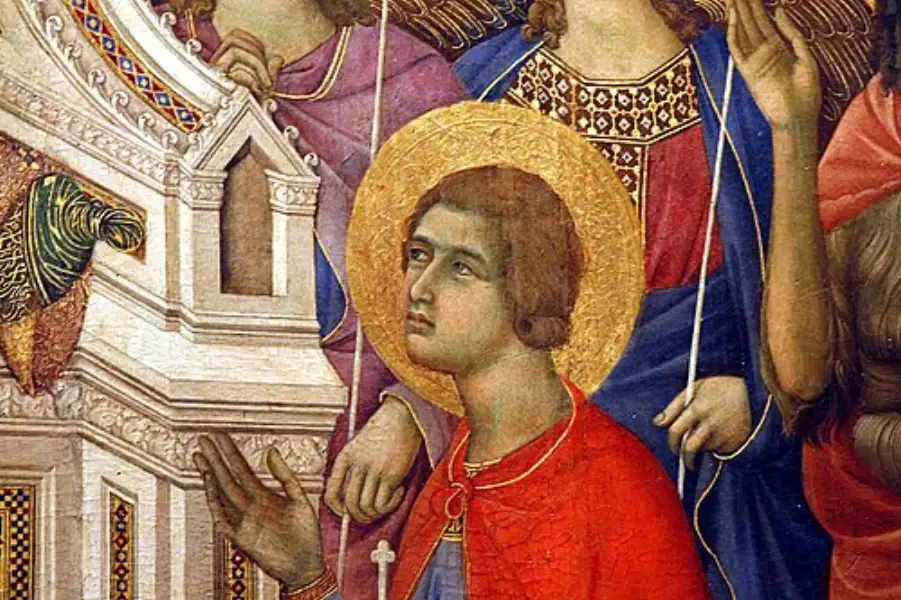
Crescentius of Rome is venerated as one of the youngest of the early martyrs, a boy of about eleven who died in the persecution of Diocletian. According to his legend, he was born around 292 to a noble Roman family and baptized, together with his parents, by the priest Epigmenius. When the persecution reached the city, the household escaped to Perugia, where the father, Euthymius, passed away; the boy was then taken back to Rome, condemned, and beheaded outside the walls on the Via Salaria. He was buried in the cemetery of Priscilla, near the road of his martyrdom, and his grave became a place of pilgrimage in the Middle Ages. Around 1058 Pope Stephen IX, at the request of Bishop Antifredus, translated the relics from Rome to Siena, where the saint's cult became especially beloved; other remains reached Tortosa in 1606. Duccio placed him among the saints of his great Maestà, and Siena still honors him as a patron.
The Complete Life
A Noble Household in Peril
The little that is told of Crescentius comes from an acta preserved only in a seventeenth-century copy, and the story it tells is simple. He was born, probably around the year 292, into a family of the Roman nobility; his father was named Euthymius. The household received baptism together, at the hands of a priest named Epigmenius — an act that in the age of Diocletian was itself a quiet defiance of the law. When the great persecution broke out, the emperor's officers turned against precisely such families, and the household escaped north to Perugia, hoping that distance from the capital would mean safety. It did not. In Perugia the father passed away, leaving the widow and her small son exposed. The boy was then taken back to Rome, into the city whose courts were condemning Christians daily. Everything in his short life had prepared him for that return: noble birth, the washing of baptism, the loss of his father, and the example of parents who had chosen exile rather than betrayal of their faith. The copy that preserves these details, kept in the Biblioteca Vallicelliana, is late and uncertain in its particulars, but it safeguards the memory of a family that gave everything for the name of Christ.
§ Crescentius of Rome
Martyrdom on the Via Salaria
Back in Rome, Crescentius was not spared because of his age. The tradition records that he was eleven years old when he was brought to judgment, and that he refused whatever terms were offered him. The sentence was death by the sword, carried out on the Via Salaria just beyond the city walls, along the ancient road by which the early Christians had always buried their dead. There his body was laid in the cemetery of Priscilla, among the martyrs and the ordinary faithful of the Roman Church. Modern scholars caution that the acta on which this account rests cannot be trusted in its details — the sole manuscript is a copy of about 1600, and the life it preserves was probably composed not long before 1058, when the relics were moved to Siena, rather than from anything resembling eyewitness testimony. Yet the outline of a child put to death on the Via Salaria and buried at Priscilla belongs to the Church's oldest memory of him. His feast is kept on 14 September, and the carrying of his relics to Siena is commemorated separately on 12 October, a second festival that keeps the double geography of his life before the faithful.
§ Crescentius of Rome
Siena and the Memory of a Boy Martyr
For a saint whose documented history is so slight, Crescentius has left a remarkably visible trail. His burial place on the Via Salaria drew pilgrims through the Middle Ages, and around 1058 Pope Stephen IX, answering the request of Bishop Antifredus, carried the relics from Rome to Siena. In that city the cult of the young martyr flourished as nowhere else; he entered the civic devotion of the republic and was painted by Duccio among the saints adoring the Virgin in the Maestà, the altarpiece that stands at the beginning of the Sienese school. Other remains were translated to Tortosa in 1606, spreading his name beyond Italy. Historians remain honest about the sources: the only biographical text was derived from a manuscript copy conserved in the Biblioteca Vallicelliana, and its narrative probably took shape near the time of the Sienese translation rather than from eyewitness record. But devotion has never depended on the critics. In Siena especially, the child martyr of the Via Salaria has been honored for nearly a thousand years as one of the patrons of the city, his image fixed forever among the painted saints of Duccio's great panel.
§ Veneration
Timeline
- 292
Born around this year into a noble Roman family and baptized together with his parents by Epigmenius.
§ Introduction
- 303
Beheaded at about eleven years of age on the Via Salaria outside the walls of Rome during the persecution of Diocletian.
§ Introduction
- 303
Laid to rest in the Priscilla cemetery beside the Salaria road, where his grave drew medieval pilgrims.
§ Veneration
- 1058
Pope Stephen IX translated the relics from Rome to Siena at the request of Bishop Antifredus.
§ Veneration
- 1606
Other relics of the saint were translated to Tortosa.
§ Veneration
The Record
- Patron of
- patron of Siena
- Symbols
- palm of martyrdom·depicted as a boy in Duccio's Maestà
- Canonization
- Pre-congregation; ancient cult centered on his grave and his relics
Prayer
Bibliography
Show 3 sources
- Monks of Ramsgate. 'Crescentius.' Book of Saints, 1921. CatholicSaints.Info, 15 October 2012
- Balboni, Dante. 'San Crescenzio di Roma.' Santi e Beati
- Menzies, Lucy. The Saints in Italy. Medici Society Limited, 1924, p. 125
Profile text adapted from the Wikipedia article, licensed CC BY-SA 4.0.
Pray with this saint every day
Save St. Crescentius to your favorites, read the full profile, and get feast-day reminders in the Saints app.
Get the Saints AppFree on the App Store for iPhone and iPad