
1668 – 1750·Feast May 19
St. Crispin of Viterbo
Capuchin Lay Brother and Questor of the Poor
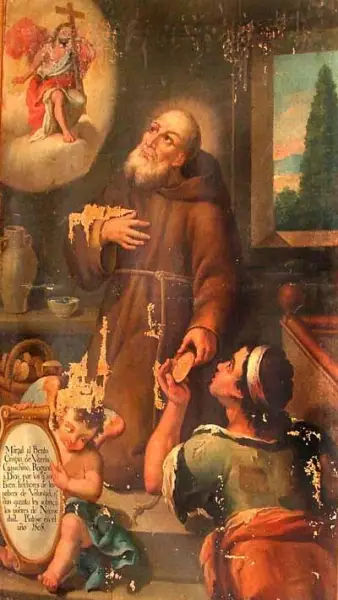
Overview
Crispin of Viterbo, born Pietro Fioretti, was a Capuchin lay brother whose eighty-one years were spent in kitchens, gardens, and infirmaries rather than in pulpits. Born at Viterbo in 1668 to a craftsman father who died early, he was consecrated as a boy to the Mother of God, whose protection he acknowledged all his life. Received into the Order of Friars Minor Capuchin in 1693 under the name Crispino da Viterbo, he served in turn at Viterbo, Tolfa, Rome, Albano, Bracciano, Monterotondo, Oviedo, and Orvieto, begging alms, cooking, gardening, and nursing the sick. His humility, cheerfulness, and gift for counsel drew bishops, cardinals, and Pope Clement XI himself to his kitchen; the people called him 'il santarello' — the little saint — and miracles were attributed to him during his lifetime. He died of pneumonia in Rome on 19 May 1750, having foretold that he would die there. Declared Venerable in 1796 and beatified in 1806, he was canonized by Pope John Paul II on 20 June 1982, the first canonization of that pontificate.
The Complete Life
The Little Saint of Viterbo
Pietro Fioretti was born on 13 November 1668 at Bottarone, near Viterbo, the son of Ubaldo Fioretti, a craftsman, and Marzia Antoni, a widow with a daughter of her own from an earlier marriage; two days later, on 15 November, the parish church of San Giovanni Battista carried him through baptism. His father died before the boy reached the age of five, and his mother raised him alone. In 1674 she led him to a Marian shrine near their home and placed him under the protection of the Mother of God, instructing him to pay her the honor a good son owes his mother; from that day he spoke of the Blessed Virgin as his 'other mother.' The townspeople, noticing his piety and his remarkable knowledge of the saints, nicknamed him 'il santarello' — the little saint. Educated by the Jesuits, he learned Latin well, and was then apprenticed to an uncle who was a shoemaker and who provided for the rest of his education. The trade in leather, the Jesuit classroom, and the shrine of Our Lady formed the boy who would become one of the most beloved friars of central Italy.
§ Life
Entering the Capuchins
The call came through a sight rather than a sermon: a Franciscan procession passing through Viterbo awakened in the young shoemaker the desire to serve God in the religious life. In 1693 he asked for admission to the Order of Friars Minor Capuchin at their house in his native city, and the friars, delighted with the 'little saint' of the town, received him eagerly. His novitiate began on 22 July, when he took the name Crispino da Viterbo — a name that kept his old trade in plain view. He chose as his model Felice di Cantalice, the humble questor of the Roman friaries, and imitated him so closely that he too called himself the ass, the beast of burden, of his order; asked on one occasion why his head went uncovered, he answered, with perfect seriousness, that a beast of burden has no use for a hat. His first assignments were the humblest the house could offer: gardener and cook at Viterbo, then infirmarian at Tolfa from 1694 to 1697, where during an epidemic he turned to God for help and, it was said, effected a number of cures.
§ Life
Questor and Counselor
Crispin's apostolate was itinerant domestic service. After Tolfa came Rome for several months, then Albano and Bracciano until 1703, when he was transferred to Monterotondo; he remained there until 1709 and reached Oviedo the following January, where in the kitchen he raised a small altar in honor of the Mother of God. At Orvieto he served as questor, soliciting alms for the poor, and the households of the town became so attached to him that the superior was compelled to return him to the post, for the townspeople would welcome no substitute. He begged for his convent, went out to visit the convicts in the local prison and the sick in hospitals and infirmaries, and became a familiar figure on the roads between the friaries. His simplicity attracted the great as surely as the humble: Cardinal Filippo Antonio Gualtieri liked to meet and speak with him, and Pope Clement XI visited him in his kitchen and encountered him again at Castel Gandolfo. Nobles and prelates came away regarding him as a kind of wonderworker, for cures and other favors were credited to his prayers during his own lifetime.
§ Life
Humor, Hunger, and the Mother of God
Crispin's holiness took the shape of his day. He rose early to meditate before attending a number of Masses; his midday meal was a little vegetable soup, or a scrap of bread softened in water; in summer he slept on the roof; at Orvieto he kept a small room on the first floor. He had chosen this austerity freely, in an age of softer comfort, and joined to it a warmth that disarmed everyone: he was remembered for his sense of humor as much as for his penances. His devotion to the Mother of God, pledged by his mother in 1674, ordered everything; he read the lives of the saints constantly, especially Clare of Assisi, Fidelis of Sigmaringen, and Joseph of Leonessa, and strove to embody his patron Felix of Cantalice. When a nun of Orvieto treated him badly, he answered without rancor that it was a mercy: at least one woman in the town knew him and treated him as he deserved. Humor, hunger, and humility belonged together in him, and visitors as great as popes recognized in the 'little saint' a completely simple heart.
§ Life
Death in Rome
In the winter of 1747 Crispin fell so ill that his death seemed near, and Rome was judged the right place for him; he rallied, however, and was able to return to his duties. Three years later his strength began to fail again, and on 13 May 1750 he was sent from Albano to Rome, his superiors aware that the end was approaching. He himself had foreseen it, even before the decision became known, and he wished only to survive past the feast of Saint Felix of Cantalice. His wish was honored almost to the day: he died of pneumonia on 19 May 1750, at the age of eighty-one, in the convent of the Immaculate Conception on the Via Veneto in Rome. Calls for his canonization began as soon as he had breathed his last. His body, found incorrupt when exhumed in 1959, rests today under one of the side altars of Santa Maria della Concezione dei Cappuccini, the Capuchin church of Rome, in a state of remarkable preservation — a quiet postscript to a life spent in kitchens, gardens, and infirmaries, and a standing consolation to the simple faithful who pray there.
§ Life
From Cause to Canonization
The formal cause opened on 16 September 1761 under Pope Clement XIII, with the investigation into his holiness held in Rome. A papal decree confirming his heroic virtue allowed Pope Pius VI to declare him Venerable on 7 July 1796, and Pope Pius VII beatified him in Rome. The cause for canonization itself was not opened until 28 February 1923. The decisive miracle was a cure granted to Rinaldo Crescia on 21 May 1950; the inquiry ran in the diocese of its origin between 1958 and 1960; the Congregation for the Causes of Saints validated the process on 18 March 1977, medical experts pronounced the cure miraculous on 22 February 1978, and the congregation's officials and consultants concurred on 9 January 1979. On 21 March 1979 the congregation, sitting by itself, gave its approval and laid the case before Pope John Paul II, who recognized the healing as a miracle worked through Crispin's intercession. On 20 June 1982 he canonized the humble Capuchin in Saint Peter's Basilica — the first canonization of a pontificate that would raise many saints to the altars.
§ Sainthood
The First Saint of a New Pontificate
Crispin of Viterbo left no writings, no foundations, and no doctrine — only a reputation that has not faded in two and a half centuries. His body lies in the church of Santa Maria della Concezione dei Cappuccini in Rome, exhumed in 1959 and found incorrupt, and pilgrims still pause at the side altar where the craftsman's son rests among the great of the Church. The Capuchins keep his feast on 21 May, close to the Roman date of 19 May, the day of his death. For his order he remains the model of the lay brother: a man who never celebrated a Mass, never founded a house, and never held an office beyond questor, yet whose counsel popes sought and whose miracles were credited in his own lifetime. As the first saint canonized by John Paul II, he opened a pontificate of many canonizations, and he stands as proof that the kingdom of God is entered not by rank or learning but by poverty of spirit. His warmth, his jokes, and his hungry faith remain the whole of his doctrine, and they have proved enough.
§ Sainthood
Timeline
- 13 Nov 1668
Born at Bottarone in Viterbo to Ubaldo Fioretti, a craftsman, and Marzia Antoni.
§ Life
- 15 Nov 1668
Baptized in the church of San Giovanni Battista, two days after his birth.
§ Life
- 1674
His mother consecrated him to the protection of the Mother of God at a Marian shrine near their home.
§ Life
- 22 Jul 1693
Entered the Capuchins at Viterbo, beginning his novitiate on 22 July under the name Crispino da Viterbo.
§ Life
- 1694
Sent to Tolfa as infirmarian, serving there until 1697 and credited with cures during an epidemic.
§ Life
- 1703
Transferred to Monterotondo, where he remained until 1709.
§ Life
- Jan 1710
Arrived at Oviedo in January and made a small altar to the Mother of God in the kitchen.
§ Life
- 1747
Fell gravely ill in winter; sent to Rome to recover, then returned to his duties.
§ Life
- 13 May 1750
Sent from Albano to Rome as his health declined, foreseeing that he would die there.
§ Life
- 19 May 1750
Died of pneumonia in Rome on 19 May at the convent of the Immaculate Conception on the Via Veneto.
§ Life
- 16 Sep 1761
The canonization cause opened in Rome under Pope Clement XIII on 16 September.
§ Sainthood
- 7 Jul 1796
Declared Venerable by Pope Pius VI on 7 July after the decree on heroic virtue.
§ Sainthood
- 1806
Beatified by Pope Pius VII in Rome.
§ Sainthood
- 28 Feb 1923
The cause for his canonization was formally opened on 28 February.
§ Sainthood
- 21 May 1950
Rinaldo Crescia was healed on 21 May; the cure was later recognized as the miracle that opened the way to canonization.
§ Sainthood
- 1959
His remains were exhumed and found incorrupt.
§ Life
- 20 Jun 1982
Canonized by Pope John Paul II on 20 June, the first canonization of his pontificate.
§ Sainthood
The Record
- Major works
- Small altar dedicated to the Mother of God in the Oviedo friary kitchen
- Symbols
- Franciscan habit
- Canonization
- Canonized 20 June 1982 by Pope John Paul II; beatified in 1806 by Pope Pius VII
Prayer
Bibliography
Show 4 sources
- 'Saint Crispin of Viterbo.' Saints SQPN, 8 June 2017, retrieved 4 October 2017
- Oliveira, Plinio Corrêa de. 'St. Crispin of Viterbo, May 21.' Tradition in Action, retrieved 4 October 2017
- 'San Crispino (Pietro Fioretti) da Viterbo.' Santi e Beati, retrieved 4 October 2017
- Index ac status causarum beatificationis servorum dei et canonizationis beatorum. Typis polyglottis vaticanis, January 1953, p. 54
Profile text adapted from the Wikipedia article, licensed CC BY-SA 4.0.
Pray with this saint every day
Save St. Crispin of Viterbo to your favorites, read the full profile, and get feast-day reminders in the Saints app.
Get the Saints AppFree on the App Store for iPhone and iPad