
died 5 December 304·Feast December 5
St. Crispina
Noble Martyr of Numidia under Diocletian
Overview
Crispina was a wealthy Christian matron of the Roman province of Numidia, in what is now Algeria, who died rather than deny her faith during the Diocletian persecution. Born at Thagora in the third century and married into a distinguished family with children of her own, she was brought before the proconsul Annius Anullinus at Theveste and ordered to sacrifice to the gods. Her refusal — she declared she honored one God alone — cost her her hair, her dignity, and finally her life: her head was shaved so that she might be mocked in public, and when neither ridicule nor the tears of her children moved her, she was condemned and beheaded on 5 December 304, offering her head for execution with joy. The record of her trial, written not long afterward, became one of the valued documents of the persecution, preserved by Ruinart and retold by Alphonsus Liguori. Augustine of Hippo preached about her a century later, ranking her fame in Africa with that of Agnes of Rome and Thecla, and by about 400 her grave at Theveste had become a walled pilgrimage complex dominated by a large church.
The Complete Life
A Matron of Numidia
Crispina came from Thagora, a town of the Roman province of Numidia whose site lies near Taoura in modern Algeria — the Tabula Peutingeriana records the name as Thacora — and she belonged to a distinguished family of that province. By the time the persecution of Diocletian reached Africa she was a wealthy matron, a mother of children, a woman whose standing made her a valuable prize for the judges charged with forcing Christians to conform. The Acts of her martyrdom, our source for everything about her, were written not long after her death and are counted a valuable historical document of the persecution period. They present her not as a consecrated virgin like Agnes but as a Christian wife and mother whose faith had matured in the ordinary duties of a great household. That circumstance gave her witness a particular force: the proconsul could threaten not only her body but her family's future, and her refusal showed that she had weighed exactly what she was risking and found the claims of the gods empty beside the one God she honored.
§ Biography
The Examination before Anullinus
Her mission, in the manner of the martyrs, was her trial. Brought before Annius Anullinus, the proconsul of Africa, Crispina was ordered to sacrifice to the gods of the empire. She answered that she honored one God alone, and no threat could move her further. Her reply has been preserved in the acts: she cared nothing for the present life and feared only eternal torments — words that turned the proconsul's own penalty into a confession of faith. The confrontation had all the elements the African Church loved in its martyr narratives: rank humbled, a judge outmaneuvered, a woman speaking with more authority than the court that summoned her. The record of the examination was written down and circulated; it entered Thierry Ruinart's anthology of the martyrs' acts, and centuries afterward Alphonsus Liguori gave it new form in his Victories of the Martyrs. Through that written record a single refusal, spoken before a Roman tribunal at Theveste, became a standing exhortation to every later generation of African Christians forced to make the same choice between the empire's gods and the God of the Christians.
§ Biography
Strength under Humiliation
The acts let us see the interior of her courage. When threatened with death, Crispina answered that she was anxious only for the life of her soul and feared eternal torments alone — a statement of priorities in which the visible world weighed less than the invisible. The judge tried humiliation where threats had failed: at his command her head was shaved, and she was exposed to public mockery, a punishment designed to break a woman of her rank. She remained unmoved. Then came the assault closest to her heart, the tears of her own children, and she held firm even then, steadfast between love of family and love of Christ. When the sentence of death was finally pronounced she did what few could do: she thanked God, and offered her head for execution with joy. Her strength, as Augustine told his hearers a century later, was not her own — the Lord himself, he said, was for her a better defense than her own right hand, and it was He who guarded her through the savagery of the persecutors.
§ Biography
Martyrdom at Theveste
Crispina was beheaded at Theveste, in Numidia, on 5 December 304, in the midst of the empire-wide persecution Diocletian had unleashed. The acts describe the end without concealment: condemned, she gave thanks to God and presented her neck gladly to the executioner. Her death came in the last great trial of African Christianity, and she was among its most striking victims — rich, noble, and famous throughout the province. The date of her death, her 'birthday' in the language of the martyrs, was kept by the African Church from the beginning; a century later Augustine could assume that his hearers knew exactly whom he meant when he preached on her feast. 'Who in Africa has not heard of these things?' he asked, recalling how the persecutors had spent their rage on a delicately nurtured rich woman and found her stronger than themselves, noble and wealthy as she was. Her body was buried in a cemetery beyond the walls of Theveste, and that grave, within a lifetime, had become the center of a devotion so great that the ground around it was rebuilt to receive the pilgrims who came to her.
§ Biography
Grave, Basilica, and Mosaic
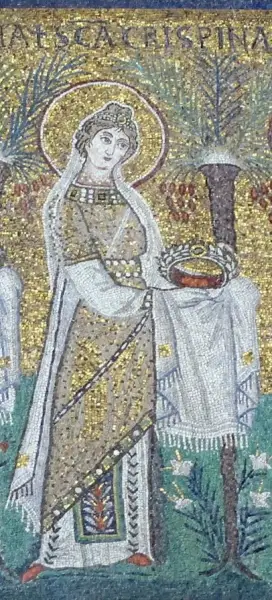
The memory of Crispina took monumental form with remarkable speed. By about the year 400 the burial site in the cemetery beyond Theveste had been transformed into a major pilgrimage destination, ringed by an enclosing wall. A great church stood at its heart, raised on a lofty podium and fronted by an atrium; from it the faithful descended to a lesser trefoil chapel honoring the saint, set three meters below the church floor. To the west lay an area partitioned into four sections — probably shallow basins — edged with low walls and lined with pilasters along the walkways, and farther west still stood a porticoed building thought to be stables for pilgrims' animals. The architecture shows how far her fame had traveled. Augustine, preaching in those same decades, mentioned her again and again and ranked her with Agnes of Rome and Thecla in the veneration of Africa. Her image entered art as well: she appears among the saints in the mosaic procession of the Basilica of Sant'Apollinare Nuovo at Ravenna. The acts of her examination survived in Ruinart's collection and in Alphonsus Liguori's Victories of the Martyrs, and her feast is kept on 5 December in both East and West.
§ Commemoration
Timeline
- 5 Dec 304
Beheaded at Theveste in Numidia on 5 December after refusing before Proconsul Annius Anullinus to sacrifice to the gods.
§ Biography
- 400
By about this year her grave outside Theveste had become a walled pilgrimage complex centered on a large church and a trefoil chapel dedicated to her.
§ Commemoration
- 1776
Alphonsus Liguori published a version of her acts in his Victories of the Martyrs.
§ Commemoration
In Their Own Words
I care not for the present life, and am only anxious for the life of my soul. I fear eternal torments only.
The persecutors turned their rage against Crispina, whose birthday we celebrate today. They unleashed their savagery against a rich woman delicately nurtured; but she was strong, because the Lord was for her a better defense than the hand of her right hand, and He was guarding her.
The Record
- Symbols
- shown among the saints in the mosaic of Sant'Apollinare Nuovo, Ravenna
- Canonization
- Pre-congregation; her cult rests on the Acts of her martyrdom, written soon after her death
Prayer
Bibliography
Show 5 sources
- Schiavo, Anthony (2018). I Am A Christian: Authentic Accounts of Christian Martyrdom and Persecution from the Ancient Sources. Arx Publishing. ISBN 9781935228189
- Meier, Gabriel. 'St. Crispina.' The Catholic Encyclopedia, Vol. 4. New York: Robert Appleton Company, 1908
- Adamiak, Stanisław (2019). 'CSLA.E07611'
- Boulding, Maria (2003). Exposition of the Psalms 99-120. New City Press. ISBN 9781565481961
- Jacobs, Ine (2015). 'Holy Goals and Worldly Means. Urban Representation Elements in Church Complexes.' Religious Practices and Christianization of the Late Antique City (4th–7th cent.). Brill, p. 82. doi:10.1163/9789004299047_005
Profile text adapted from the Wikipedia article, licensed CC BY-SA 4.0.
Pray with this saint every day
Save St. Crispina to your favorites, read the full profile, and get feast-day reminders in the Saints app.
Get the Saints AppFree on the App Store for iPhone and iPad