
died 1st century (traditional)·Feast May 12
St. Crispoldus
First Bishop and Martyr of Bettona
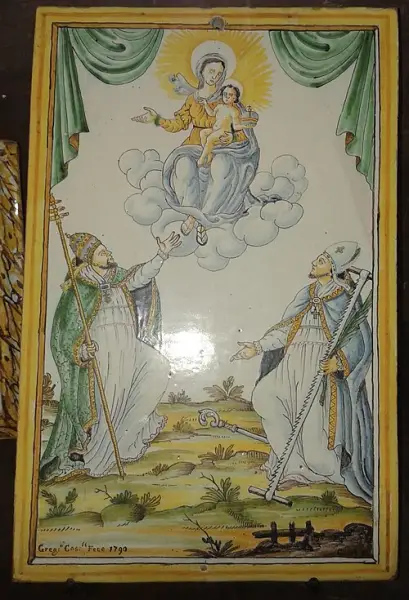
Overview
Crispoldus, whose name also appears in the forms Cyspolitus, Crispoltus, and Chrysopolitus, is honored as a first-century Christian martyr and as the patron saint of Bettona in Umbria. Tradition, preserved in a legendary Passio written in the twelfth century, describes him as born in Jerusalem and as belonging to the Seventy Disciples, sent to Italy by Saint Peter around the year 58 to preach the Gospel. He is said to have labored in Umbria, working miracles at Bettona, where he was consecrated bishop by Brictius of Massa Martana. While preaching in his diocese he was arrested by soldiers of the Emperor Maximian, brought before the prefect Asterius, and, on his refusal to sacrifice to the Roman gods, put to death after torture. His sister Tutela and twelve other women were executed for attempting to bury him and a fellow martyr named Barontius. Scholars note that his Germanic name makes the apostolic connection unlikely, yet his cult at Bettona is ancient and enduring, centered on the church of Santa Maria Maggiore, where his relics rest.
The Complete Life
A Disciple Sent from Jerusalem
The earliest account of Crispoldus survives only in a legendary Passio committed to writing in the twelfth century, and it must be read with the caution that scholars advise. According to that tradition, he was born in Jerusalem and numbered among the Seventy Disciples whom the Gospels describe as sent out by Christ himself. The same narrative relates that in the year 58 the Apostle Peter dispatched Crispoldus to Italy, entrusting him with the preaching of Christianity in a land where the Church was still young and vulnerable. He made his way to Umbria, and at the town of Bettona the tradition credits him with miracles that prepared the people to receive the faith. Modern scholarship tempers this story: the saint's name is Germanic in origin, which makes direct contact with the apostolic generation improbable, and the account is probably legendary in form. Nevertheless, the tradition preserves the memory of a missionary of great antiquity whose work in Umbria was remembered with gratitude, and whose name entered the episcopal lists not only of Bettona but also of the neighboring dioceses of Nocera and Foligno.
§ Veneration
Shepherd of Bettona
Crispoldus is venerated as the first bishop of Bettona, the Umbrian town that honors him as its patron. The Passio relates that before undertaking the government of his flock he was consecrated by Brictius, called also Brizio, the bishop of Massa Martana. This Brictius is a shadowy figure who appears in the traditions of several Umbrian sees, appearing likewise in the traditions of Spoleto and of Foligno; the church historian Giuseppe Cappelletti suggested that his office may have been regional in scope rather than tied to any one diocese, which would account for his association with so many communities. Whatever the exact arrangement, the memory of Bettona is firm in holding that its first Christian community gathered around Crispoldus as its bishop. His ministry was that of an apostolic pioneer: proclaiming the Gospel in a town steeped in Roman civic and religious life, forming a people who had no prior Christian institution to receive them, and giving the Church of Umbria one of its most ancient and beloved foundations. In the memory of Umbria, the consecration of a missionary by a neighboring prelate marks the very moment at which the hill towns of the region first received a bishop and an altar of their own.
§ Veneration
Martyrdom at Bettona
The preaching that planted the Church at Bettona also drew down the hostility of the imperial authorities. According to the tradition, Crispoldus was arrested by soldiers of the Emperor Maximian, the colleague of Diocletian in the great persecution of the early fourth century, though older accounts place his death in the first century. He was brought to trial before the prefect Asterius, who invited him to offer sacrifice to the Roman gods as the price of his life. The bishop refused, and after being tortured he was put to death. His blood was not shed alone: at the same time a Christian named Barontius, called Baronzio, was beheaded for his faith. When Crispoldus's sister Tutela, together with twelve other women, attempted to bury the two martyrs, they too were arrested; refusing like them to sacrifice to the idols, they were executed. The Church of Umbria fixed the memory of this shared martyrdom on May 12, the day still kept as the feast of Crispoldus and his companions. The account thus binds into a single commemoration the bishop, his companion in death, and the women who died for the corporal work of mercy, a whole company of witnesses gathered about one day.
§ Veneration
A Cult Honored from Antiquity
Crispoldus belongs to the company of saints who were never formally canonized, since his veneration arose in the earliest ages of the Church, when martyrs were honored by the spontaneous devotion of the communities they had served. He is counted among the martyrs who are saints of the Catholic Church, and his feast is kept on May 12, the traditional date of his passion. The antiquity of his cult is witnessed by documents: his name appears in a record of 1018 preserved in the archives of the cathedral of Assisi, and the dioceses of Nocera and Foligno, as well as Bettona, include him in their episcopal lists, a sign that his memory was cherished across a wide region of Umbria. The twelfth-century Passio that recounts his life is itself evidence of a living devotion that sought to clothe a beloved local patron with the details of his story. Whatever the historian may conclude about the details, the continuity of reverence around his tomb has never been broken. In this sense his canonization, if the word may be used at all, was accomplished not by decree but by the unbroken prayer of the faithful at his grave, the oldest and surest form the Church knows.
§ Veneration
The Shrines of Bettona
The memory of Crispoldus is written in the stones of Bettona. A church was raised on the place of his martyrdom, in what today is Passaggio di Bettona, within the commune's territory. In the eighth century the church of San Crispolto was built inside the walls of the historic center when the saint's remains were translated there; a silver and gilded reliquary bust rests in its transept, at the left hand of the principal altar of the martyr. The building was later renovated in the eighteenth century with a brick facade by Antonio Stefanucci, and after a Benedictine beginning it passed to the Franciscan Order. In the thirteenth century a new church, Santa Maria Maggiore, was constructed within the walls of Bettona and consecrated in 1225 by Bishop Guido; it became a Benedictine foundation in 1266 and afterwards a Franciscan church, restored in 1266 and again in 1797. When the earthquake of 1997 damaged the Basilica of San Francesco in Assisi, Santa Maria Maggiore too required repair, and the shrine of the first bishop of Bettona was renewed for a new generation of pilgrims.
§ Veneration
Timeline
- 58
According to the legendary Passio, Peter sent Crispoldus from Jerusalem to Italy to preach Christianity.
§ Introduction
- 750
In the 8th century the church of San Crispolto was built, and the saint's remains were moved within the town walls.
§ Veneration
- 1018
A document from the archives of Assisi Cathedral records the name of Crispoldus.
§ Veneration
- 1225
Bishop Guido of Bettona consecrated the new church of Santa Maria Maggiore, built to hold the saint's relics.
§ Veneration
- 1266
Santa Maria Maggiore became a Benedictine foundation and afterwards a Franciscan church, and was restored the same year.
§ Veneration
- 1797
The church preserving the martyr's remains underwent a further restoration.
§ Veneration
- 1997
After the earthquake that damaged the Basilica of San Francesco in Assisi, Santa Maria Maggiore required renewed renovation.
§ Veneration
The Record
- Major works
- Traditional founding of the Christian community of Bettona
- Patron of
- Patron saint of Bettona
- Symbols
- Silver and gilded reliquary bust·Bishop's vestments·Palm of martyrdom
- Canonization
- Pre-congregation; venerated as a martyr since the early centuries of the Church.
Prayer
Bibliography
Show 3 sources
- Antonio Borelli (30 May 2002). "San Crispolto (Crispolito) e compagni Martiri di Bettona". Santi e Beati. Retrieved May 13, 2009.
- "Nocera". Catholic Encyclopedia. 1913. Retrieved May 13, 2009.
- Giuseppe Cappelletti, Le chiese d'Italia della loro origine sino ai nostri giorni (Venice, 1846), 398.
Profile text adapted from the Wikipedia article, licensed CC BY-SA 4.0.
Pray with this saint every day
Save St. Crispoldus to your favorites, read the full profile, and get feast-day reminders in the Saints app.
Get the Saints AppFree on the App Store for iPhone and iPad