
died 27 June 362·Feast June 27
St. Crispus, Crispinianus, and Benedicta
Roman Martyrs of Julian's Persecution
Overview
Crispus (also called Crispinus), Crispinianus, and Benedicta were Roman Christians put to death in the persecution of the emperor Julian the Apostate, with the traditional date of their martyrdom fixed at 27 June 362. Their deaths followed closely upon the execution of the soldiers John and Paul, whose passion they had attended with devoted courage. Crispus was a priest, Crispinianus a cleric, and Benedicta a woman whom the Bollandists describe as a virgin, though Bosio calls her a matron. When John and Paul were slain secretly and buried in their own house, the three mourned and prayed ceaselessly for a sign of the martyrs' resting place, and their account records that God revealed it to them. Discovered in prayer at the tomb, they were arrested and brought before Julian himself. Each confessed the faith in a memorable formula and refused the demanded sacrifice, and all three were executed, their bodies left for the dogs. Three men rescued the remains by night and laid them near the bodies of John and Paul, where a shrine grew into the present Basilica of Saints John and Paul on the Caelian Hill.
The Complete Life
Three Christians of Rome
The acta preserve with unusual precision the identity of this company of martyrs. Crispus, whose name is given in some sources as Crispinus, served the Roman Church as a priest; Crispinianus was a cleric whose exact rank the sources leave undetermined, though his own confession before the emperor describes him as the servant of the servants of Christ; and Benedicta was a woman of the Roman community, called a venerable woman in the martyrologies. On her state of life the ancient witnesses differ: the Bollandists, drawing on her bold reply to the emperor that she had taken Christ as her spouse, concluded that she was a virgin, while Antonio Bosio, writing in his great survey of Rome's underground cemeteries, describes her as a matron. What united the three was not a common rank but a common devotion: when the soldiers John and Paul were condemned to death by the emperor Julian for their refusal to return to the old gods, it was to this priest, this cleric, and this woman that the condemned men turned for the consolation of the Church's sacraments and the company of the faithful.
§ Acta martyrum
Comforters of the Condemned
Under house arrest and awaiting execution, John and Paul sent for Crispus, Crispinianus, and Benedicta, so that the priest might offer Mass for them and that the story of their sufferings might be carried to the other Christians of the city. Ten days after that first visit the three returned, seeking to comfort the condemned once more, but this time the guards turned them away. Shortly afterward John and Paul were put to death in secret and buried within their own home. When the news reached the three mourners, they shut themselves in their house and gave themselves to grief and ceaseless prayer, weeping day and night. Then they prayed to receive some sign of where the bodies of the martyrs had been laid. Their account records, in a single solemn phrase, that God revealed the place to them, though it does not say by what means. Guided by this revelation they went to pray at the resting place of John and Paul, and there they were discovered, seized, and taken prisoner to face the judgment of the emperor Julian himself.
§ Acta martyrum
Trial and Martyrdom
The acta shift at this point into the record of a courtroom, as the three Christians stand before the emperor who had ordered the death of their friends. When Julian interrogated Crispus, the priest admitted his office without disguise, confessing himself a priest and a sinner. Commanded to sacrifice to the pagan gods, he refused in words that the martyrologies preserve: his sacrifice was offered day and night to his Lord God Jesus Christ, and to the idols he would not sacrifice. Julian turned in rage to Crispinianus, who likewise acknowledged his service in the Church as the servant of the servants of Christ, and he too refused the demanded sacrifice. Last the emperor addressed Benedicta, ordering her both to offer sacrifice and to accept a husband. She answered in a loud voice that she was a Christian, that Christ was her spouse, and that she rejected his gods as she would reject the dirt beneath her feet. Upon these professions of faith all three were put to death, and their bodies were left to be devoured by dogs. None of the three sought to escape the confession that carried them to the place of execution.
§ Acta martyrum
Remembered in the Martyrologies
Crispus, Crispinianus, and Benedicta were never formally canonized, for their veneration as martyrs belongs to the earliest practice of the Roman Church. Their passion was preserved in two ancient sources: the Acts of Saints John and Paul and the Martyrology of Saint Jerome. From these the Bollandist hagiographers, led by Godfrey Henschen, wove a single narrative in the Acta Sanctorum, published at Antwerp in 1709 under a title that names each of the three by their station: the priest Crispus or Crispinus, the cleric Crispinian, and Benedicta the virgin. Antonio Bosio had earlier recounted their story in his Roma Sotteranea, alternating between Italian and Latin. Their feast is kept on 27 June, the traditional date of their martyrdom, with their burial recorded on the following day in the old Roman reckoning of the calendar. The memory of their confession before Julian has been handed on through the centuries as part of the larger witness of the Roman Church during the brief but sharp persecution of that apostate emperor. In the calendars of the Church their names stand joined, one priest, one cleric, and one woman, a quiet reminder that holiness in the early Roman community paid no regard to earthly station.
§ Acta martyrum
The Shrine on the Caelian Hill
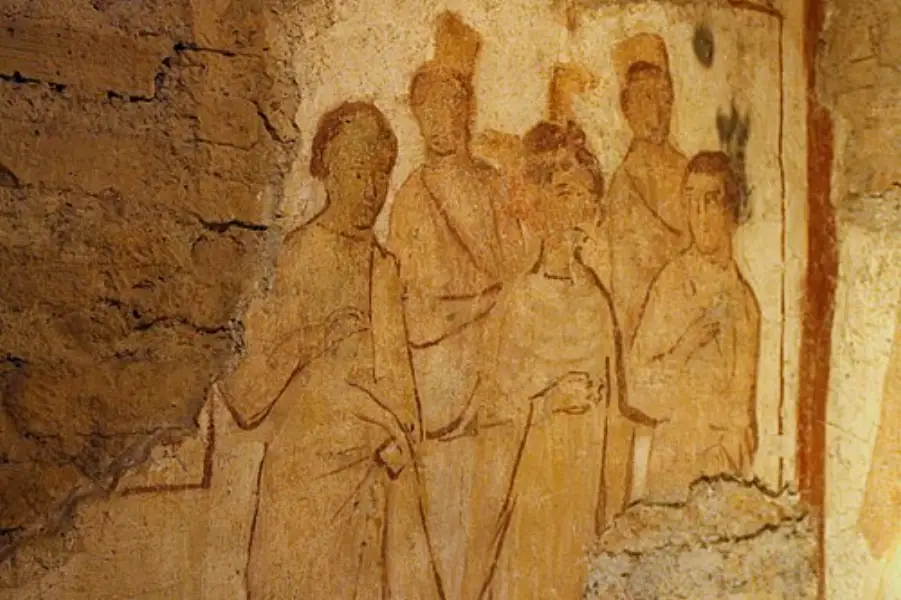
The house in which John and Paul were buried, and near them the three martyrs who died for visiting them, eventually became the present Basilica of Saints John and Paul on the Caelian Hill. In the nineteenth century, archaeological excavations carried out beneath the basilica revealed a complex of Roman homes, within which there came to light a confessio — the devotional shrine raised over the resting place of the martyrs. The painted decoration of the shrine's walls belongs to the closing years of the fourth century, close in time to the deaths it commemorates. Its frescoes show two male figures with hands raised in prayer, probably John and Paul themselves, and another scene depicts the arrest of three people who can be identified with Crispus, Crispinianus, and Benedicta. In harmony with the martyrdom account, a dog is painted at the side of the Roman authorities, recalling the fate intended for the martyrs' bodies. Three niches cut into the tuff of the confessio have been understood as the burial place of the martyrs, and pilgrims may still descend to the rooms where the story of these witnesses of 362 is painted upon the walls.
§ Place of burial
Timeline
- 27 Jun 362
Crispus, Crispinianus, and Benedicta were martyred at Rome under the emperor Julian, traditionally on 27 June.
§ Acta martyrum
- 28 Jun 362
On 28 June, the bodies of all three were secretly buried by two priests, John and Pimeneus, together with a layman called Fabianus in the home of John and Paul.
§ Acta martyrum
- 395
By the end of the fourth century the confessio of the martyrs had received its painted wall decoration, including the scene of their arrest.
§ Place of burial
- 1650
Antonio Bosio recounted their story, alternating Italian and Latin, in his Roma Sotteranea.
§ Acta martyrum
- 1709
The Bollandists synthesized the twin sources of their passion into a unified account in volume five of the Acta Sanctorum for June.
§ Acta martyrum
In Their Own Words
I offer sacrifice always to my Lord God Jesus Christ, day and night; but to your idols, I do not sacrifice.
I am a Christian, and I have Christ as my spouse; and I reject your gods, as if they were the dirt upon which my feet tread.
Mourning in their home, and praying each day, and the tears from their eyes did not cease, both day and night.
The Record
- Patron of
- Persecuted Christians
- Symbols
- Fresco of the arrest on the Caelian Hill·Dog at the side of the Roman authorities
- Canonization
- Pre-congregation; venerated as martyrs from antiquity, their cult synthesized by the Bollandists in the Acta Sanctorum.
Prayer
Bibliography
Show 6 sources
- Henschen, Godfrey; et al. (1709). "De sanctis martyribus Romanis Crispo vel Crispino Presbyt., Crispiniano Clerico, et Benedicta Virgine". Acta Sanctorum Junii (in Latin). Vol. V. Antwerp: Peter Jacobs. p. 258.
- Bosio, Antonio (1650). Roma Sotteranea (in Latin and Italian). Vol. III. Rome: Lodovico Grignani. pp. 535-536.
- Borrelli, Antonio (December 12, 2003). "Santi Giovanni e Paolo" (in Italian). Santi Beati. Retrieved March 5, 2017.
- Webb, Matilda (2001). The Churches and Catacombs of Early Christian Rome: A Comprehensive Guide. Sussex Academic Press. p. 103. ISBN 9781902210575.
- "Roma: Domus del Celio" (in Italian). Archart. January 29, 2011.
- Placidi, Marco. "Basilica dei SS. Giovanni e Paolo". Sotterranei di Roma (in Italian). Centro Ricerche Speleo Archeologiche.
Profile text adapted from the Wikipedia article, licensed CC BY-SA 4.0.
Pray with this saint every day
Save St. Crispus, Crispinianus, and Benedicta to your favorites, read the full profile, and get feast-day reminders in the Saints app.
Get the Saints AppFree on the App Store for iPhone and iPad