
1st century·Feast October 4
St. Crispus of Chalcedon
Synagogue Ruler Converted by Paul
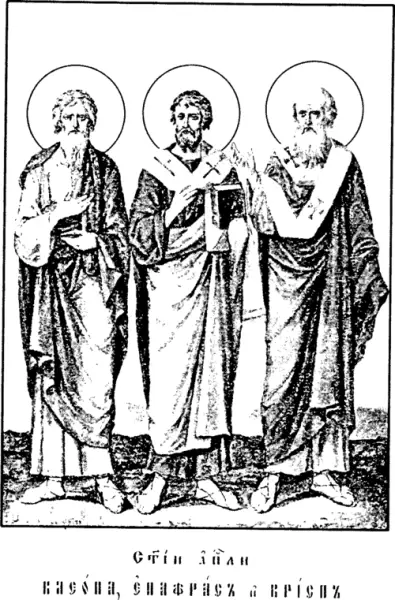
Overview
Crispus of Chalcedon stands at the crossing point of the New Testament and the early Church. He first appears in the Acts of the Apostles as the ruler of the Jewish synagogue at Corinth, a man of standing in one of the great commercial cities of Greece. There he heard the preaching of Paul of Tarsus and became a believer, and Acts records that he was baptized by the Apostle together with his household. Paul's First Letter to the Corinthians mentions him by name, the Apostle recalling with gratitude that he had baptized Crispus. According to tradition, Crispus went on to serve as Bishop of Chalcedon, the city across the Bosporus from Byzantium that would later lend its name to the famous council of 451. The Eastern Orthodox Church numbers him among the Seventy Disciples and keeps his feast on October 4. His passage from synagogue ruler to Christian bishop made him an enduring sign of the Gospel's power to gather the Church from Israel and the nations alike.
The Complete Life
From the Synagogue to Christ
Crispus first appears in the Christian story at Corinth, where he held the office of ruler of the Jewish synagogue, a position of leadership and responsibility within the city's Jewish community. Corinth was a flourishing Greek city, and Paul of Tarsus preached there during his missionary labors. When Crispus heard the Gospel, he believed, and Acts records his conversion as one of the notable fruits of Paul's preaching in the city. In an unusual mark of personal esteem, Paul himself baptized Crispus, together with the other believers of his household. The Apostle returned to this memory years later in his First Letter to the Corinthians, thanking God that among the few he had baptized in Corinth was Crispus. For a man who had presided over the synagogue, the step was costly: it meant confessing Jesus as the Christ before his own community. The tradition of the Church has always seen in Crispus a figure of the first importance, an emblem of the way the earliest Christian communities were born from the synagogue and gathered both Jew and Greek into one body.
§ Crispus of Chalcedon
Bishop of Chalcedon
Tradition relates that after his years at Corinth, Crispus went on to serve as Bishop of Chalcedon, the ancient city on the eastern shore of the Bosporus, opposite Byzantium. If the tradition is right, the man whom Paul baptized in Greece became the chief shepherd of a church at the very gateway between Europe and Asia, in the region where Christianity would soon flourish and where the great council of 451 would later be held. Nothing further is recorded of his episcopal labors; the ancient sources are nearly silent, and a single line of tradition carries almost all that is known of him. Yet the outline is sufficient: a convert of the apostolic age, formed in the faith by an Apostle, entrusted with the oversight of a young church far from the place of his conversion. In him the Church sees the first generation of bishops, men who carried the Gospel from the great missionary cities into the towns and provinces of the Roman world. Such brevity is characteristic of early lives, in which the essential facts of conversion, baptism, and episcopal service were preserved chiefly by the communities that continued to read the apostolic texts naming him.
§ Crispus of Chalcedon
Among the Seventy
The memory of Crispus has been preserved above all in the Christian East. The Eastern Orthodox Church counts him among the Seventy Disciples, the band of missionaries sent out by the Lord himself in the Gospel narrative, and ranks him with those who bore the faith from Jerusalem to the ends of the earth. His feast is kept on October 4, when his intercession is invoked by the faithful. In the West his name is remembered each time the letters of Paul are read, for the Apostle's own words preserve the fact of his baptism at Corinth. He stands beside Gaius, with whom he is often paired in the calendars, as one of the quiet figures of the apostolic age: not a writer of epistles or a hero of dramatic martyrdom, but a man whose conversion from the synagogue and whose service as a bishop helped the Church take root in two worlds, the Greek city of Corinth and the Bithynian shore of the Bosporus. Every autumn the Orthodox churches recall him in their liturgy, and the passages of Paul that mention his baptism give his name a permanence in Christian worship that few monuments of stone could rival.
§ Crispus of Chalcedon
The Record
- Major works
- Episcopal service at Chalcedon (traditional)
- Patron of
- Converts from Judaism
- Symbols
- Bishop's vestments·Scroll of the Gospels
- Canonization
- Pre-congregation; counted among the Seventy Disciples in the Eastern Orthodox Church.
Prayer
Bibliography
Show 1 sources
- Online, Catholic. "St. Crispus & Gaius - Saints & Angels". Catholic Online. Retrieved 2025-12-04.
Profile text adapted from the Wikipedia article, licensed CC BY-SA 4.0.
Pray with this saint every day
Save St. Crispus of Chalcedon to your favorites, read the full profile, and get feast-day reminders in the Saints app.
Get the Saints AppFree on the App Store for iPhone and iPad