
1869-1927·Feast May 21
St. Cristóbal Magallanes Jara
Priest and Martyr
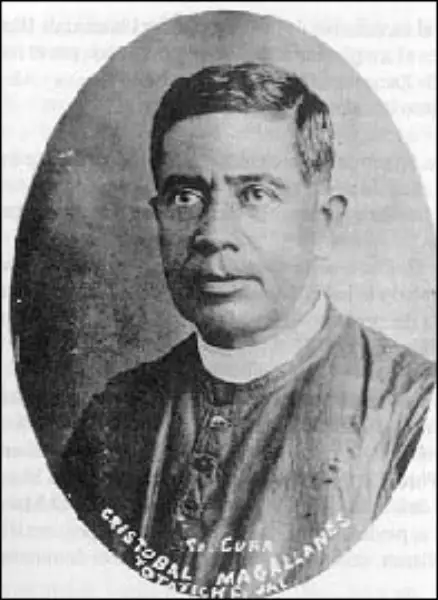
Overview
Cristóbal Magallanes Jara was born on 30 July 1869 at San Rafael, Totatiche, in Jalisco, the son of farmers Rafael Magallanes and Clara Jara; as a boy he herded sheep before entering Guadalajara's conciliar seminary of San José at nineteen. Ordained at thirty in 1899, he was chaplain to the Holy Spirit arts-and-works school in Guadalajara, then became parish priest of his native Totatiche. There he founded schools and carpentry shops, helped plan the dam of La Candelaria, took a special interest in the Huichol people and in the mission at Azqueltán, and — when decrees closed the Guadalajara seminary in 1914 — opened a clandestine auxiliary seminary in his parish that grew to seventeen students and won the archbishop's recognition. He wrote and preached against armed rebellion, yet during the Cristero War he was falsely charged with promoting the uprising. Arrested on 21 May 1927 while on his way to a farm Mass, he gave his few possessions to his executioners and absolved them; without trial he was shot on 25 May at Colotlán alongside Agustín Caloca. John Paul II beatified him in 1992 and canonized him in 2000 with twenty-five companion martyrs of Mexico.
The Complete Life
Early Life
Cristóbal Magallanes Jara was born on 30 July 1869 at San Rafael, Totatiche, in the highlands of Jalisco in western Mexico, born to the farming couple Rafael Magallanes Romero and Clara Jara Sánchez; he was baptized on 7 August. His youth was the rural Mexican classic: he worked as a shepherd, in the same country that had produced the shepherd-boy curas of a hundred village hagiographies, and at nineteen he entered Guadalajara's Conciliar Seminary of San José. The Mexico of his childhood and formation was the Mexico of Porfirio Díaz — outwardly orderly, officially tolerant of the Church while keeping it under tight political control, and building the anticlerical legal arsenal that the twentieth century would eventually use. The Jalisco he came from was also one of the most Catholic regions of the republic, whose villages would later supply the Cristero armies.
§ Early life
Conversion and Vocation
Cristóbal was ordained a priest at thirty, at Santa Teresa in Guadalajara in 1899 — a late ordination by modern standards and the ordinary timing of the era — and served first as chaplain to the Holy Spirit school of trades in Guadalajara, a trade school for the poor. He was then named parish priest of his native Totatiche, returning to the town that had raised him as its pastor. It was the whole of his priestly life: for nearly three decades he was the priest of one parish, and everything else recorded of him — the schools, the workshops, the dam, the mission, the clandestine seminary — grew out of that single pastorate.
§ Ordination and priestly life
Mission and Ministry
At Totatiche Magallanes became the engine of the town's material and spiritual development. He founded schools and carpentry workshops, and helped plan hydrological projects, among them the La Candelaria dam — the village priest as the only engineer, banker, and advocate a poor municipio had. He took a special interest in the evangelization of the indigenous Huichol people, one of the least assimilated nations of Mexico, and was instrumental in founding the mission at the Huichol town of Azqueltán, insisting that the church's mission included those the national state had written off. When government decrees closed the Guadalajara seminary in 1914, amid the Mexican Revolution's anticlerical turn, he opened a clandestine auxiliary seminary in his parish in July 1915; it grew to seventeen students and won the archbishop's formal recognition — a small act of civil disobedience in defense of the Church's future clergy.
§ Ordination and priestly life
Spirituality and Teaching
Magallanes's recorded convictions run against the grain of what was about to happen to his country. He wrote and preached against armed rebellion, holding that the faith was not to be defended by the gun even when it was being stripped from the schools and the churches — a position that put him at odds, in the end, with the Cristero rank and file even as the government accused him of fomenting them. His spirituality was pastoral and practical: the faith made visible in schools, workshops, water, and the instruction of the poor, and in the care of peoples — the Huichol — whom the century's politics had no use for. That he died as a martyr falsely charged with the rebellion he had preached against is the sharpest fact of his biography.
§ Introduction
Trial and Final Years
When the Cristero War came to Jalisco after the 1926 suppression of public worship, Magallanes stayed at his post. In May 1927 he was arrested on 21 May, on the road while traveling to say Mass at a farm — the charge, trumped up in the absence of any evidence, that he had been promoting the armed uprising. There was no trial. On 25 May 1927 he was shot at Colotlán, Jalisco, alongside his young vicar Agustín Caloca. The witness tradition records his composure at the end: he gave his few possessions to the soldiers of the firing squad and absolved them before they fired. He was fifty-seven.
§ Death
Canonization
Magallanes was beatified by Pope John Paul II on 22 November 1992, in the first great beatification of the Mexican martyrs. On 21 May 2000 — the anniversary of his arrest — the same Pope canonized him in Rome with twenty-five companion martyrs of the Mexican persecution, the collective canon of priests and laymen killed in the Cristero era. The group's calendar places them on 21 May, and Magallanes, as the best documented and the most pastorally representative of them, stands first in the list. The group's common memorial is 21 May, and in popular devotion Magallanes himself has come to be invoked by those suffering from cancer.
§ Introduction
Legacy
Magallanes's legacy in Mexico is that of the priest who built rather than fought. Totatiche still marks his works, and his statue stands on the exterior of Guadalajara's cathedral among the figures of Jalisco's saints. He is invoked in popular devotion against cancer, and the canonization of the Mexican martyrs in 2000 — celebrated in Rome in the presence of thousands of Mexican pilgrims — fixed the Cristero persecution in the Church's universal memory. For the model he offers, his own words before death are the epitome: he blessed and absolved the men detailed to kill him.
§ Introduction
Timeline
- 30 Jul 1869
Born at San Rafael, Totatiche, Jalisco, son of the farmers Rafael Magallanes Romero and Clara Jara Sanchez.
§ Early life
- 7 Aug 1869
Baptized on 7 August, eight days after his birth.
§ Early life
- 1888
Enrolled in the Conciliar Seminary of San José in Guadalajara at the age of nineteen.
§ Early life
- 1899
Ordained a priest at Santa Teresa in Guadalajara and appointed chaplain to a local school of arts and works.
§ Ordination and priestly life
- 1914
Government decrees closed the Guadalajara seminary, and he proposed setting up a clandestine seminary within his own parish.
§ Ordination and priestly life
- Jul 1915
Opened the Auxiliary Seminary of Totatiche in July, which soon drew a body of seventeen students.
§ Ordination and priestly life
- 21 May 1927
Arrested while traveling to celebrate Mass at a farm, on false charges of promoting the Cristero Rebellion.
§ Death
- 25 May 1927
Executed without trial at Colotlán, Jalisco, four days after his arrest, together with Agustín Caloca.
§ Death
- 22 Nov 1992
Beatified by Pope John Paul II on 22 November.
§ Introduction
- 21 May 2000
Canonized by Pope John Paul II on 21 May as head of the group of Magallanes and his twenty companion martyrs.
§ Legacy
In Their Own Words
I die innocent, and ask God that my blood may serve to unite my Mexican brethren.
The Record
- Patron of
- Cancer patients (as listed in his cultus)·Clergy persecuted for the faith
- Symbols
- Cassock and sacerdotal vestments·Bible·Rosary·Palm of martyrdom
- Canonization
- Beatified by Pope John Paul II on 22 November 1992; canonized by Pope John Paul II on 21 May 2000
Prayer
Bibliography
Show 6 sources
- 1 2 3 "Cristóbal Magallanes", Saints Resource, RCL Benziger
- ↑ " "Saint Cristóbal Magallanes and Companions", Franciscan Media" . Archived from the original on April 22, 2020 . Retrieved April 22, 2020 .
- ↑ Watkins, Basil (2015). The Book of Saints: A Comprehensive Biographical Dictionary . Bloomsbury Publishing. ISBN 978-0-567-66415-0 .
- ↑ "San Agustín Caloca", El Testigo Fiel
- ↑ " "San Agustín Caloca Cortés, Pbro.", El Camino de los Mártires" . Archived from the original on April 12, 2020 . Retrieved April 23, 2020 .
- 1 2 3 "Agustín Caloca Cortés", Vatican News Service
Profile text adapted from the Wikipedia article, licensed CC BY-SA 4.0.
Pray with this saint every day
Save St. Cristóbal Magallanes Jara to your favorites, read the full profile, and get feast-day reminders in the Saints app.
Get the Saints AppFree on the App Store for iPhone and iPad