
died 28 April 640·Feast April 28
St. Crónán of Roscrea
Abbot-bishop and father of Roscrea's monastic school
Overview
Saint Crónán, who died on 28 April 640, served as abbot-bishop and principal patron of Roscrea, an episcopal see later absorbed into the diocese of Killaloe. A native of the territory of Éile, he passed his youth in Connacht before coming back to his home district around 610 to establish the abbey that made Roscrea a center of monastic life and learning, complete with a school. His first settlement, at the lonely wooded marsh of Sean Ros or Loch Cré, proved so hidden away that pilgrims kept losing their path to it, and he moved his community instead to the woods of Cré, the site of the modern town of Roscrea in County Tipperary. Both the Annals of Tigernach and the Annals of Ulster style him bishop of Nendrum. The miracle story most closely bound to his memory concerns his scribe Dimma, said to have copied the Four Gospels in what he believed was a single day while the sun stood in the sky for forty; the surviving Book of Dimma is among the treasures of early Irish Christianity. Because several Irish saints bore the same name, the record is tangled, but the Bollandist tradition places his death on 28 April 640.
The Complete Life
A Son of Éile
Crónán was born in the territory of Éile, the region remembered in later centuries as Ely O'Carroll, in the heart of Ireland. His father bore the name Odhran, while his mother had come from west Clare, a family tie across the Shannon that may have shaped the boy's horizons beyond his home district. Of his childhood and formation the surviving sources say almost nothing directly, but they record that the decisive years of his youth were spent in Connacht, the western province where so many Irish holy men received their first schooling in the monastic life. This pattern of leaving home to train abroad and returning to found a church in one's own territory was entirely typical of the early Irish church, whose saints constantly moved between provinces as students, teachers, and founders. When Crónán eventually came back to Éile, he did so not as an unknown young man but as one prepared to lead, and the district that had produced him became the field of his life's labor. The man who emerged from those Connacht years would found an abbey, gather scholars around him, and be remembered by the annalists with an episcopal title.
§ Life
From the Marsh of Loch Cré to Roscrea
Around the year 610 Crónán returned to his native district and began the work for which he is remembered. His first choice of site reveals much about the monastic instincts of the age: his first settlement, at the site called Sean Ros or Loch Cré, lay in a wooded morass deliberately far from the haunts of men. remoteness was prized by Irish monks as an aid to prayer, but this site proved too secluded for its own good, for pilgrims seeking the holy man repeatedly lost their way in the wild country. Crónán therefore abandoned the spot and moved his community to the woods of Cré, the place that still carries the name Ros Cré, in County Tipperary. There he founded Roscrea Abbey and established a school, making the new foundation not merely a house of prayer but a center of sacred learning. Under his leadership the abbey became the head of a small episcopal see, with Crónán serving as both abbot and bishop, a combination common in the early Irish church. He should not be confused with his near contemporary Crónán Mochua, who died in 637, nor with the many other Irish saints who shared his name.
§ Life
The Scribe and the Forty-Day Sun
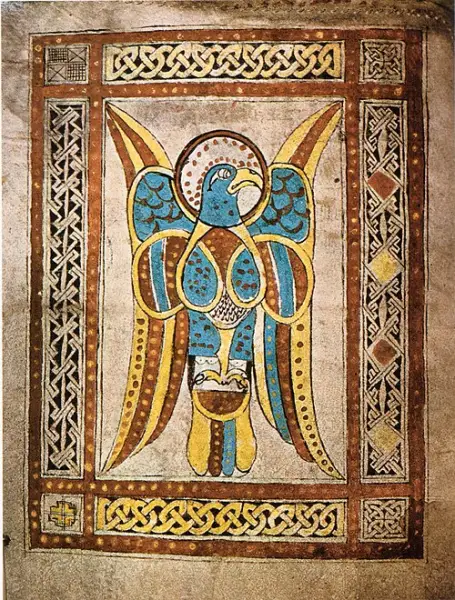
Like the Acts of so many Irish saints, the hagiography of Crónán abounds in miracles, and the most striking concerns how the Four Gospels were written out by a monk of his community. The scribe Dimma could undertake only a single day's labor, from sunrise to sunset, yet at Crónán's command he took up the task and wrote on without pause until all four Gospels stood complete. The sun, so the legend runs, stood fixed in the sky for forty days together and as many nights, while Dimma himself never suspected that more than one day had passed. The manuscript connected with this story survives as the Book of Dimma, and its scribe, Dimma MacNathi, signs his name at the close of each Gospel. Scholars once identified him with the Dimma who became bishop of Connor and appears alongside Crónán in the letter of Pope John IV of 640 regarding Pelagianism in Ireland, though the identification cannot be sustained. William Reeves noted that both the Annals of Tigernach and the Annals of Ulster describe Crónán as bishop of Nendrum, a detail that complicates but does not overturn his Roscrea connection. In the twelfth century the case containing the book was richly gilded at the command of O'Carroll, Lord of Ely.
§ Hagiography
Patron of Roscrea
Crónán's death is placed, with the weight of the Bollandist tradition behind it, on 28 April 640, notwithstanding the conflicting statements produced by the number of contemporary Irish saints who bore his name. The date has remained his feast day ever since, and he is honored in both the Roman Catholic and Orthodox traditions. He is remembered above all as the patron of Roscrea, the Tipperary town that grew in the shadow of his abbey, whose diocese was eventually incorporated into Killaloe. His memory also attaches to places beyond his own foundation: the ruined oratory of Temple Cronan keeps his name in the west, and in a later age Saint Cronan's Boys National School in Bray, County Wicklow, was named in his honor, showing that his cult remained living memory among Irish Catholics long after the medieval world had passed. The manuscript most closely tied to his circle, the Book of Dimma with its gilded case, endures as one of the signal treasures of early Irish art, a gilded testimony to the school he planted in the woods of Cré and to the scribes who worked under his rule.
§ Legacy
Timeline
- 610
Returned from Connacht to his native district of Éile and first settled at the remote wooded morass of Sean Ros, also called Loch Cré.
§ Life
- 610
Abandoned Sean Ros after pilgrims kept losing their way and moved to the woods of Cré, founding Roscrea Abbey with its school.
§ Life
- 640
Mentioned alongside the scribe Dimma in the letter of Pope John IV concerning Pelagianism in Ireland.
§ Hagiography
- 28 Apr 640
Died at Roscrea on 28 April; his feast day preserves the date of his death.
§ Hagiography
- 1100
O Carroll, Lord of Ely, had the case containing the Book of Dimma richly gilded during the twelfth century.
§ Hagiography
The Record
- Major works
- Roscrea Abbey and its monastic school
- Patron of
- patron of Roscrea, County Tipperary
- Canonization
- Pre-congregation; honored as a saint since the age of the early Irish church, with his feast kept on 28 April
Prayer
Bibliography
Show 6 sources
- Grattan-Flood, William. "Cronan." The Catholic Encyclopedia. Vol. 4. New York: Robert Appleton Company, 1908.
- "St. Cronan", Roscrea Online. Archived from the original on 25 November 2017.
- Gwynn, Aubrey; R. Neville Hadcock (1979). Medieval Religious Houses Ireland. London: Longman. p. 43.
- Reeves, William, Ecclesiastical Antiquities of Down, Connor, and Dromore (1847), p. 148.
- "Roscrea", The Father Michael O'Flanagan History and Heritage Centre.
- "Saint Cronan". New Catholic Dictionary. CatholicSaints.Info. 16 September 2012.
Profile text adapted from the Wikipedia article, licensed CC BY-SA 4.0.
Pray with this saint every day
Save St. Crónán of Roscrea to your favorites, read the full profile, and get feast-day reminders in the Saints app.
Get the Saints AppFree on the App Store for iPhone and iPad