
c. 269 – 304·Feast July 25
St. Cucuphas
Martyr of Diocletian's persecution venerated at Barcelona
Overview
Cucuphas, whose name takes a remarkable range of forms across the languages of western Europe, is a martyr of Spain put to death during the persecution of Diocletian. Born around 269 into a noble Christian family at Scillis in Africa Proconsularis, he is said to have served as a deacon of the church in Carthage together with Saint Felix, who would later suffer martyrdom at Girona. The two men made their way to Barcelona to evangelize the region, and there Cucuphas worked as a merchant while preaching the faith, baptizing converts, and supporting the local Christian community, winning a reputation for generosity to the poor and for working miracles. Arrested under the Roman governor, he endured a sequence of torments near Barcelona and was imprisoned somewhere along the route between ancient Barcino and Egara before his throat was cut in 304. Two Christian women of Illuro, Juliana and Semproniana, saw to his burial, and both likewise died as martyrs. The Benedictine abbey of Sant Cugat del Vallès, raised on the site of his martyrdom, became the center of his cult, and his relics were honored at Saint-Denis near Paris as well. His feast is kept on 25 July, though some places observe it on the 27th to avoid clashing with the feast of Santiago.
The Complete Life
A Deacon from Africa
Cucuphas came into the world around the year 269 at Scillis, a town of Africa Proconsularis in the Roman province that corresponds to the Tunisian coast today, and his name is traditionally explained as Phoenician, meaning he who jokes or he who likes to joke. His family was noble and Christian, and he grew to adulthood in one of the great centers of the African church. There he became a deacon of the Catholic Church in Carthage, serving alongside Saint Felix, who would one day win the crown of martyrdom at Girona in Spain. The pairing of the two men mattered for the shape of their lives: they left Africa together as missionaries, crossing the Mediterranean to the coast of Hispania in an age when the church of Carthage sent preachers abroad. Nothing in the record suggests hesitation or half-measures in this background. A deacon of the urban church, a man of good family who chose poverty and danger, a North African whose tongue carried the old Phoenician world within the new Christian one, he arrived at Barcelona as an evangelist ready to labor in whatever form the mission required.
§ Life
Merchant and Preacher at Barcelona
The account of Cucuphas's Spanish mission joins commerce with evangelization in a way that has endeared him to working Christians ever since. His legend tells that he kept shop as a trader in Barcelona, and in that guise he proclaimed the Gospel, baptized new believers, and stood by the city's Christians. Trade gave the foreign deacon a livelihood, a reason to move through the city's markets, and daily contact with the people whose souls he sought; the legend presents the two callings not as a compromise but as a single vocation. The old accounts add that he gave freely to the poor and worked wonders, so that his reputation gathered around him long before his arrest. He was not alone in the work: his companion Felix carried the mission onward to Girona, where he too would die for the faith, but Cucuphas remained bound to Barcelona and its neighborhood. In an age when the church of a provincial capital could still be small and exposed, a preacher who baptized, taught, and materially supported the faithful was worth more than any garrison. It was in this double character, merchant and deacon, that the persecution finally found him.
§ Life
Torments and the Scaffold
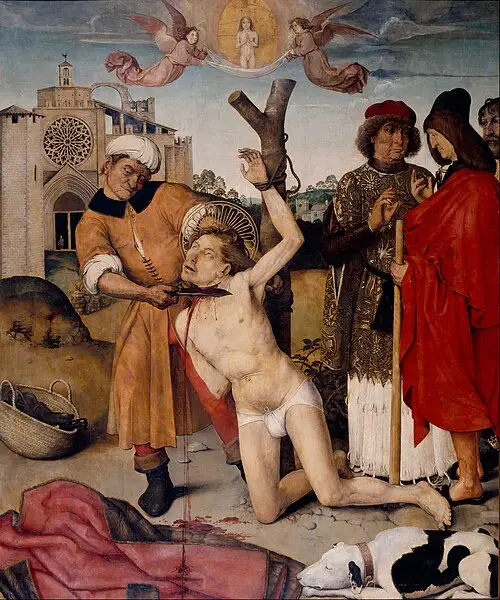
Cucuphas was martyred near Barcelona in the great persecution of Diocletian. Twelve soldiers received orders to flog the prisoner and to lacerate his flesh with iron nails and scorpions. The passio elaborates his torments in the vivid manner of the genre: set alight to roast, having first been doused in vinegar and pepper, he was preserved by heavenly intervention; a great bonfire meant to consume him instead killed his executioners; and his jailers, finding him in his cell shining with heavenly light, were converted to the faith he was dying for. On the following day his tormentors beat him with whips of iron, and by the same heavenly intervention the prefect Maximianus perished when his carriage caught fire. His successor Rufus, the new prefect, took a more pragmatic course: declining every kind of torture, he ordered the saint's immediate execution by the sword, and Cucuphas's throat was cut in 304. His cell had stood somewhere along the twenty miles of road that ran between Barcino and Egara in Roman times, and it was near Barcelona that he died. At Illuro, the modern Mataró, two Christian women, Juliana and Semproniana, took charge of burying him, and paid for that act of mercy with their own martyrdom, joining him in the calendar of the saints.
§ Life
A Cult of Poets and Liturgies
Few martyrs of the early Spanish church left so dense a trail in the written record. The poet Prudentius honored Cucuphas in a hymn, and the saint appears in the Hieronymian Martyrology, in the Prayer Book of Verona of the seventh century, in the Martyrology of Ado, in the Martyrology of Usuard of the ninth century, and in the Martyrology of Saint Peter of Cardeña of the tenth, presumed a copy of a seventh-century manuscript. The Mozarabic Liber Sacramentorum of Toledo preserves a ninth-century mass dedicated to him. Most beautiful of these witnesses is the early medieval hymn that begins Barcino laeto Cucufate vernans, composed in the seventh century and attributed to Quiricus of Barcelona, which sings the city's vernal joy in its martyr and the privet branches strewn upon his tomb. The image is telling: a martyrdom of nails and fire had become, in the church's memory, a festival of spring. Devotion of this intensity did not depend on documentary proof, and modern scholars may doubt the details of the passio, but the depth and antiquity of the cult are beyond question, rooted in Barcelona and spreading through the liturgical books of an entire peninsula.
§ Textual references
From Sant Cugat to Saint-Denis
The Benedictine abbey of Sant Cugat del Vallès, built on the Roman site of Castrum Octavianum, is considered to stand where the martyr died, and when the first monastic community gathered there in the ninth century it dedicated itself to the veneration that already flourished at the spot. Sant Cugat had claimed the relics since the eighth century, and in that same century Saint Fulrad carried one of them to Saint-Denis, where Cucuphas's relic occupies an honored spot in the apse, at the right hand of Saint Denis, even now. From the fourteenth century the martyr's remains rested in a small chest painted with scenes from his life, later moved to the Barcelona parish of Sant Cugat del Rec and, after a commemoration in 1950, to a resting place in the crypt of Santa Maria del Mar. Churches from Reichenau to the cathedrals of Braga and Oviedo claimed his relics, and the twelfth-century Historia Compostelana records Diego Gelmírez carrying them secretly from Braga to Santiago de Compostela. In France the Bois de St-Cucufa near Rueil-Malmaison keeps his name, with pilgrimages to Saint Quiquenfat lasting into the eighteenth century. Hunchbacks and petty thieves honored him as patron, and Catalan folklore still ties knots in his name to find what is lost.
§ Relics
Timeline
- 269
Born at Scillis in Africa Proconsularis to a noble Christian family
§ Life
- 304
Executed near Barcelona in the great persecution under Diocletian, his throat cut after imprisonment and torture; the women Juliana and Semproniana buried him
§ Life
- 650
Named in the seventh-century Prayer Book of Verona and honored in the hymn Barcino laeto Cucufate vernans
§ Textual references
- 750
Saint Fulrad brought one of the martyr's relics from Sant Cugat to the abbey of Saint-Denis during the eighth century
§ Relics
- 850
Monks of Saint Benedict first formed a house at Sant Cugat in the ninth century, dedicating it to the pre-existing veneration of the martyr
§ Relics
- 1150
The twelfth-century Historia Compostelana tells how Diego Gelmírez moved the martyr's relics from Braga to his cathedral at Santiago
§ Relics
- 1505
Ayne Bru painted The Martyrdom of Saint Cucuphas in 1504-7
§ Introduction
- 1950
Sant Cugat commemorated a relic proceeding from the chest of Sant Cugat del Rec; today those remains rest in the crypt of Santa Maria del Mar
§ Relics
- 2001
Catalan devotees grew alarmed on learning the saint's name had vanished from the new Roman Martyrology, though he stood listed under his Latin form Cucuphas
§ Veneration in Spain
The Record
- Patron of
- hunchbacks·petty thieves·invoked in folklore for the recovery of lost objects
- Symbols
- depicted being beheaded or having his throat cut
- Canonization
- Pre-congregation; honored as a martyr since antiquity, listed in the Hieronymian Martyrology and the Roman Martyrology
Prayer
Bibliography
Show 5 sources
- Anglès, Higini. "Hispanic Musical Culture from the 6th to the 14th Century." The Musical Quarterly, Vol. 26, No. 4 (Oct., 1940), pp. 494–528.
- M. Suarez, La Historia Compostelana, 1950. Book I, chapter XV.
- "Què sabem del màrtir" (PDF). Archived from the original (PDF) on 2009-09-04.
- Santi, beati e testimoni - Dizionario dei nomi.
- "Rueil-Malmaison". justtourfrance.com.
Profile text adapted from the Wikipedia article, licensed CC BY-SA 4.0.
Pray with this saint every day
Save St. Cucuphas to your favorites, read the full profile, and get feast-day reminders in the Saints app.
Get the Saints AppFree on the App Store for iPhone and iPad