
died 340·Feast June 12
St. Cunera
Virgin Martyr of Rhenen and Protector of Horses
Overview
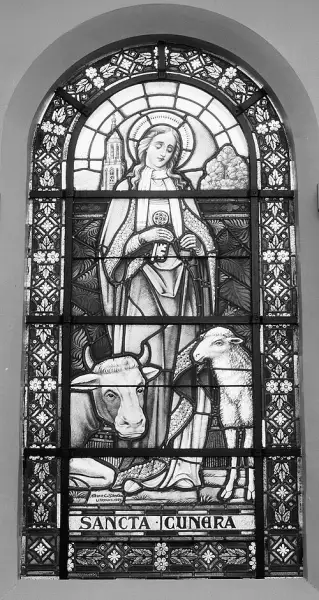
Cunera of Rhenen, also called Kunera, was a virgin martyr whose death is dated to 28 October 340 at Rhenen in the diocese of Utrecht. Her name first appears in written record in the eleventh century, and the full shape of her story comes from a legend of the fourteenth century: she was, by that account, a princess of the Orkney Islands and the sole virgin to survive the massacre of Saint Ursula and her companions at Cologne. Carried to Rhenen by the king of the Rhine, she won the love of the town through her kindness to the poor, until the jealousy of the queen cost her her life by strangling with a scarf. Her body, hidden in a stable, was revealed by the agitation of the horses, and from her tomb came a stream of healings and rescues of the drowning. She became the patron of Rhenen, a protector of horses and a helper against animal disease and sore throat, honored with pilgrimage, a great church and tower, and a relic of her martyrdom still preserved in Utrecht. Her feast is kept on 12 June.
The Complete Life
The Princess from the Orkneys
The legend that fixed Cunera's story in the fourteenth century begins far from the Rhine, among the islands of the Orkneys, where she was born a princess. Setting out in the company of Saint Ursula, she joined that great band of consecrated virgins on their pilgrimage toward Rome and beyond. When the Huns fell upon the company at Cologne and put the eleven thousand to the sword, Cunera alone, the tale relates, escaped the slaughter. Her escape was strange and sheltering: the king of the Rhine, present at the scene, hid her beneath his cloak and carried her away to his palace at Rhenen on the Dutch frontier of the Roman world. There the fugitive found not a prison but a home. The fourteenth- and fifteenth-century Latin and Dutch versions of the legend disagree on details, and modern scholarship is frank that the historical events underlying the story cannot be recovered; like Ursula herself, Cunera must be received as a figure of devotion rather than documentation. Yet the tale records something true about the saint her cult honored: a young woman of foreign birth whose gentleness made a foreign court love her, and whose survival of violence became, in the memory of Rhenen, the beginning of a new life of charity.
§ Life
Keybearer of the Poor at Rhenen
At Rhenen, Cunera's charity made her the beloved of the whole town. The poor found in her a tireless advocate, and the king himself came to trust her so completely that he placed in her hands the key to his cellars, an office that made her the provisioner of the household's alms. The key she carried became, with the scarf that ended her life, one of the two attributes by which art has known her ever since. Such favor could not last unchallenged. The queen watched an outsider receive the confidence that belonged to a wife, and jealousy curdled into resolve. While the king was away hunting, the murderous moment came: Cunera was strangled in the palace by means of a scarf, and her body was buried in secret within the stable, as though the daughter of kings could be hidden like a stolen chattel. But the place of concealment proved her first shrine. The horses, the beasts she would one day be invoked to protect, could not rest beside the hidden crime; their anguish drew attention to the stable and uncovered the deed. The queen perished by her own hand, leaping from a cliff, and the chamberlain who had helped her was beheaded. Justice, the legend insists, came quickly to the martyr's ashes.
§ Life
Martyrdom on a Hunting Day
The death of Cunera is fixed by the tradition of Rhenen to 28 October 340, and the day of her passion was an ordinary day turned monstrous: the king absent with his hounds, the household in the hands of a resentful queen, and a young woman whose only offense was that the poor loved her. Strangled with a scarf, the instrument of silk that gives her cult its most intimate relic, she joined the company of martyrs whose blood had been shed not in an arena but in the domestic treachery of a court. Her burial in the stable kept her, for a little while, in the company of the animals whose patron she would become; the legend lingers over the distress of the horses, as if the brute creation itself refused to be silent about the sin committed beside them. Once the crime was discovered and the body honored, the town claimed her without reserve. From her grave, the tradition records, came many healings and rescues of those in danger of drowning, favors that carried her fame far beyond the walls of Rhenen and made her tomb a goal of pilgrims. The scarf that killed her was kept with reverence, and centuries of devotion would gather around the cloth that had strangled the saint.
§ Life
Willibrord's Proclamation and the Pilgrim Fairs
The veneration of Cunera reached back into the first age of Dutch Christianity: Saint Willibrord, the apostle of the Frisians and bishop of Utrecht, who died in 739, is said to have announced her canonization, giving the ancient martyr an official place in the church of the Netherlands. Her name in written record is later, appearing first in the eleventh century, but the cult itself needed no documentation to flourish. In the late Middle Ages a great pilgrimage gathered at Rhenen each year in connection with the annual horse fair, so that the memory of the maiden strangled in a stable became bound to the trade and blessing of horses, of which she was honored as protector. The town answered the pilgrim crowds with stone: the local church of Saint Peter was consecrated to Cunera, and in time that building gave way to the present Cunera Church with its mighty Cunera Tower, finished in 1531, which still defines the skyline of Rhenen. In the late fifteenth century the legend gained a new chapter when the king of the story was identified with Radbod, the Frisian king who died in 719, and fictional genealogies wove the martyr into the webs of northern royalty.
§ Veneration
The Scarf in the Museum
The Reformation ended the public cult of Cunera at Rhenen but could not end her story. In 1580 the Reformation emptied the Cunera church of its sacred images, and her relics were carried away for safety, finding new homes at Emmerich in the Duchy of Cleves and at Bedaf in Uden. The most touching survivor is the scarf itself, the wurgdoek or dwale with which the queen strangled her: preserved through all the upheavals, it is now kept in the Museum Catharijneconvent in Utrecht. Scientific examination has shown the cloth to be a genuine ancient textile, a fabric of Coptic linen woven in the fifth century, a silent witness to how a relic of this kind traveled from the eastern Mediterranean into the treasury of a Dutch shrine. The town kept her name in its great tower, its church, and its identity; she remains the patron of Rhenen, invoked for horses, against the diseases of animals, and against sore throat, the affliction that recalls the rope about her neck. Historians may doubt, as they must, the historicity that underlies the fourteenth-century legend, but the devotion of a millennium and a half has its own testimony: kindness outlives the jealous hands that strangle it.
§ Veneration
Timeline
- 28 Oct 340
Strangled to death at Rhenen in the diocese of Utrecht; her body was secretly buried in a stable.
§ Life
- 1531
The Cunera Tower at Rhenen, companion to the church consecrated in her honor, was completed.
§ Veneration
- 1580
Amid the Protestant Reformation, the images of the saints were removed from the Cunera church.
§ Veneration
The Record
- Major works
- Cunera Church, Rhenen·Cunera Tower, Rhenen (completed 1531)
- Patron of
- Rhenen·horses·against animal diseases·against sore throat
- Symbols
- key·scarf
- Canonization
- Her canonization is said to have been announced by Saint Willibrord, bishop of Utrecht (d. 739)
Prayer
Bibliography
Show 1 sources
- "Cunera". Online Dictionary of Netherlands (in Dutch). 2017.
Profile text adapted from the Wikipedia article, licensed CC BY-SA 4.0.
Pray with this saint every day
Save St. Cunera to your favorites, read the full profile, and get feast-day reminders in the Saints app.
Get the Saints AppFree on the App Store for iPhone and iPad