
c. 600 – 663·Feast November 12
St. Cunibert of Cologne
Bishop of Cologne and regent of Austrasia
Overview
Cunibert, also written Cunipert or Kunibert, was the ninth bishop of Cologne, holding the see from 623 until his death on 12 November around 663. Born about 600 somewhere along the Moselle into the Ripuarian Frankish aristocracy, he was educated at Metz at the court of Chlothar II, took holy orders, and became archdeacon of Trier before his elevation to Cologne at about the age of twenty-three. The documents of his own era record him from 627 to 643. His episcopate unfolded at the very center of Merovingian politics: he advised King Dagobert I, tutored the king's son and heir Sigebert III, and when Sigebert was invested as king of Austrasia in 633 or 634, Dagobert named Cunibert and Adalgisel Grimo, holder of the palace mayor's office, to act as co-regents of the young kingdom. After the death of Adalgisel's successor Pepin of Landen, Cunibert stood as the crown's foremost public officer, and in that capacity he revised the Lex Ribuaria, the law of the Rhineland Franks. Throughout his years in office monastic life flourished in his diocese and churches were founded and restored. He died in the city he had long served and was buried in a Cologne church that now bears his name.
The Complete Life
A Frankish Noble Along the Moselle
Cunibert entered the world around the year 600, somewhere along the Moselle river, into one of the leading families of the Ripuarian Franks, the aristocracy that dominated the lower Rhineland. His birth into that ruling class shaped everything that followed, for the Frankish church of his day drew its bishops almost entirely from noble houses, and the skills of court and cathedral were learned in the same places. The family sent the boy to be educated at Metz, at the court of King Chlothar II, where he received the formation of a royal page rather than that of a cloister. There he absorbed the working knowledge of power, law, and administration that would later make him indispensable to two kings. Yet he chose the ecclesiastical path, taking holy orders and rising to become archdeacon of Trier, one of the principal sees of the Moselle country. The combination was potent: a nobleman with a court education, ordained among the clergy of a great diocese, still young when the king's attention fell upon him. By his early twenties the essential facts of his career were set, and the road led not along the Moselle of his birth but downriver to Cologne.
§ Life
Bishop of Cologne
In 623 Cunibert was made bishop of Cologne, the ninth bishop of the city, succeeding to one of the oldest and most important sees of the Frankish church. He was still a young man, and his appointment bound the diocese tightly to the Merovingian court from which he had come. His first years in office brought him into the company of the church's assembled bishops: he attended the Synod of Clichy in 626 or 627, the great assembly at which Frankish ecclesiastical discipline was ordered for the age. Contemporary documents mention him between 627 and 643, the window through which his public career is directly visible to historians. When Dagobert I succeeded to the rule of the Franks, Cunibert stood among the king's trusted advisors, and the king entrusted him with what mattered most: the education of his son and heir, Sigebert III, whom the bishop served as tutor. The trust was of a piece with his whole career, for the Frankish kingdoms depended on bishops who could blend spiritual authority with political reliability. In Cologne itself the young prelate had begun the work that would fill his episcopate, fostering the monastic and pastoral life of a great Rhineland diocese.
§ Life
Regent of Austrasia
The decisive turn of Cunibert's public life came in 633 or 634, when Dagobert invested his son Sigebert III as king of Austrasia, the eastern part of the Frankish realm. To guard the child-king's throne the monarch appointed two co-regents: Cunibert of Cologne and Adalgisel, the mayor of the palace. The pairing joined the highest ecclesiastical and civil officers of Austrasia in a shared guardianship of the kingdom. After Adalgisel's successor in the mayoral office, Pepin of Landen, had died, Cunibert stood forth as the king's foremost public officer, the leading figure in the government of Austrasia. In that capacity he undertook the work for which jurists remember him: a revision of the Lex Ribuaria, the law code of the Ripuarian Franks among whom he had been born. Few bishops of the age left a mark on legislation, and the revision stands as evidence of how fully the bishop of Cologne had become a maker of Frankish policy as well as a shepherd of souls. Throughout these same years his diocese prospered spiritually, for monasticism flourished under his episcopate, and churches across his see were founded and restored through his care.
§ Life
A Bishop Who Built Up the Church
The sources sketch Cunibert's sanctity less through miracle tales than through what he built. The record of his episcopate notes that monasticism flourished and that churches were founded and restored throughout his years in office, a summary that conceals a lifetime of patronage, ordination, and pastoral oversight. A bishop who encourages monasteries plants communities of prayer that outlast him; a bishop who restores churches repairs the fabric of worship for generations who will never know his name. Cunibert's own spiritual formation had joined the court of Chlothar II to the clergy of Trier, and the same breadth marked his mature service: he could preside over synods at Clichy, tutor a king's son, direct the government of a kingdom, and still govern his own diocese with diligence. The Franks of his era expected their bishops to be such men of both worlds, and the church of Cologne evidently judged that he had kept the two callings in right order. When he died on 12 November, around the year 663, the date passed into his calendar as his feast, and his burial in a church bearing his own name made his grave a place where the faithful of Cologne could honor their bishop as a saint.
§ Life
Cologne Remembers Its Bishop
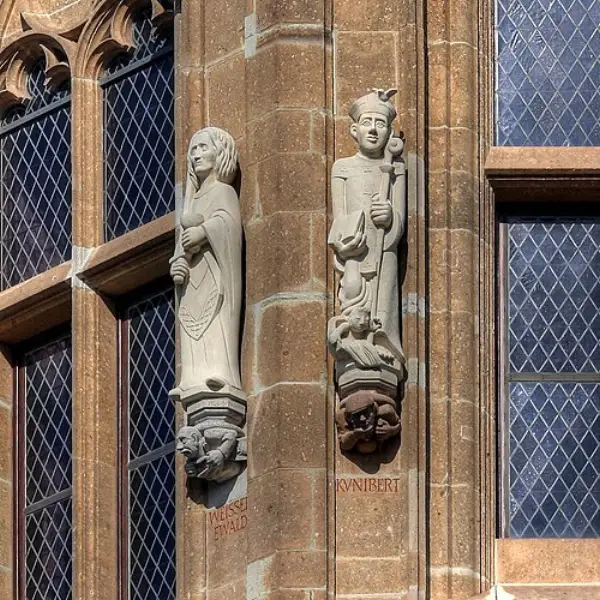
Cunibert's memory took permanent root in the city he governed. He was buried in a Cologne church that came to bear his name, and there his tomb became the focal point of a cult that the Roman Catholic Church has ever since recognized, keeping his feast on November 12, the day of his death. He stands in the line of great Merovingian bishops who made Cologne a center of the Rhineland church, and his regency of Austrasia placed him among the small company of churchmen who have effectively ruled a kingdom. Historians of the period know him chiefly through the documentary record between 627 and 643 and through the Lex Ribuaria, the law he revised; the faithful of Cologne know him through the church that keeps his name and the feast that recalls his death each November. His statue watches from the tower of the city hall of Cologne, a civic acknowledgment of the bishop whose regency helped shape the Austrasian kingdom and whose episcopate helped shape the city. Nine centuries of veneration have not erased the outlines of the man: a Frankish noble who became a bishop, a tutor who became a regent, and a statesman who remained a pastor.
§ Life
Timeline
- 600
Born about this year on the Moselle, into one of the leading families of the Ripuarian Franks
§ Life
- 623
Made bishop of Cologne, the ninth occupant of the see
§ Life
- 627
Attended the Synod of Clichy in 626 or 627
§ Life
- 633
Sigebert III was invested as king of Austrasia in 633 or 634, with Cunibert and Adalgisel appointed co-regents of the kingdom
§ Life
- 643
Contemporary sources record him for the last time, having served as chief public official of the king and revised the Lex Ribuaria after Pepin of Landen's death
§ Life
- 12 Nov 663
Died on 12 November and was buried in a Cologne church that now carries his name
§ Life
The Record
- Major works
- Revision of the Lex Ribuaria
- Canonization
- Pre-congregation; regarded as a saint by the Roman Catholic Church, with his feast kept on the day of his death, November 12
Prayer
Bibliography
Show 3 sources
- "Cunibert of Cologne", Oxford Dictionary of Saints.
- Rettberg, Friedrich Wilhelm (1846). "Kirchengeschichte Deutschlands, Erster Band" [Church History of Germany, Volume 1] (in German).
- Gorlinski, Virginia. "Saint Cunibert". Encyclopedia Britannica.
Profile text adapted from the Wikipedia article, licensed CC BY-SA 4.0.
Pray with this saint every day
Save St. Cunibert of Cologne to your favorites, read the full profile, and get feast-day reminders in the Saints app.
Get the Saints AppFree on the App Store for iPhone and iPad