
c. 975 – 1040·Feast March 3
St. Cunigunde of Luxembourg
Holy Roman Empress who became a Benedictine nun
Overview
Cunigunde of Luxembourg, called also Cunegunda or Cunegondis, was Empress of the Holy Roman Empire as the wife of Emperor Henry II, and after his death in 1024 she governed briefly as interim regent before laying down power to become a Benedictine nun. Born around 975, one of the eleven children of Siegfried I of Luxembourg and a woman named Hedwig, she descended in the seventh generation from Charlemagne through her paternal grandmother. She married Henry in 999 and was crowned with him at Mainz and Paderborn in 1002, an event without precedent, since no queen of Germany is known to have been crowned before her. As empress she was a genuine political partner: charters name her as advocate or initiator in a third of her husband's surviving acts, she sat in imperial councils, and she influenced his great endowments to the church, above all the cathedral and monastery of Bamberg. Crowned empress beside Henry in Saint Peter's on 14 February 1014 by Pope Benedict VIII, she endured later calumny, which legend says she refuted by walking unharmed over red-hot ploughshares. Widowed in 1024, she retired in 1025 to the Benedictine house for nuns she had founded at Kaufungen, where she served the sick and lived in prayer until her death on 3 March 1040. Canonized in 1200, she is patroness of Luxembourg and the Archdiocese of Bamberg.
The Complete Life
A Daughter of the House of Luxembourg
Cunigunde was born around 975 into the rising comital house of Luxembourg, one of the eleven children of Count Siegfried I, who died on 15 August 998, and of his wife Hedwig. The identity of her mother engaged genealogists for centuries: one of the most famous theses, advanced by Joseph Depoin, held that Hedwig was the child of Duke Gilbert of Lorraine and of Gerberga of Saxony, herself a daughter of Henry I. If that were true, Cunigunde would have married her distant cousin, but since Henry II opposed consanguineous marriage on principle, the hypothesis is generally set aside. Another tradition, encountered almost as often, makes her the daughter of Berthold of Schweinfurt of the House of Babenberg and of Eilika of Walbeck, daughter of Count Lothar. What is certain is the imperial pedigree on her father's side: her grandmother on the father's side, who likewise bore the name Cunigunde, belonged to the Carolingian line, which made the future empress a seventh-generation descendant of Charlemagne. She grew up amid eleven siblings in a family that was planting dynastic roots between the Meuse and the Rhine, and from that crowded, ambitious household came the woman who would one day wear the crown of the Ottonian empire and, after it, the veil of a Benedictine nun.
§ Life
A Marriage of Companionship
In 999 Cunigunde married King Henry, then Duke of Bavaria, and the union became one of the most discussed marriages of the Middle Ages. Tradition says the convent had drawn her from her early years, and that her marriage to Henry was a spiritual one, contracted for companionship alone, the two agreeing by mutual consent never to complete their union; some writers assert that before the wedding she pledged her virginity with Henry's approval. The truth remains debatable. The couple were certainly childless, and some authors suppose that later hagiographers, confronted with that childlessness, wrongly read it as proof of a virginal union; others accept that the marriage was purely platonic. Whatever the private reality, the public partnership prospered. In 1002 Henry was crowned king of Germany at Mainz by Archbishop Willigis on 9 July, and Cunigunde received her own coronation at Paderborn on 10 August from the same hands, an event without precedent, since earlier queens had only been crowned empresses in Rome after their husbands' imperial elevation. In 1004 Henry added the crown of Italy at Pavia, though no evidence records Cunigunde's coronation as queen of Italy. The couple's shared reign had begun, and it would carry them to the imperial throne itself.
§ Life
Partner in the Rule
Cunigunde was no ornament of the throne but a working political partner. Ottonian charters often styled the ruler's wife consors regni, partner in the rule, and with her the title was substance rather than flattery: in one-third of Henry's surviving charters she emerges as advocate or initiator of the act. As her husband's closest adviser she took part in imperial councils, and she is reported to have exercised influence over his endowments of land to the church, which included the cathedral and monastery at Bamberg in Bavaria, the great foundation for which the couple is jointly remembered. In 1012 she joined Henry in commissioning the Pericopes of Henry II from the monks of Reichenau, the island monastery in Lake Constance then among the leading centers of book illumination; its dedication picture shows the couple crowned by Christ himself, led forward by the Apostles Peter and Paul, with Cunigunde represented the same size as her husband and pointing directly toward Christ, a gesture read as the sign of her political readiness. The dedicatory poem names her co-regent. During these years she also suffered a grave illness and vowed that, if her health returned, she would raise a Benedictine house at Kassel; recovering, she kept her oath, and the building was begun before Henry's death left it unfinished.
§ Life
The Widow of Kaufungen
When Henry died in 1024, Cunigunde was obliged to assume the regency of the empire, which she exercised with her brother until Conrad II was elected on 8 September 1024 and she handed over the imperial insignia. As a widow she found herself comparatively poor, her wealth having been given away in charitable works by the imperial couple during their lifetime. Exactly one year after her husband's death, in 1025, she withdrew to Kaufungen Abbey in Hesse, the house of Benedictine sisters she had established there. At its dedication she presented a relic of the True Cross, laid aside her imperial insignia, and put on the garb of a nun, exchanging the empire for the cloister in a single ceremony. There she remained for the last fifteen years of her life, performing works of charity, caring for the sick, and giving herself to prayer, a former empress living under the rule she had chosen. Her death came at Kaufungen on 3 March 1040, and she was laid to rest in Bamberg Cathedral at her husband's side, though she may first have been laid elsewhere and re-interred in the cathedral in 1201, after her canonization. The stone tomb that Riemenschneider later carved for the couple made their graves the artistic centerpiece of the cathedral they founded.
§ Religious life and death
The Saint Proved in the Fire
Pope Innocent III canonized Cunigunde in Rome on 29 March 1200, fifty-three years after Henry's own canonization in July 1147. To prepare the case a biography of the empress was compiled, and this life, together with the papal bull of canonization, relates several miracles worked by the empress. The most famous tells how, when slanderers charged her with disgraceful behavior, heaven itself made her innocence plain: she walked across pieces of flaming iron, the red-hot ploughshares of legend, and came through unharmed, filling her husband the emperor with delight. A second story relates how she fell asleep one night and was carried to bed; her sleeping maid let a candle tumble, and flames took hold of the bedding. Both women woke in time, and at Cunigunde's signing of the cross the fire vanished at once, sparing them from burning. A third legend concerns her niece Judith, abbess of Kaufungen, a frivolous young woman who preferred feasting with the younger sisters to the observance of the choir. After gentle remonstration failed, Cunigunde slapped her across the face, and the marks remained on Judith's face for life, a standing warning to any in the community who would treat their vows lightly. Harsh as the tale is, the medieval church treasured it as proof that holiness does not shrink from correction.
§ Canonization and veneration
Patroness of Luxembourg and Bamberg
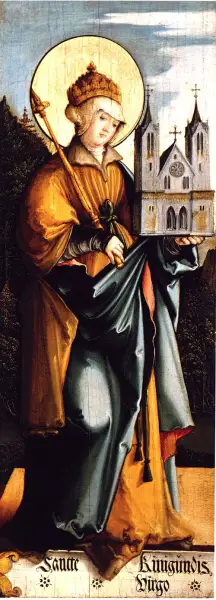
Cunigunde's veneration spread wide and rooted deep. In art she appears as an empress in imperial robes, often holding a church, and her usual attribute is the ploughshare that recalls the ordeal by fire, a scene carved on the Riemenschneider tumba at Bamberg alongside the Key miracle. That double tomb of 1499-1513 shows the couple with lions at their feet, and the sculptor's decision to give the empress a lion, ordinarily reserved for men while women received a dog of loyalty, was a deliberate tribute to a ruler who exercised sovereign rights in her own name; one of the lions is the Roude Leiw, the red lion of Luxembourg's arms since 1235-39. The Adamspforte doorcase of 1235 at Bamberg Cathedral, with Stephen standing beside the donor empress as she holds the model of a church, remains the most significant monumental image of her from the High Middle Ages. In Luxembourg, of which she is the only female saint, churches honor her at Clausen, consecrated in 1865 and painted with scenes of her life in 1906, home to a tooth relic and the Cunigunde bell consecrated in 1959; the octagonal chapel at Heiderscheidergrund rose in 1848-52, and the churches of Hoscheid-Dickt of 1852 and Oberschlinder of 1875 keep her name. Detroit's St. Cunegunda Church carried her across the Atlantic, and the Eastern Orthodox church venerates her on 3 March as well.
§ Reception and iconography
Timeline
- 975
Born around this year, one of the eleven children of Siegfried I of Luxembourg and his wife Hedwig
§ Life
- 999
Married King Henry, the future Emperor Henry II
§ Life
- 9 Jul 1002
Crowned queen of Germany alongside Henry at Mainz by Archbishop Willigis
§ Life
- 10 Aug 1002
Received her own coronation at Paderborn from Willigis, the earliest crowning of a queen of Germany on record
§ Life
- 1012
With Henry commissioned the Pericopes of Henry II from the monks of Reichenau, depicted with the emperor in its dedication picture
§ Reception and iconography
- 14 Feb 1014
Crowned Holy Roman Empress with Henry in St. Peter's Basilica, Rome, by Pope Benedict VIII
§ Life
- 1024
Henry died, leaving unfinished the Kassel monastery she had vowed to build; she assumed the regency of the empire with her brother
§ Life
- 8 Sep 1024
Surrendered the imperial insignia once Conrad II was chosen to succeed her late husband
§ Life
- 1025
Retired to Kaufungen Abbey in Hesse, where at its dedication she offered a relic of the True Cross and received the Benedictine habit
§ Religious life and death
- 3 Mar 1040
Died at Kaufungen and was buried at Bamberg Cathedral beside her husband
§ Religious life and death
- 1147
Her husband Henry II was canonized in July, fifty-three years before her own canonization
§ Canonization and veneration
- 29 Mar 1200
Canonized by Pope Innocent III in Rome, on the strength of a compiled biography and recorded miracles
§ Canonization and veneration
- 1201
May have first been buried elsewhere and then re-interred at Bamberg Cathedral after her canonization
§ Religious life and death
- 1235
The doorcase of the Adamspforte at Bamberg Cathedral, the most significant monumental depiction of the empress in the High Middle Ages, was created
§ Reception and iconography
- 1500
Tilman Riemenschneider carved the limestone tumba of the imperial couple at Bamberg Cathedral between 1499 and 1513
§ Reception and iconography
- 1865
The parish church of Saint Cunigunde at Clausen in Luxembourg was consecrated, later gaining murals of her life in 1906 and a bell in 1959
§ Reception and iconography
The Record
- Major works
- Kaufungen Abbey, a monastery of Benedictine nuns at Kaufungen in Hesse·Benedictine monastery at Kassel, begun in fulfillment of a vow made during illness
- Patron of
- Patroness of Luxembourg·Archdiocese of Bamberg
- Symbols
- an empress in imperial robes·a model of a church·a ploughshare
- Canonization
- Canonized by Pope Innocent III in Rome on 29 March 1200
Prayer
Bibliography
Show 7 sources
- Farmer, David Hugh (1997). The Oxford Dictionary of Saints (4th ed.). Oxford: Oxford University Press. p. 119. ISBN 0-19-280058-2.
- Weinfurter, Stefan (1999). Heinrich II. (1002–1024) Herrscher am Ende der Zeiten. Regensburg: Friedrich Pustet Verlag.
- Bentley, James (1993). A Calendar of Saints: The Lives of the Principal Saints of the Christian Year. London: Little, Brown. p. 45. ISBN 0-316-90813-4.
- Melton, J. Gordon (2014). Faiths Across Time: 5,000 Years of Religious History, Vol. 2. Oxford: ABC-Clio. p. 664.
- Jackman, Donald C. (2012). Studia Luxembourgensia. Pennsylvania: Editions Enlaplage. p. 25.
- Hirschmann, Frank G. & Maréchal, Romain (2014). Die heilige Kaiserin Kunigunde von Luxemburg. Trier: Verlag Michael Weyand.
- Plefka, Sven (2001). "Heilige und Herrscherin - Heilige oder Herrscherin? Rekonstruktionsversuche zu Kaiserin Kunigunde". Bericht des Historischen Vereins Bamberg 137, 35-52.
Profile text adapted from the Wikipedia article, licensed CC BY-SA 4.0.
Pray with this saint every day
Save St. Cunigunde of Luxembourg to your favorites, read the full profile, and get feast-day reminders in the Saints app.
Get the Saints AppFree on the App Store for iPhone and iPad