
c. 634 – 687·Feast March 20
St. Cuthbert
Bishop of Lindisfarne and Wonder Worker of Britain
Overview
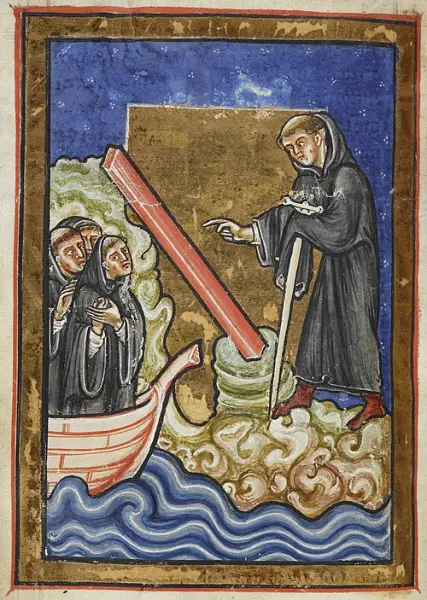
Cuthbert was a monk, hermit, and bishop of the early Northumbrian church, formed in the Celtic tradition at Melrose and Lindisfarne. Tradition places his birth around 634 at Dunbar, then part of the Anglo-Saxon kingdom of Northumbria. As a young shepherd he experienced a vision on the night Aidan, founder of Lindisfarne, died, and resolved to enter monastic life. He served as guest-master at the new monastery of Ripon before returning to Melrose, where he became prior, and around 665 was made prior of Lindisfarne. After the Synod of Whitby he accepted Roman customs and laboured to introduce them at Lindisfarne. Renowned for austere living, generosity to the poor, and a reputation for healing, he preached across the breadth of Northumbria and earned the name Wonder Worker of Britain. In 676 he withdrew to the hermit's life on Inner Farne, though he granted one audience he could not withhold: the abbess Ælfflæd, whom he received on Coquet Island. In 684 he was elected bishop, consecrated at York the following March, and served as Bishop of Lindisfarne until retiring to his cell shortly before his death on 20 March 687. His body, found incorrupt in 698, became the centre of one of medieval England's greatest cults, carried by fleeing monks to Durham, where his tomb endures in the cathedral built around it.
The Complete Life
A Child of Northumbria's New Faith
Cuthbert was born in the mid-630s at Dunbar, then an Anglo-Saxon settlement in the Northumbrian kingdom that stretched in modern terms from northern England into south-eastern Scotland as far as the Firth of Forth. His birth came only about ten years after King Edwin of Northumbria accepted baptism from Paulinus of York, a Roman missionary of the Gregorian mission, and the slow conversion of Edwin's people formed the backdrop of Cuthbert's whole life. Power in the kingdom changed hands violently, and pagan rule reappeared at intervals even as the faith spread. Edwin's successor Oswald brought Irish monks from Iona to establish Lindisfarne around 635, very nearly at the moment Cuthbert was born, giving the young kingdom a double inheritance of Roman and Celtic Christianity. Whether Cuthbert came from a noble family is uncertain. Alban Butler relates that the boy was fostered near Melrose, a custom that may point to noble birth, as may references to his riding a horse in youth; yet another early writer saw in his boyhood tending of sheep on the hills near the monastery a suggestion of humble parentage. As a boy employed as a shepherd, he saw in one night's vision how angels bore the soul of Aidan up to heaven, and only afterwards learned that Aidan had died that same night. Irish genealogies even suggest he may have been a second cousin of King Aldfrith of Northumbria.
§ Origins and background
From Shepherd's Vision to Monastic Vows
The decisive moment of Cuthbert's youth came on the night in 651 when Aidan, the founder and first bishop of Lindisfarne, died. Keeping watch as a shepherd, Cuthbert saw the saint's soul carried heavenward and resolved thereupon to become a monk. He appears to have undergone a period of military service before entering religion, a fact that reminds us how unsettled the border country remained. He joined the recently founded monastery at Melrose, where he came under the guidance of the prior Boisil and absorbed the learning and ascetic discipline that would mark his whole career. His reputation for piety, diligence, and obedience grew steadily. When Alchfrith, king of Deira, established a new monastery at Ripon, Cuthbert was sent there as guest-master, the officer responsible for hospitality, under Eata. That posting ended abruptly when Wilfrid was made abbot of Ripon instead, and Eata withdrew with Cuthbert back to Melrose. Upon Boisil's death, traditionally dated 661, Cuthbert succeeded to the priorship; another account has him appointed after the plague of 664 carried off his predecessor while Cuthbert himself survived the sickness. He was also possibly a second cousin of King Aldfrith, according to Irish genealogies, a connection later cited when he proposed that Aldfrith be crowned king.
§ Career
Preacher Across the Breadth of Northumbria
After the Synod of Whitby of 664 settled the Roman and Celtic dispute over Christian practice, Cuthbert, formed as he was in the Celtic tradition, joined his mentor Eata in embracing the Roman usages, seemingly without any struggle. Eata then summoned him to introduce those customs at Lindisfarne, where he served as prior from around 665. His ministry among the people was tireless. He journeyed as a missionary the length and breadth of the land, from Berwick to Galloway, preaching in remote villages and ministering to their spiritual needs, work that made him beloved across the whole kingdom. He showed an equal gift for impressing royalty and nobility, yet unlike the intransigent Wilfrid he combined firmness of life with charm and generosity to the poor. Stories of healing and insight multiplied around him, and so many came to consult him that he acquired the title of Wonder Worker of Britain. His preaching left physical marks on the landscape as well: at Dull in Scotland he established an oratory, a great stone cross, and a small cell for his own use, and tradition further credits him with founding the church of St Cuthbert in Edinburgh. This peripatetic apostolate among scattered rural communities was, alongside his later solitude, the defining labour of his public life.
§ Career
The Hermit of Inner Farne
Cuthbert's asceticism was the wellspring of everything else he did. Though he never shrank from travel, preaching, or the company of the powerful, he preferred whenever possible the eremitical life, and he received the many visitors who sought him out while living with great austerity. In 676, yearning for a more contemplative way of life, he obtained his abbot's permission to withdraw from Lindisfarne altogether. Writers disagree about where he first settled: Archbishop Eyre identified the place with St Cuthbert's Island near Lindisfarne, while the antiquary James Raine located it near Holburn, at the spot now known as St Cuthbert's Cave. Before long he transferred to Inner Farne, two miles out from Bamburgh, devoting himself there to a life of extreme solitude and hardship. At first he still received visitors, but in time he confined himself entirely to his cell, opening his window only to give his blessing to those who came. One guest he could not refuse was the abbess and royal virgin Ælfflæd, daughter of King Oswiu, who had taken over from St Hilda as Whitby's abbess in 680; their meeting took place not on Farne but on Coquet Island further down the coast. In this balance of hidden prayer and reluctant availability his spirituality found its purest expression.
§ Hermit's life
Bishop Against His Will, Saint at His Rest
In 684 Cuthbert's retreat was interrupted. At a synod gathering at Twyford, generally identified with today's Alnmouth, he was elected Bishop of Hexham. Reluctant to abandon his solitude, he refused for a time to leave his hermitage, and yielded only when a large delegation that included King Ecgfrith came to him in person. Even then he declined the see of Hexham, agreeing instead to serve as Bishop of Lindisfarne and exchanging places with Eata, who took Hexham in his stead. Archbishop Theodore consecrated him at York on 26 March 685, with six bishops taking part. His episcopate lasted barely two years. Cuthbert, then probably in his early fifties, sensed that his death was approaching, and after Christmas 686 he resigned his office and returned to his cell on Inner Farne. There, after a painful illness borne with the patience for which he had always been known, he died on 20 March 687. He was buried at Lindisfarne on the same day, in the monastery that had been the stage of almost his entire adult life. His passing closed a career that had spanned shepherd, soldier, monk, prior, hermit, missionary, and bishop within a single generation of Northumbrian Christianity.
§ Election as Bishop, Lindisfarne and death
Incorrupt and Undisturbed
Cuthbert belongs to the age before formal canonization processes: he was acclaimed a saint by the Church of his region on the strength of his life and, decisively, of what was found after his death. According to Bede, when his sarcophagus was opened eleven years after his burial his body was discovered perfectly preserved, incorrupt. This apparent miracle ignited the steady growth of his cult, and countless miracles were thereafter attributed to his intercession and to prayer near his remains. In 698 his body was laid to rest again at Lindisfarne in the ornamented oak coffin that the phrase St Cuthbert's coffin ordinarily denotes, though he would have many more coffins over the centuries. When Danish raiders destroyed Lindisfarne in 875, the monks carried his body with them through seven years of wandering before it came to rest at Chester-le-Street; a further invasion in 995 brought the community to Durham, where in 999 the relics were enshrined in the new White Church on 4 September, a date still kept as his feast of translation. In 1104 the tomb was opened again and the relics moved to a shrine behind the cathedral altar, the small Gospel book now known as the St Cuthbert Gospel being found in the casket. Even Henry VIII's commissioners, who stripped the shrine at the Dissolution, could not dislodge the relics, which remain interred at Durham to this day.
§ Relics
The People of the Saint
Few medieval English saints commanded such devotion in life and after death. Around 720 Bede composed both a metrical and a prose account of Cuthbert's life, and Cuthbert has been called perhaps the most popular saint in England before the death of Thomas Becket in 1170. a dream of Cuthbert heartened Alfred the Great in his warfare against the Danes, and the royal house of Wessex thereafter cultivated his cult, finding in it a message of national unity that reached from one end of the English people to the other. The community of his devotees defined the identity of the country between the Tees and the Tweed; its people, the haliwerfolc, the people of the saint, inhabited the semi-autonomous Liberty and later Palatinate of Durham, where the bishops wielded nearly royal power and the saint became the symbol of regional autonomy. His banner was carried to war with the Scots until the Reformation era, and a modern interpretation of it now hangs at his shrine. His cult was adopted alike by converted Danes and by the Normans. The Cross of St Cuthbert appears on the flags of County Durham and Kirkcudbrightshire and on the arms of the universities of Durham and Newcastle; the eider duck of the Northumberland coast is still called Cuddy's duck; and the St Cuthbert Gospel, recovered from his coffin, preserves the earliest surviving Western bookbinding.
§ Legacy
Timeline
- 634
Born at Dunbar in Anglo-Saxon Northumbria, roughly a decade after King Edwin's baptism and near the founding of Lindisfarne monastery.
§ Origins and background
- 651
While tending sheep near Melrose, saw a vision of Aidan's soul carried to heaven by angels and resolved to become a monk.
§ Origins and background
- 655
Appointed guest-master at the new monastery founded at Ripon by King Alchfrith, serving under Eata.
§ Career
- 664
Survived the plague that killed Melrose's prior and was appointed prior in his place; accepted Roman customs after the Synod of Whitby.
§ Career
- 665
Sent by Eata to Lindisfarne as prior to introduce the Roman observances there.
§ Career
- 676
With his abbot's leave, withdrew from public ministry to the eremitical life, settling on the island of Inner Farne.
§ Hermit's life
- 684
Elected Bishop of Hexham at a synod at Twyford, but accepted office only as Bishop of Lindisfarne, exchanging sees with Eata.
§ Election as Bishop, Lindisfarne and death
- 26 Mar 685
Consecrated bishop at York on 26 March by Archbishop Theodore and six other bishops.
§ Election as Bishop, Lindisfarne and death
- 686
After Christmas 686 he resigned his see and returned to his hermit cell on Inner Farne, feeling death approaching.
§ Election as Bishop, Lindisfarne and death
- 20 Mar 687
Died on Inner Farne on 20 March after a painful illness and was buried at Lindisfarne the same day.
§ Election as Bishop, Lindisfarne and death
- 698
Reburied in a decorated oak coffin at Lindisfarne; his body was found incorrupt when the sarcophagus was opened.
§ Relics
- 875
Danish raiders took Lindisfarne; the monks fled with his body, wandering for seven years before resting at Chester-le-Street.
§ Relics
- 995
Threatened by another Danish invasion, the community of Cuthbert settled at Durham, where the wagon carrying his coffin was said to have stuck fast.
§ Legacy
- 4 Sep 999
Relics enshrined in the new White Church at Durham on 4 September, afterwards kept as the feast of his translation.
§ Relics
- 1104
Tomb opened and relics translated to a shrine behind the altar of the completed cathedral; the small Gospel book now called the St Cuthbert Gospel was found in the casket.
§ Relics
- 1346
At the Battle of Neville's Cross the Prior of Durham raised the saint's corporal cloth as a banner, beginning its use in battle against the Scots.
§ Legacy
- 17 May 1827
The coffin was examined one final time on 17 May, revealing a gold square cross richly set with garnets.
§ Relics
In Their Own Words
a figure of reconciliation and a rallying point for the reformed identity of Northumbria and England
by the mediation of holy St Cuthbert and the presence of the said holy Relic
The Record
- Major works
- Founding of an oratory with a large stone cross and a small cell at Dull, Scotland·Founding of St Cuthbert's Church, Edinburgh (attributed)·Missionary and pastoral journeys across Northumbria, from Berwick to Galloway
- Patron of
- patron saint of Northumbria·patron of the Diocese of Hexham and Newcastle
- Symbols
- bishop holding a second crowned head in his hands·seabirds and animals
- Canonization
- Pre-congregation canonization; venerated as a saint from shortly after his death in 687, with his cult centred on his tomb at Durham.
Prayer
Bibliography
Show 6 sources
- Battiscombe, C. F., ed. (1956). The relics of Saint Cuthbert: studies by various authors. Durham: Printed for the Dean and Chapter of Durham Cathedral at the University Press.
- Bede (721). "The Life and Miracles of St. Cuthbert, Bishop of Lindesfarne". Fordham University. Retrieved 20 March 2019.
- Brown, Michelle P. (2003). The Lindisfarne Gospels: Society, Spirituality and the Scribe. University of Toronto Press. ISBN 978-0-8020-8597-9.
- Burton, Edwin Hubert (1908). "St. Cuthbert". In Herbermann, Charles (ed.). Catholic Encyclopedia. Vol. 4. New York: Robert Appleton Company.
- Farmer, David Hugh (2011). The Oxford Dictionary of Saints (5th ed.). Oxford: University Press. p. 108. ISBN 978-0-19-959660-7.
- Marner, Dominic (2000). St. Cuthbert: His Life and Cult in Medieval Durham. University of Toronto Press. ISBN 978-0-8020-3518-9.
Profile text adapted from the Wikipedia article, licensed CC BY-SA 4.0.
Pray with this saint every day
Save St. Cuthbert to your favorites, read the full profile, and get feast-day reminders in the Saints app.
Get the Saints AppFree on the App Store for iPhone and iPad