
c. 1543 – 1577·Feast November 30
St. Cuthbert Mayne
Martyred Seminary Priest of Elizabethan England
Overview
Cuthbert Mayne was an English Catholic priest executed under the penal laws of Elizabeth I, and the earliest martyr among the seminary priests formed on the Continent. Born at Youlston near Barnstaple in Devon and baptised on the feast of St Cuthbert, he was educated with the help of an Anglican uncle, became rector of Huntshaw in 1561, and took degrees at Oxford. There he came to know Edmund Campion and other Catholics and in time accepted the Catholic faith himself. When a letter inviting him to Douai was intercepted and reached the Bishop of London, he escaped to Cornwall and then crossed to the English College at Douai in 1573. Ordained priest in 1575, he returned to England in April 1576 and lodged in the household of the wealthy Catholic layman Francis Tregian at Golden in Cornwall, posing as his steward. A raid by the High Sheriff of Cornwall in June 1577 uncovered an Agnus Dei around his neck, and he was taken. Convicted of high treason at the Launceston assizes on the strength of judicial presumption, he answered the sentence with the words Deo gratias. Offered his life if he would renounce his faith and acknowledge royal supremacy over the Church, he refused, and was hanged, drawn, and quartered at Launceston on 29 November 1577. He was beatified in 1886 and canonised among the Forty Martyrs of England and Wales in 1970.
The Complete Life
A Devon Boyhood and an Academic Rise
Cuthbert Mayne was born at Youlston, near Barnstaple in Devon, the son of William Mayne, and was baptised at the Church of St Peter in nearby Shirwell on 20 March 1543/4, which happened to be the feast day of St Cuthbert, the saint whose name he bore. His prospects were secured by an uncle who served as a priest of the established Church of England and paid for the boy's schooling at Barnstaple Grammar School. In December 1561, still a young man, he was instituted rector of the parish of Huntshaw, a benefice he held before and during his university career. He went up to Oxford, first to St Alban Hall and afterwards to St John's College, taking his Bachelor of Arts degree on 6 April 1566 and proceeding Master of Arts on 8 April 1570. These were years of sharpening religious tension. On 27 April 1570 the bull Regnans in Excelsis placed Elizabeth I under excommunication, releasing from their allegiance the subjects who obeyed her laws and unsettling every spiritually ambitious Englishman. The able Devon scholar who had risen through the established system was, without anyone yet noticing, standing on the edge of a decision that would cost him everything.
§ Early life
Conversion at Oxford and Flight to Douai
At Oxford Mayne moved in circles that would shape the Catholic revival in England. He came to know Edmund Campion, and among his acquaintances were Gregory Martin and Humphrey Ely, together with Henry Shaw, Thomas Bramston, Henry Holland, Jonas Meredith, and Roland Russell, most of them already or soon to be Catholics. At some point during these years Mayne too accepted the Catholic faith. The consequences followed quickly. Late in 1570 Gregory Martin wrote pressing him to come to Douai, but the letter was seized and came to the Bishop of London, who dispatched a pursuivant to arrest Mayne and the others named in it. Warned in time by Thomas Ford, Mayne slipped away into Cornwall, where he lay concealed, and in 1573 made his way to the English College at Douai in what is now northern France, the seminary founded to train priests for the endangered Catholic community of England. There he completed his preparation, was ordained a priest in 1575, and on 7 February 1576 took the degree of Bachelor of Theology at Douai University. Within weeks he was ready for the hazardous return home.
§ Catholic conversion
A Steward's Disguise in Cornwall
On 24 April 1576 Mayne set out from Douai for missionary work in England alongside the priest John Payne. He soon took up residence in the household of Francis Tregian at Golden, in the parish of Probus in Cornwall, where he lived under the disguise of the family steward. Tregian, born in 1548, was among the richest landowners in Cornwall, and his household offered the priest both cover and a Catholic centre of gravity in the south-west. Such work was perilous by design. Missionaries from Douai were regarded by the government as papal agents intending to overthrow the queen, and in June 1576 the authorities opened a systematic search in Cornwall, beginning with a visit by William Bradbridge, Bishop of Exeter. The net closed in the following year. On 8 June 1577 Richard Grenville, the High Sheriff of Cornwall, raided Tregian's house, his officers banging and beating at the door of Mayne's chamber. On forcing an entry Grenville found around the priest's neck a Catholic devotional object, an Agnus Dei, a Lamb of God impressed on Paschal wax blessed by the pope. Mayne was taken into custody together with his books and papers, and the first seminary priest of the English mission faced the machinery of the state.
§ Catholic conversion
Judged by Presumption at Launceston
Awaiting trial at the circuit assizes, Mayne was held in Launceston Castle. When his trial opened on 23 September 1577, five counts were laid against him: obtaining from Rome a faculty containing absolution of the queen's subjects, publishing it at Golden, teaching papal authority and denying royal supremacy, bringing the Agnus Dei into the kingdom and delivering it to Tregian, and celebrating Mass. He answered each charge squarely. The supposed faculty was only a printed sheet publicising the Jubilee announced for 1575, and its application had expired; he had asserted nothing definite to the three unlettered witnesses against him; wearing the Agnus Dei proved neither its importation nor its delivery; and the presence of missal, chalice, and vestments did not prove he had said Mass. The judge, Sir Roger Manwood, directed the jury to convict, teaching the jurors that, when plain proofs were absent, strong presumptions must serve in their place, and the jury found him guilty of high treason on all counts. Sentence of hanging, drawing, and quartering followed, to which Mayne replied simply, Deo gratias. His execution was briefly delayed when one of the judges objected and reported the proceedings to the Privy Council, but the Council ordered it to proceed nonetheless.
§ Imprisonment and trial
From Gallows to Altar
Mayne's path to the altars followed the long, slow vindication of the English Catholic martyrs. He was beatified equipollently by Pope Leo XIII, by means of a decree dated 29 December 1886, the form of canonization used where a longstanding cult testifies to martyrdom without a formal judicial process. On 25 October 1970 Pope Paul VI canonised him together with the other martyrs of England and Wales, enrolling him in the group known as the Forty Martyrs of England and Wales, of which the first seminary priest to die was a natural and honoured member. His three feast days mark the layered memory: 30 November as an individual saint, 25 October with the Forty Martyrs, and 29 November among the Douai Martyrs. Relics of his body survive, including a portion of his skull preserved at Lanherne Convent in Cornwall. The scholar Christopher M. B. Allison has suggested that the silver reliquary found in 2015 within a Jamestown, Virginia grave — that of Captain Gabriel Archer, dead by 1609/10 — may hold a relic of Mayne, a hint of how far the memory of the martyred priest travelled in the Catholic world of his own century.
§ Legacy
Memory in Launceston and Beyond
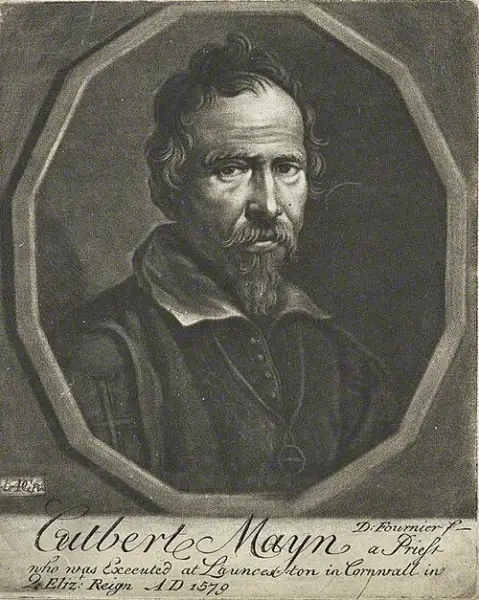
Launceston, the town of his death, remains the heart of his cult. A gallows had been erected in its marketplace for his execution, and in time the town adopted him as patron. Memorials are numerous there, and in 1977 the Roman Catholic church on St Stephen's Hill, known until then as the Church of the English Martyrs, took the name Church of St Cuthbert Mayne; it houses the National Shrine to the saint. Since 1921 an annual pilgrimage has been kept at Launceston each June. Schools bear his name, among them the voluntary aided Roman Catholic and Church of England school in Torquay and a Catholic junior school in Hemel Hempstead. Artists have kept his image before the faithful: Daniel Fournier engraved his mezzotint, Ushaw College holds paintings of him, and stained-glass windows depict him at Ushaw College's Chapel of St Cuthbert, at Our Lady Star of the Sea in Falmouth, at St Saviour's in Lewisham, at St Mary of the Angels in Bayswater, at St Edmund's College, Ware, and at Our Lady of Lourdes in Harpenden. Historians have also placed his condemnation in its political setting, seeing in it local Protestant-Catholic rivalries and a government eager to magnify the threat of papal agents so as to justify harsher legislation against English Catholicism.
§ Legacy
Timeline
- 20 Mar 1544
Baptised at the Church of St Peter, Shirwell, on a date that fell on St Cuthbert's feast.
§ Early life
- Dec 1561
Instituted rector of the parish of Huntshaw, before his university studies.
§ Early life
- 6 Apr 1566
Awarded his B.A. at Oxford, having studied at St Alban Hall and then St John's College.
§ Early life
- 1570
A letter from Gregory Martin urging him to Douai was intercepted; warned by Thomas Ford, he evaded arrest.
§ Catholic conversion
- 8 Apr 1570
Took his M.A. degree at Oxford, where he had met Edmund Campion and other Catholics.
§ Early life
- 1573
Travelled by way of Cornwall to the English College, Douai.
§ Catholic conversion
- 1575
Ordained a priest of the Roman Catholic Church at Douai.
§ Catholic conversion
- 7 Feb 1576
Obtained the degree of Bachelor of Theology of Douai University.
§ Catholic conversion
- 24 Apr 1576
Left for the English mission with John Payne, soon joining Francis Tregian's household at Golden, Cornwall.
§ Catholic conversion
- 8 Jun 1577
Arrested when High Sheriff Richard Grenville raided Tregian's house and found an Agnus Dei around his neck.
§ Catholic conversion
- 23 Sep 1577
Convicted of high treason on five counts at the Launceston assizes, with Francis Tregian and eight laymen arraigned alongside him.
§ Imprisonment and trial
- 29 Nov 1577
Executed by hanging, drawing, and quartering in the marketplace at Launceston, after refusing to renounce his religion.
§ Execution
- 29 Dec 1886
Beatified equipollently by Pope Leo XIII by means of a decree.
§ Legacy
- 1921
An annual June pilgrimage in his memory was initiated at Launceston.
§ Legacy
- 25 Oct 1970
Canonised by Pope Paul VI as one of the Forty Martyrs of England and Wales.
§ Legacy
- 1977
The Roman Catholic church on St Stephen's Hill in Launceston was renamed the Church of St Cuthbert Mayne, the site of his National Shrine.
§ Legacy
In Their Own Words
Deo gratias
the queen neither ever was, nor is, nor ever shall be, the head of the church of England
The Record
- Major works
- Secret pastoral mission among the Catholic gentry of Cornwall from the household of Francis Tregian at Golden, Probus
- Patron of
- patron of Launceston, Cornwall
- Symbols
- noose around neck·crucifix·knife in chest·martyr's palm·holding a Bible
- Canonization
- Beatified 29 December 1886 by Pope Leo XIII; canonized 25 October 1970 by Pope Paul VI as one of the Forty Martyrs of England and Wales.
Prayer
Bibliography
Show 7 sources
- Wainewright, John. "Blessed Cuthbert Mayne." The Catholic Encyclopedia Vol. 10. New York: Robert Appleton Company, 1911.
- Foster, Joseph (1891). Alumni Oxonienses 1500-1714. University of Oxford. Retrieved 13 December 2017.
- Duffy, Patrick. "St. Cuthbert Mayne", Catholic Ireland
- Law, T. G. "Cuthbert Mayne and the Bull of Pius V." The English Historical Review. Vol. 1, No. 1, Jan. 1886
- Rowse, A. L., Tudor Cornwall, New York, 1969
- Anstruther, Godfrey. Seminary Priests, St Edmund's College, Ware, vol. 1, 1968, pp. 224–226.
- Allison, Christopher M. B. "Jamestown's Relics: Sacred Presence in the English New World." Conversations: An Online Journal of the Center for the Study of Material and Visual Cultures of Religion (2016). doi:10.22332/con.ess.2016.2
Profile text adapted from the Wikipedia article, licensed CC BY-SA 4.0.
Pray with this saint every day
Save St. Cuthbert Mayne to your favorites, read the full profile, and get feast-day reminders in the Saints app.
Get the Saints AppFree on the App Store for iPhone and iPad