
died 31 August 725·Feast August 31
St. Cuthburh
Queen of Northumbria, First Abbess of Wimborne
Overview
Cuthburh, also called Cuthburg or Cuthburga, died on 31 August 725 and was the first abbess of Wimborne Minster. Born a princess of the House of Wessex, daughter of Cenred, she was sister to King Ine of Wessex and to Ingeld, an ancestor of Alfred the Great, and also to the saintly Cwenburh. Her marriage to Aldfrith, king of Northumbria, bound two of the most powerful Anglo-Saxon kingdoms together, and she is the only wife recorded for him. Their children included Osred, who later ruled Northumbria, and perhaps a daughter, Osana, herself afterwards venerated as a saint. Before Aldfrith died in 705 — so Florence of Worcester reported, writing long after these events — the royal couple renounced their married life for the love of God, and Cuthburh entered the nunnery at Barking under Abbess Hildelith. After Aldfrith died around 705, she and her sister Cwenburh established a double monastery at Wimborne in Dorset, in her brother's kingdom of Wessex. She is remembered as austere, governing the community so strictly that she communicated with prelates only through a little hatch in the nunnery wall. She died at Wimborne on 31 August 725 and is said to lie buried under the wall of the chancel.
The Complete Life
A Princess of the House of Wessex
Cuthburh was born into the royal house of Wessex, the daughter of Cenred of Wessex. Her family placed her at the very centre of Anglo-Saxon politics. Her brother Ine became one of the most powerful rulers in England, her brother Ingeld was an ancestor of Alfred the Great, and her sister Cwenburh would share her religious vocation. Her marriage to Aldfrith, king of Northumbria, was a dynastic alliance of the first importance, binding the Northumbrian king to her brother Ine and linking the two great kingdoms of the north and south. She is the only wife recorded for Aldfrith, and through her the lines of Wessex and Northumbria met: their son Osred would one day reign in Northumbria, a second son, Offa, may also have been hers though her maternity of him is uncertain, and the couple is thought to have had a daughter, Osana, who was herself later venerated as a saint. Cuthburh is traditionally associated with the woman named in the dedication of Aldhelm's treatise De virginitate, and it is thought that she was related to Aldhelm in some way, a connection that would have brought her into contact with the most learned churchman of her people.
§ Life
Renunciation and the Cloister at Barking
The turning of Cuthburh's life came, according to a report by the chronicler Florence of Worcester, written long after the events it describes, before Aldfrith died in 705. Husband and wife, the chronicler records, gave up their married intimacy for the love of God, dissolving their royal marriage not by political divorce but by mutual consecration. Following this decision, Cuthburh withdrew from the world and entered the nunnery at Barking, placing herself under Abbess Hildelith, one of the distinguished abbesses of that ancient East Saxon house. The move from a Northumbrian queen's court to a subject's place in a community of nuns was a descent the Gospels would recognise, and it set the pattern for the rest of her life. When Aldfrith died around 705, she did not return to power or to the marriage market of the Anglo-Saxon kingdoms. Instead, together with her sister Cwenburh, she turned her energies toward founding a religious house of her own, a double monastery established in her brother Ine's kingdom of Wessex at Wimborne in Dorset, where she would exercise as abbess the authority she had set aside as queen.
§ Life
Austerity Behind the Little Hatch
The sources preserve a striking sketch of Cuthburh's manner of governing her monastery: she is described as austere. So strict was her separation from the world that when bishops and other prelates came to Wimborne, she communicated with them through a little hatch in the nunnery, speaking to the highest churchmen of the land through an opening rather than face to face. This was not mere severity but a theology made visible, an insistence that the abbess of a community of virgins belonged to God alone, whatever the rank of her visitor. The austerity of her discipline left so deep an impression that it entered even the visionary literature of the Anglo-Saxon Church. Among the surviving letters of St Boniface there is preserved an anonymous story telling of a vision in which Abbess Cuthburh appeared in Hell, a strange and sobering testimony to how her severity was remembered, whether as warning or as the garbled echo of a terrible ascetic reputation. Whatever the truth of that vision, the historical abbess emerges as a woman of unflinching discipline, a queen who had renounced a throne and who ruled her Dorset community with the same absoluteness with which she had once renounced it.
§ Life
Death Beneath the Chancel Wall
Cuthburh died at Wimborne on 31 August 725, having governed the community she founded for roughly two decades. Tradition places her burial beneath the chancel wall of her own minster, a place of honour within the church her royal blood and renounced crown had built. There her remains became an object of devotion, and Wimborne Minster stood as her shrine through the centuries of Anglo-Saxon and medieval Christianity. Her cult endured at least until the violence of the sixteenth century. In 1538, with Wimborne Minster in need of repair, the church's guardians petitioned Thomas Cromwell for leave to melt down the silver reliquary holding Cuthburh's head. A few years later the tower of the church collapsed, and it has been guessed that royal officials seized the reliquary for the King in the general spoliation; what then became of her head itself, the record does not say. Thus even the relics of this tough-minded princess-abbess were scattered by the Reformation, though the minster at Wimborne still bears her memory and her name in its dedication to Saint Cuthberga.
§ Life
Memory at Wimborne
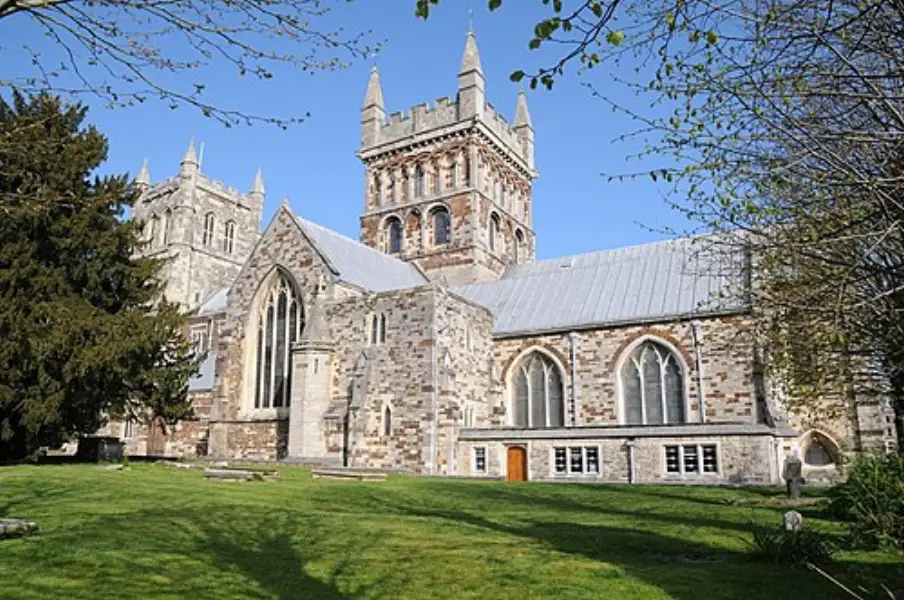
Cuthburh's most durable monument is the community she and her sister planted at Wimborne, which grew from a double monastery in the kingdom of Wessex into the minster whose collegiate church still dominates the Dorset town. Her feast day, 31 August, the date of her death, has been kept in her memory through the centuries, and she is venerated in the Catholic Church, the Anglican Communion, and the Eastern Orthodox Church. Her family multiplied her spiritual legacy: her sister Cwenburh was remembered as a saint alongside her, her daughter Osana received veneration in her turn, and the line of Wessex to which she belonged produced a long succession of royal saints. Scholars have continued to find her interesting: the medievalists who compiled the Blackwell Encyclopedia of Anglo-Saxon England recorded her, Mary Dockray-Miller discussed her in a study of Anglo-Saxon motherhood and mothering, and the standard dictionaries of saints keep her entry brief but secure. Few women of the eighth century left a clearer trace: a queen who renounced her marriage, a foundress who ruled behind a hatch, and an abbess whose severity was remembered, for better or worse, in the letters of Boniface himself.
§ Life
Timeline
- 705
Before Aldfrith's death in 705, she and the king renounced their married life for the love of God, as Florence of Worcester later recorded.
§ Life
- 705
Entered the nunnery at Barking under Abbess Hildelith after leaving the Northumbrian court.
§ Life
- 705
After Aldfrith's death, founded a double monastery at Wimborne in Dorset together with her sister Cwenburh.
§ Life
- 31 Aug 725
Died at Wimborne on 31 August; tradition places her burial beneath the chancel wall.
§ Life
- 1538
Wimborne's guardians petitioned Thomas Cromwell for leave to melt down the silver reliquary holding Cuthburh's head.
§ Life
The Record
- Major works
- Foundation of the double monastery at Wimborne, Dorset, with her sister Cwenburh
- Canonization
- Pre-congregation canonization; venerated as a saint from early Anglo-Saxon times, with her shrine at Wimborne Minster.
Prayer
Bibliography
Show 6 sources
- Farmer, D. H. (1987). The Oxford Dictionary of Saints, p. 96. Oxford: Clarendon Press.
- Lapidge, Michael; Blair, John; Keynes, Simon; Scragg, Donald, eds. (1999). "Cuthburg". The Blackwell Encyclopedia of Anglo-Saxon England. Oxford: Blackwell Publishing. p. 135. ISBN 0-631-22492-0.
- Mayo, C.H. (1860). History of Wimborne Minster: The Collegiate Church of Saint Cuthberga and King's Free Chapel at Wimborne, (pp. 4–6). London: Bell and Daldy.
- Kirby, D. P. The Earliest English Kings. London: Unwin Hyman, 1991. ISBN 0-04-445691-3, p. 145.
- Dockray-Miller, Mary. Motherhood and Mothering in Anglo-Saxon England, Springer, 2000, ISBN 9780312299637, p. 29.
- Bonifacius, Ephraim Emerton, and Austin P. Evans. The Letters of Saint Boniface. New York: Columbia University Press, 1940. P. 190.
Profile text adapted from the Wikipedia article, licensed CC BY-SA 4.0.
Pray with this saint every day
Save St. Cuthburh to your favorites, read the full profile, and get feast-day reminders in the Saints app.
Get the Saints AppFree on the App Store for iPhone and iPad