
c. 681 – 8th century·Feast February 8
St. Cuthmann of Steyning
Shepherd and Church-Builder of Sussex
Overview
Cuthmann of Steyning, also spelt Cuthman, lived as a hermit and builder of churches in Anglo-Saxon Sussex, remembered chiefly through the medieval biography preserved at the Abbey of Fécamp in Normandy and printed in the Bollandist Acta Sanctorum. According to his legend he was born around 681, probably at Chidham near Bosham, though some traditions claim Devon or Cornwall. He was a shepherd who, after his father's death, cared for his paralysed mother in poverty, the pair begging from house to house. He devised a one-wheeled cart in which to carry her, setting out eastwards towards the rising sun and resolving that when the improvised withy-rope of his cart broke, he would take it as God's sign to stop and build a church. The rope broke at Steyning, and there he built the church that became St Andrew's, aided by the local people and, as the story tells, by a mysterious stranger who fixed his roof-beam and named himself as the one in whose name the church was being built. The church existed by 858, when King Æthelwulf of Wessex, father of Alfred the Great, was buried there. Cuthmann was venerated at Steyning before the Norman Conquest, and the translation of his relics to Fécamp spread his cult across Normandy.
The Complete Life
Born Near the Apostle of Sussex
The biography of Cuthmann preserved at the Abbey of Fécamp in Normandy places his birth around 681 in Devon or Cornwall, holding instead for Chidham near Bosham, a village some twenty-five miles from Steyning where his life's work would be done. The Chidham tradition has attracted attention because of its timing. A boy born at Chidham at that date would have been in exactly the right place at the right time to hear the preaching of St Wilfrid, the Apostle of Sussex, whose evangelisation of the South Saxon kingdom ran from 680 to 685; it has accordingly been speculated that Wilfrid was the very man who brought Cuthmann and his mother and father to baptism, though some authorities prefer a later date for the saint. What is certain of his boyhood is its hardship. His legend tells that he was a shepherd, and that when his father died he was left to care for his paralysed mother. When the family fell on hard times and was forced to beg from door to door, the young shepherd invented a solution of both devotion and engineering: a one-wheeled cart, or wheelbarrow, its rope running from the handles up across his shoulders to bear part of his mother's weight, in which he moved her about with him wherever he went.
§ Birth
East Towards the Rising Sun
Cuthmann's journey began in necessity and became a pilgrimage. Impoverished after his father's death, he placed his paralysed mother in the cart he had built and set out from his home, travelling eastwards towards the rising sun. The rope of the cart broke along the way, and he improvised a fresh one from withies, pliable green shoots twisted into a cord, deciding at the same moment on a rule for his whole future: when this new rope broke, he would accept the breaking as a sign from God that he had reached the place where he should stop and build a church. The withy rope duly snapped at the spot now called Steyning. There the wandering shepherd knelt and prayed to the Father Almighty, acknowledging that his wanderings had been brought to an end and asking that the work now beginning might be carried through, confessing his own lack of skill and asking God, who had given him the desire to be a builder, to make up for what he lacked and bring the building of the holy house to completion. After first raising a hut to shelter his mother and himself, he set about the work that would make Steyning famous.
§ Travels to Steyning
Building the Church at Steyning
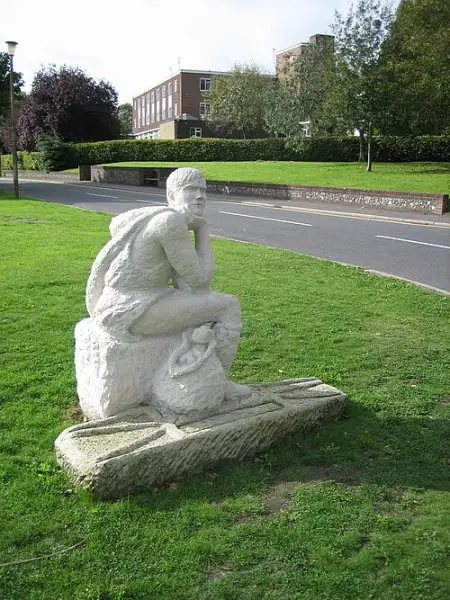
At Steyning, with help from the local people, Cuthmann built the church that stands at the origin of the present St Andrew's. The church was in existence by 858 at the latest, for according to the Annals of St Neots that was the year Æthelwulf, King of Wessex and father of Alfred the Great, chose to be buried there, a mark of the house's early royal standing. The legend of its building closes with an encounter of unmistakable meaning. As the church was nearing completion, Cuthmann struggled with a difficult roof-beam, and a stranger demonstrated the remedy. Asked his helper's name, Cuthmann heard the reply that he was the one in whose name the church was rising, words understood of Christ himself and of the dedication to St Andrew. In the twentieth century the church instituted a chapel in Cuthmann's honour within its walls, and after a long interval the parish successfully sought to restore his name to the building, which is now dedicated to St Andrew and St Cuthman, the apostle given precedence but the shepherd-builder reincluded after centuries of omission. A statue by Penny Reeve looks from the churchyard across the road towards the church he built.
§ Travels to Steyning
Legends of the Holy Shepherd
The stories that gathered around Cuthmann reveal how his neighbours understood his holiness: as a sanctity attached to the ordinary work of a shepherd and the landscape of Sussex. One tradition relates that while he was minding sheep he drew a line around his flock with his staff so that he could go off to collect food, and on his return found the sheep had not crossed the invisible boundary. The miracle was localised in a Chidham field that was known for centuries afterwards as St Cuthman's Field or St Cuthman's Dell, where a large stone on which the holy shepherd was accustomed to sit was credited with miraculous properties. Another legend places him at the centre of Sussex geography itself: the Devil, enraged at the conversion of England through apostles like Cuthmann, resolved to dig a channel by night and let in the sea to drown the Christians of the county. Cuthmann discovered the plan and outwitted him, setting a candle behind a sieve and toppling the neighbourhood cock from its perch; seeing the light and hearing the cock crow, the Devil fled, leaving unfinished earthworks that explained Chanctonbury Ring and the Devil's Dyke. Humble labour, protective care, and the defeat of evil: these were the qualities the legends enshrined.
§ Other legends
From Local Cult to Normandy
Cuthmann belongs to the age of pre-congregation sanctity: he was honoured as a saint around Steyning before the Norman Conquest, revered in the church he had himself raised. The turning point of his cult came when the Norman abbey of Fécamp acquired the Steyning church, by then dedicated to him, and translated his relics to Normandy in the wake of the Conquest. This translation carried his name across the Channel and made him well known on the continent, so that his feast was kept in numerous Norman religious houses. The evidence of that continental fame is still visible: a German engraving of around 1450 by Martin Schongauer depicts him with his cart, and a carving on a choir seat in Ripon Cathedral, from within a few decades of that date, shows him with a three-wheeled wheelbarrow. His medieval Life was included, transcribed from an anonymous source, and printed among the saints' lives gathered in the Bollandist Acta Sanctorum of 1658, which fixed his feast day as 8 February, a date also observed in the Eastern Orthodox calendar. At his birthplace of Chidham a Guild of St Cuthman survived into the sixteenth century, recorded in a tax of 1522 under Henry VIII.
§ Veneration
The Boy with a Cart
Cuthmann's memory has shown remarkable persistence for a saint of whom so little is historically certain. Charters issued under William the Conqueror sometimes name Steyning St Cuthman's Port or St Cuthman's Parish, testimony to how thoroughly the town identified itself with him. Though the church he founded was for centuries rededicated to Andrew alone, moves begun in January 2007 within the parish succeeded in having it rededicated to St Andrew and St Cuthman, restoring the shepherd-builder to the dedication after the long interval since the medieval college's dissolution. The church keeps a Cuthmann chapel, stained-glass windows in the south aisle show him as shepherd and as builder, and Penny Reeve's modern statue stands outside looking towards the building; his wheelbarrow even survives as the logo on Steyning's town sign. Literature has claimed him too: in 1938 Christopher Fry wrote the play The Boy with a Cart, which in 1950 was staged at the Lyric Theatre in Hammersmith under John Gielgud's direction with the young Richard Burton playing Cuthman, and which praised the joint labour of man and God, root and sky together, in the story of the trudging shepherd. Windows and images of him also survive further afield, including at St Swithun's Church, East Grinstead.
§ Veneration
Timeline
- 681
His Fecamp biography dates his birth to about this year, at Chidham near Bosham, though some traditions prefer Devon or Cornwall.
§ Birth
- 685
A Chidham birth in this period would fall within Wilfrid's Sussex mission of 680 to 685, making Wilfrid the probable baptiser of Cuthmann and his parents.
§ Birth
- 858
According to the Annals of St Neots, Aethelwulf, King of Wessex and father of Alfred the Great, was buried in his church at Steyning.
§ Travels to Steyning
- 1066
After the Norman Conquest, the Abbey of Fecamp acquired his Steyning church and carried his relics to Normandy, spreading his cult on the continent.
§ Veneration
- 1260
The college of secular canons administering the Steyning church was dissolved, and the church was rebuilt and rededicated to Saint Andrew.
§ Birth
- 1450
Martin Schongauer's German engraving of the saint with his cart, dated about this year, shows how far his cult had reached in Normandy's religious houses.
§ Veneration
- 1522
A Guild of St Cuthman at his birthplace of Chidham was subject to a tax under Henry VIII.
§ Veneration
- 1658
His Life was transcribed and printed in the Bollandist Acta Sanctorum, which records his feast day as 8 February.
§ Veneration
- 1938
Christopher Fry wrote his play about the saint, The Boy with a Cart.
§ Veneration
- 1950
Fry's play was staged at the Lyric Theatre in Hammersmith, directed by John Gielgud with Richard Burton playing Cuthman.
§ Veneration
- Jan 2007
Parish moves began to rededicate the Steyning church to St Andrew and St Cuthman, giving Andrew precedence while restoring Cuthman's name.
§ Veneration
In Their Own Words
Father Almighty, you have brought my wanderings to an end; now enable me to begin this work. For who am I, Lord, that I should build a house to name? If I rely on myself, it will be of no avail, but it is you who will assist me. You have given me the desire to be a builder; make up for my lack of skill, and bring the work of building this holy house to its completion.
I am he in whose name you are building this church.
The Record
- Major works
- Founding of the church at Steyning, now dedicated to St Andrew and St Cuthman
- Patron of
- patron of shepherds·patron of Steyning, West Sussex
- Symbols
- wheelbarrow
- Canonization
- Pre-congregation canonization; venerated as a saint in the Steyning area before the Norman Conquest.
Prayer
Bibliography
Show 5 sources
- Acta Sanctorum February volume II, Feb. 8th, p. 197-199 (in Latin)
- Smyth, Alfred P. (1995). King Alfred the Great. Oxford, UK: Oxford University Press. p. 674, n. 81. ISBN 0-19-822989-5.
- Stephens, G. R., W. D. Stephens, "Cuthman: A Neglected Saint", Speculum, Vol. 13, No. 4 (October, 1938), pp. 448–453
- Loomis, C. Grant, "The American Tall Tale and the Miraculous", California Folklore Quarterly, Vol. 4, No. 2 (April, 1945), page 119
- "Steyning parish church renamed". West Sussex Gazette. 29 January 2009. Retrieved 5 February 2016.
Profile text adapted from the Wikipedia article, licensed CC BY-SA 4.0.
Pray with this saint every day
Save St. Cuthmann of Steyning to your favorites, read the full profile, and get feast-day reminders in the Saints app.
Get the Saints AppFree on the App Store for iPhone and iPad