
8th century·Feast Not recorded
St. Cwenburh
Royal Sister of Wessex and Abbess of Wimborne
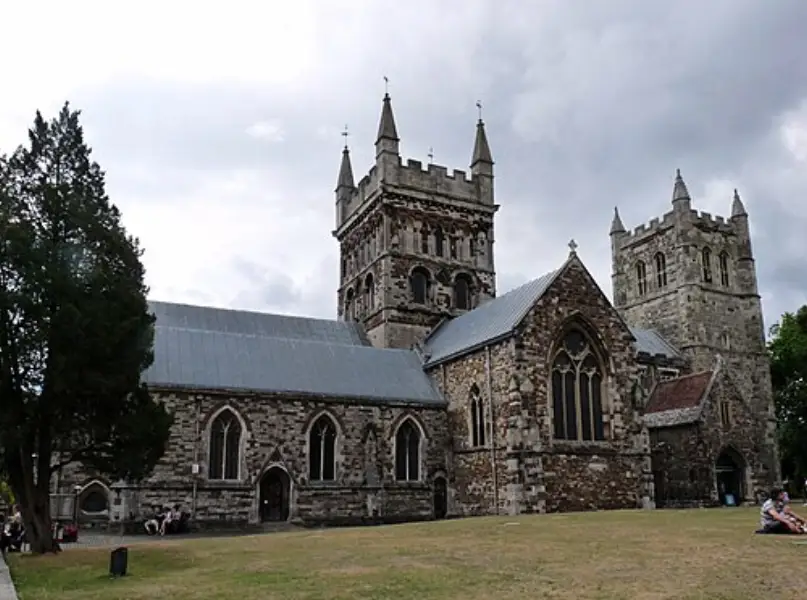
Overview
Cwenburh of Wimborne was an eighth-century Anglo-Saxon saint, a sister of King Ine of Wessex and of Saint Cuthburh, who served as Wimborne monastery's first abbess. Almost nothing about her survives. She is known primarily from a single annal of the Anglo-Saxon Chronicle, which records that in 718 Ingild, Ine's brother, died, and that Ine's sisters were Cwenburh and Cuthburh, the latter having founded the monastery at Wimborne and been given in marriage to Aldfrith, king of the Northumbrians, before the couple separated during his lifetime. Cwenburh also appears in one copy of the Chronicle's genealogical preface, named in the pedigree of the ninth-century King Æthelwulf of Wessex, father of Alfred the Great, as a daughter of Cenred. It is possible that she succeeded her sister Cuthburh as abbess of Wimborne after Cuthburh's death. Cwenburh is mentioned again in the Old English catalogue On the Resting-Places of the Saints, preserved in eleventh-century manuscripts, where one version appends her name after Saint Cuthburh at Wimborne Minster, though the scholar Felix Liebermann judged this addition to be later and the surrounding clause to refer to Cuthburh alone. The abbess Tetta is sometimes taken as another name for Cwenburh, or else reckoned a third sister.
The Complete Life
A Princess Whom the Chronicle Names
Cwenburh belonged to the royal house of Wessex at the turn of the seventh and eighth centuries. The genealogical preface to the Anglo-Saxon Chronicle, surviving in a single copy inside a pedigree constructed for the ninth-century King Æthelwulf of Wessex, the father of Alfred the Great, names her in the royal line: Eoppa son of Ingild, Ingild son of Cenred, Ine of Cenred, Cuthburh of Cenred, Cwenburh of Cenred, and Cenred son of Ceolwald. She was thus a sister of King Ine of Wessex, one of the most consequential of the early West Saxon kings, of Ingild, and of Saint Cuthburh, whose marriage to Aldfrith, king of the Northumbrians, briefly joined the two great houses of Wessex and Northumbria before the royal couple separated during Aldfrith's lifetime. Everything else about the family circle into which she was born reaches us through the same Chronicle: its annal for 718 records the death of her brother Ingild and, almost in the same breath, names the two sisters and recalls how Cuthburh raised the monastery at Wimborne. For a woman of the early eighth century, even this much survival is remarkable: a place in a royal pedigree reaching toward Alfred the Great, and a name joined with a saint's in the oldest records of the English people.
§ Cwenburh
Wimborne and the Question of the Abbess
Cwenburh's religious life, whatever its precise form, was bound to the monastery her sister founded. Cuthburh, after separating from Aldfrith, established the double monastery at Wimborne in Dorset and became its first abbess, and it is as Cwenburh of Wimborne that the sources know her sister's companion. The Dictionary of Saints records her under the latinised form Quenburga, and it is there suggested as a possibility that she succeeded Cuthburh as abbess of Wimborne after her sister's death, continuing the governance of the community her royal blood had founded. The identification is conjecture, but it is conjecture grounded in the pairing of the sisters' names in the tradition. A further puzzle surrounds the abbess Tetta, remembered in connection with the double monastery of Wimborne: Tetta is sometimes understood as a familiar form of Cwenburh's own name, or alternatively as a third daughter of the royal family. If Tetta and Cwenburh are one, the saintly abbess whom continental sources knew by another name was this otherwise silent Wessex princess; if they are two, then three daughters of Cenred gave themselves to God. Either way, the house at Wimborne stands at the centre of what can be known of her consecrated life.
§ Cwenburh
A Name at the Resting-Place of Saints
Cwenburh's afterlife in English memory rests on fragile but genuine testimony. One such witness, the Old English compilation On the Resting-Places of the Saints, survives in eleventh-century manuscripts; there the text declares that Saint Cuthburh rests at Wimborne Minster, the woman who first set the monastery's still-observed discipline and manner of life. A single version of that compilation appends the words and Cwenburh after the mention of Cuthburh, which would make the list the clearest surviving witness to her veneration as a saint in her own right. The nineteenth-century scholar Felix Liebermann, who edited the text in 1889, judged the added words to be a later interpolation, noting that the following clause remains grammatically singular and refers only to Saint Cuthburh. His caution has not wholly dissolved her claim: the insertion shows that some medieval scribe, copying the catalogue of holy resting places, believed Cwenburh belonged there beside her sister at Wimborne. Modern reference works have kept her in the calendar of the saints, recording her briefly under the name Quenburga. Her story is a reminder that the Church's memory holds not only the great founders but also the sisters, successors, and unnamed faithful whose silence in the sources is not silence in heaven.
§ Cwenburh
In Their Own Words
718. In this year Ingild Ine's brother died, and their sisters were Cwenburh and Cuthburh. And Cuthburh raised the monastery at Wimborne; and she was given to Aldfrith , king of the Northumbrians; but they separated during his life.
resteth Saint Cuthburh at Wimborne Minster, that first established the life and customs that are still kept in the monastery
The Record
- Canonization
- Pre-congregation canonization; commemorated in the Old English list On the Resting-Places of the Saints preserved in 11th-century manuscripts.
Prayer
Bibliography
Show 4 sources
- Farmer, David Hugh (2011), The Oxford Dictionary of Saints, 5th Edition (revised), p. 373, as Quenburga
- Liebermann, Felix (1889), Die Heiligen Englands: Angelsächsisch und Lateinisch, p. 19
- Dunbar, Agnes Baillie Cunninghame. "St. Tetta", A Dictionary of Saintly Women, Vol. 2, Bell, 1905, p. 241
- Brownlow, Canon. "The Brother and Sister and Saint Willibald", Report and Transactions - The Devonshire Association for the Advancement of Science, Literature and Art, Vol. 23, 1891, p. 232
Profile text adapted from the Wikipedia article, licensed CC BY-SA 4.0.
Pray with this saint every day
Save St. Cwenburh to your favorites, read the full profile, and get feast-day reminders in the Saints app.
Get the Saints AppFree on the App Store for iPhone and iPad