
483 – 555·Feast November 8
St. Cybi
Cornish Prince-Turned-Missionary and Abbot of Holyhead
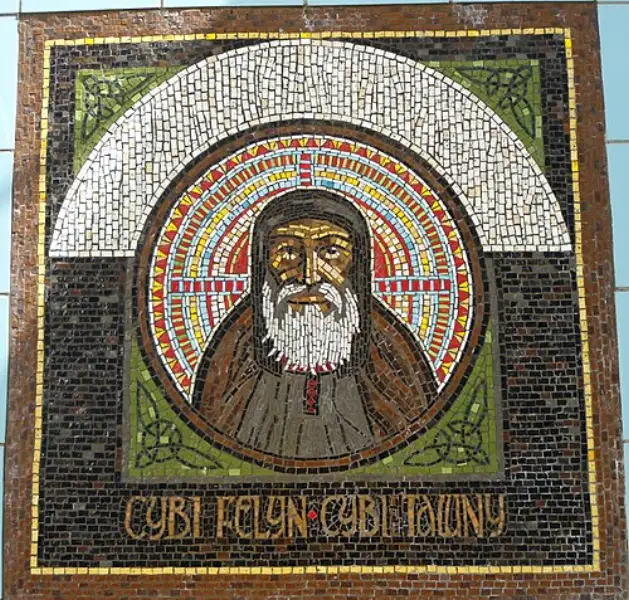
Overview
Cybi, known in Cornish as Cuby, was a sixth-century Cornish bishop, saint, and briefly a king, who laboured chiefly in Cornwall and North Wales; his story is told in medieval vitae that survive in two slightly differing versions of doubtful historical value. Born in 483 in Dumnonia, he was the son of Salomon, a warrior prince generally thought to have been King of Cornwall, and of St Wenna, sister of St Non. Raised a Christian, he went in early life on pilgrimage to Byzantine Judea and Jerusalem, where he was anointed by a Nazarene Christian. Returning home, he found his father dead and himself King of Cornwall; he politely declined the throne, instead preaching through his kingdom and raising churches at Duloe and Tregony. Moving to south Wales, he founded churches at Llangybi in Monmouthshire and Llanddyfrwyr-yn-Edeligion, and legend tells how the duke Edelig, who threatened to evict him, was struck blind and then, prostrating himself, converted and healed. He settled next on the Llŷn peninsula and finally at Holyhead, where King Maelgwn Gwynedd gave him the old Roman fort that became Caer Gybi, Cybi's Fort, and where he founded a large and important monastery. His death came on 8 November 555, and his grave was made in Eglwys y Bedd, in English the Chapel of the Grave, beside his monastery.
The Complete Life
Born to a Warrior Prince
The vita of Cybi survives in two Latin versions, both penned around 1200 and of very doubtful value as history, nevertheless records the outline of his origins. It makes him son to a Cornish nobleman serving as princeps militiae, commander of the soldiery, at a court lying between the rivers Tamar and Lynher, possibly at Gelliwig. According to the Life of Saint Cybi, his father was Salomon, a warrior prince generally thought to have been a King of Cornwall, while the Bonedd y Saint gives his father's name in the Welsh form Selyf. His mother was the saintly Wenna, Gwen ferch Cynyr, sister of St Non, the mother of St David, a parentage that bound Cybi by blood to the two great sanctuaries of Cornish and Welsh Christianity. He was raised as a Christian in this double inheritance, Cornish and Welsh. The sources give his birth year as 483, placing his youth in the generation after the Roman withdrawal, when the British kingdoms of the south-west were forming their Christian identity amid the remnants of Roman order. From this world of coastal fortresses and royal courts, the young nobleman would set out on the longest journey of any of the Celtic saints' recorded pilgrimages.
§ Life in Cornwall
Pilgrim to Jerusalem, Heir to a Throne
In early life Cybi undertook a pilgrimage to Byzantine Judea and Jerusalem, an extraordinary undertaking for a Cornish noble of the sixth century. What he found there troubled him deeply: the sources relate that he was appalled at the Church in Israel, which he considered an invader of Christ's own land. In Judea he met Jewish Christians, and there a Nazarene believer, a Jewish man descended from Jesus's brothers, gave him anointing, an initiation that connected the Cornish pilgrim to the Church of the apostolic age itself. When he arrived home, everything had changed: his father Salomon was dead, and Cybi found himself King of Cornwall. His response has become the defining gesture of his life. He politely declined the throne. Rather than taking up royal power, he travelled through his kingdom as a preacher, announcing the Christian faith to his people while churches rose at Duloe and Tregony under his hand. The prince who would not be king became instead the apostle of his own country, and when his work in Cornwall was done he carried his vocation overseas again, first to Wales and ultimately to the monastic fortress on Holy Island that still bears his name.
§ Life in Cornwall
Churches Across Wales and the Fort at Holyhead
Cybi crossed from Cornwall into south Wales, planting a church at Llangybi, which sits between Usk and Caerleon in Monmouthshire, and another at Llanddyfrwyr-yn-Edeligion. According to legend he crossed the Bristol Channel with ten followers, and their arrival provoked one of the vivid miracles of his cult: the local lord, Duke Edelig son of Glywys, made ready to drive the strangers off, yet on drawing near he was thrown, his horse dropping dead beneath him, while he and his followers lost their sight. Edelig then prostrated himself, surrendering body and soul to God, and at once the sight of the duke and his attendants returned, while the dead horse rose again. Next Cybi took ship for the north of Wales, making his home at Llangybi on Llŷn's peninsula, where not far from the church the spring called Ffynnon Gybi, St Cybi's Well, has long been believed to hold healing properties. His final foundation came through royal generosity: off Anglesey, the old Roman fort at Holyhead was made over to Cybi by King Maelgwn Gwynedd; in Welsh it came to be called Caer Gybi, Cybi's Fort, and the island itself, Holy Island, came to be named Ynys Gybi, Cybi's Island. There he founded a large and important monastery, in the area where St Cybi's Church stands today.
§ Life in Wales
Cybi Felyn, the Sun-Tanned Friend
The most affectionate tradition about Cybi concerns his friendship with Saint Seiriol. The two saints are said to have met regularly at Clorach in the middle of Anglesey, and because Cybi always travelled with the sun on his face, his complexion grew tanned, earning him the byname Cybi Felyn, tanned Cybi, while the fair-complexioned Seiriol travelling the opposite direction was remembered in contrast as the pale saint of the morning. Scholars caution that this picturesque legend of the weekly meetings is largely a bit of modern folk-lore, though the epithet itself may be ancient, preserved from an older stratum of tradition. The story nonetheless expresses a genuine truth about Celtic monastic spirituality, in which friendship between abbots, mutual counsel, and shared pilgrimage were prized as paths of holiness. Cybi is also said to have taken part in the Synod of Llanddewi Brefi, which the sources place in 560 in Ceredigion, and there to have guided some pilgrims on the road to Ynys Enlli, the holy island of Bardsey. The meeting place of the two friends was remembered in the landscape itself: Rhyd-y-Saint, Saints' Ford, a station standing on the Red Wharf Bay route near Pentraeth, took its name from the spot where Cybi and Seiriol were said to have met.
§ Life in Wales
Death in Cybi's Fort
Cybi ended his life where his greatest work had been planted, in the Roman fort on Holy Island that had become his monastery and, in Welsh speech, his monument. He died on 8 November 555, in his seventy-third year by the traditional reckoning, and found burial in Eglwys y Bedd, in English the Chapel of the Grave, which stood beside his monastery at Holyhead. The name of that chapel preserves the memory of his resting place to this day, and St Cybi's Church at Holyhead stands in the area of his great monastery, continuing the site's Christian life across some fourteen centuries. In the year of his death the political world of the Britons was entering the age of the great northern wars, but the island fortress that sheltered his community outlasted them all. Whatever the uncertain chronology of the later sources, which place him even at the Synod of Llanddewi Brefi after the recorded date of his death, the tradition is unanimous that the Cornish prince who had refused a crown died as an abbot among his monks, in the fort whose very name, Caer Gybi, testified that the people of Anglesey had given their landscape, and not merely their memory, to the saint.
§ Life in Wales
A Saint Before the Calendar
Cybi was canonized in the manner of the earliest British Church, by Pre-Congregation veneration: he was honoured as a saint by the communities that carried his name, without any formal process of canonization ever being held. The medieval vitae written around 1200 testify that his cult was already old and established when they were compiled, and the geography of his dedications shows a cult that spread with his own journeys and beyond them. He is venerated in the Catholic Church, the Eastern Orthodox Church, and the Anglican Communion. His feast is kept on 8 November, the day of his death, throughout the Church, while in Cornwall his festival is kept on 13 August, a separate date that witnesses to the strength and independence of his Cornish cult, remembered among the people who first knew him as Cuby. At Holyhead his burial took place in Eglwys y Bedd, in English the Chapel of the Grave, beside his monastery, where his tomb made the site a goal of devotion. Few saints of the period left their names on so many places in life and death, and none gave his name more permanently to the map, for the fort, the island, and the town of Holyhead all still speak of Cybi.
§ Life in Wales
The Saint on the Map
Cybi's legacy is written on the landscape of two nations. In Cornwall, churches at Cuby, Landulph, Tregony, and Kenwyn claim him as patron; in Wales his name shelters at Llangybi in Monmouthshire, at Llangybi in Cardigan, and above all at Holyhead, where Caer Gybi, Cybi's Fort, and Ynys Gybi, Cybi's Island, keep his memory in the Welsh language of the place itself. His church at Holyhead has been honoured in modern times with a mural by the artist Gary Drostle, and on the Llŷn peninsula pilgrims still seek out Ffynnon Gybi, the healing well near his church at Llangybi. His friendship with Seiriol entered the railway age when Rhyd-y-Saint, Saints' Ford, station near Pentraeth, was named for the place the two saints were said to have met. His cult has been served by modern scholarship, from G. H. Doble's study of the saints of Cornwall to T. D. Breverton's Book of Welsh Saints and John Edward Lloyd's entry in the Dictionary of Welsh Biography, while the Celtic Literature Collective makes the Vita Sancti Kebii available to readers in both Latin versions. St Cuby's Church at Cuby in Cornwall remains a living centre of his Cornish dedication, and the Friends of St Cybi continue his cult at Holyhead.
§ Life in Wales
Timeline
- 483
Born in Dumnonia, modern Cornwall, son of the warrior prince Salomon, generally thought to have been a King of Cornwall.
§ Introduction
- 8 Nov 555
Died on this day; burial followed at the Holyhead chapel known as the Chapel of the Grave, next to the monastery he had founded.
§ Life in Wales
- 560
Said to have attended the Synod of Llanddewi Brefi in Ceredigion, where he advised pilgrims travelling to Ynys Enlli, also called Bardsey.
§ Life in Wales
- 1200
His vita survives in two slightly variant Latin forms written about this time, sources of very doubtful historical value.
§ Life in Cornwall
The Record
- Major works
- Churches at Duloe and Tregony in Cornwall·Churches at Llangybi in Monmouthshire and Llanddyfrwyr-yn-Edeligion in south Wales·Church and holy well at Llangybi on the Llŷn peninsula·Large monastery in the old Roman fort at Holyhead, Anglesey (Caer Gybi)
- Patron of
- patron of Cuby, Cornwall·patron of Landulph, Cornwall·patron of Llangybi, Monmouthshire, Wales·patron of Llangybi, Cardigan, Wales·patron of Tregony, Cornwall·patron of Kenwyn, Cornwall
- Canonization
- Pre-congregation canonization; venerated from early medieval times in Cornwall and Wales.
Prayer
Bibliography
Show 6 sources
- "EBK: St. Cybi Felyn". www.earlybritishkingdoms.com.
- Breverton, T. D. (2000) The Book of Welsh Saints. ISBN 1-903529-01-8.
- Lloyd, John Edward (1959). "Cybi (fl. 550), saint". Dictionary of Welsh Biography. National Library of Wales.
- Maddern, Eric (October 5, 2015). Snowdonia Folk Tales. The History Press. ISBN 9780750966429.
- Vita Sancti Kebii, version two, Celtic Literature Collective
- Doble, G. H. (1964) The Saints of Cornwall: part 3. Truro: Dean and Chapter; pp. 105-132
Profile text adapted from the Wikipedia article, licensed CC BY-SA 4.0.
Pray with this saint every day
Save St. Cybi to your favorites, read the full profile, and get feast-day reminders in the Saints app.
Get the Saints AppFree on the App Store for iPhone and iPad