
7th century·Feast November 7
St. Cynfarwy
Seventh-Century Saint of Anglesey in North Wales
Overview
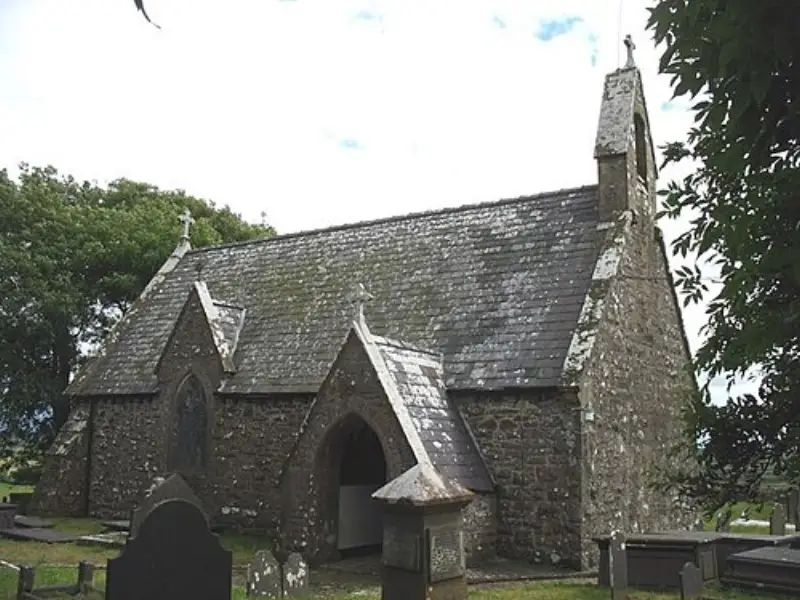
Cynfarwy was a Christian of the seventh century about whom very little is known for certain, yet whom the early Welsh church honoured as a saint, though he never went through any formal canonisation. The Bonedd y Saint — a compilation of the saints' pedigrees, put together in the late eighteenth century from older manuscripts — gives no dates of birth or death for him, but makes him the son of Awy ab Llehenog, a lord of Cornwall otherwise unknown to history. The Celtic scholar Robert Williams placed his activity in the seventh century. His lasting memorial is on Anglesey, where St Cynfarwy's Church at Llechgynfarwy is dedicated to him; as the historian Angharad Llwyd records, Cynfarwy himself founded the first church there around 630. A standing stone more than nine feet high, Maen Llechgynfarwy, survived in the field beside the church into the nineteenth century, and the settlement around the church still carries his name. His feast day falls in November, though antiquarian sources disagree over the date, some giving the tenth or eleventh of the month and others, like Llwyd, the seventh.
The Complete Life
A Shadowy Figure of the Seventh Century
Little can be stated with confidence about Cynfarwy's life. No dates of birth or death survive for him in the Bonedd y Saint — the collection of the saints' pedigrees, put together in the late eighteenth century from older manuscripts, and the principal early witness to his family. That source supplies a single genealogical fact: he was the son of Awy ab Llehenog, described as Lord of Cornwall, a figure otherwise unknown. If the pedigree is correct, Cynfarwy belonged to the southwestern British aristocracy from which several saints of Wales are said to have come, a class of families whose sons and daughters supplied the early Church with its founders and bishops. The nineteenth-century Celtic scholar Robert Williams concluded that Cynfarwy was active in the seventh century, and on that basis he is counted among the saints of the age when Christianity, long planted in Wales, was consolidating its network of local churches. Like nearly every figure of this generation, he left no writings, no dated acts and no surviving contemporary notice — only a name carried by a church. A saint so thinly recorded cannot be drawn in detail; what can be said is the shape the tradition gives him, and the evidence — manuscript genealogy, antiquarian dictionaries and a living church — on which even that shape rests.
§ Life and commemoration
A Church in Anglesey
Cynfarwy's one recorded work is the foundation of a church. St Cynfarwy's Church at Llechgynfarwy, in the Anglesey countryside some ten miles from the port of Holyhead, is dedicated to him as its patron, and the historian Angharad Llwyd, writing in 1833, dates that first church to about 630. The church that stands today is mainly a nineteenth-century building and holds Grade II listed status, but it preserves some medieval fabric and a twelfth-century font — reminders that worship on the site reaches back through the Middle Ages toward the saint's own time. A dedication of this kind is the standard memoriam of the early Welsh Church: a holy man settles, prays, gathers a community, and the place takes his name. Llechgynfarwy, sometimes written Llechcynfarwy, joins a word for stone or slate to the saint's mutated name, so that the settlement itself proclaims his patronage. Whatever else Cynfarwy did has been forgotten; the church remains as evidence that his contemporaries judged his life worth remembering, and the dedication has outlasted every rebuilding, keeping the saint's name pinned to this corner of the island's map.
§ Church and feast day
Stone, Name, and Feast
The memorials of Cynfarwy are of the humblest kind, and all the more durable for it. Until the nineteenth century a standing stone more than nine feet high rose in the field next to the church, known as Maen Llechgynfarwy — the stone of Llechgynfarwy — whose original purpose, whether marker, memorial or boundary of the saint's enclosure, can no longer be recovered. The settlement around the church keeps his name to this day. And the Church keeps his feast: antiquarian sources place it in November, though they disagree on the day, some manuscripts giving the tenth, some the eleventh, and Angharad Llwyd and others the seventh. As the historian Jane Cartwright observes, sanctity in Wales was a local affair, and Rome never formally canonised any of the medieval Welsh saints; Cynfarwy's title to veneration rests entirely on the devotion of the community that built his church and named their village after him. He belongs to the company of Anglesey saints — Caffo, Cwyllog, Eleth, Iestyn, Peulan, Tyfrydog — each remembered by a single church in the island's fields, a constellation of dedications that shows how thoroughly the early Christian generation covered even this one island with its memorials.
§ Church and feast day
Timeline
- 630
Establishes the first church at Llechgynfarwy in Anglesey, according to Angharad Llwyd
§ Church and feast day
- 650
Active as a Christian in seventh-century Wales, per the dating of Robert Williams
§ Life and commemoration
- 1780
The Bonedd y Saint, recording him as son of a lord of Cornwall, is compiled from older manuscripts
§ Life and commemoration
- Nov 1821
John Humffreys Parry publishes the genealogy of the saints in The Cambro-Briton
§ References
- 1833
Angharad Llwyd records the saint's church and feast in her History of the Island of Mona
§ Church and feast day
- 1852
Robert Williams's biographical dictionary of eminent Welshmen places Cynfarwy in the seventh century
§ References
- 1908
Baring-Gould's Lives of the British Saints records his cult and feast day
§ References
In Their Own Words
In Wales sanctity was locally conferred and none of the medieval Welsh saints appears to have been canonized by the Roman Catholic Church
The Record
- Patron of
- St Cynfarwy's Church, Llechgynfarwy, Anglesey
- Canonization
- Pre-congregation; venerated by the early church in Wales, never formally canonised
Prayer
Bibliography
Show 6 sources
- Parry, John Humffreys (November 1821). "Genealogy of the Saints". The Cambro-Briton. III. W. Simpkin and R. Marshall: 7–8.
- Baring-Gould, Sabine (1908). The lives of the British Saints: the Saints of Wales and Cornwall and such Irish Saints as have dedications in Britain. Vol. II. Honourable Society of Cymmrodorion. p. 243.
- Williams, Robert (1852). Enwogion Cymru: A biographical dictionary of eminent Welshmen, from the earliest times to the present. W. Rees. p. 95.
- Cartwright, Jane (Spring 2002). "Dead virgins: feminine sanctity in medieval Wales". Medium Aevum. 71 (1). The Society for the Study of Medieval Languages and Literature.
- Llwyd, Angharad (1833). A History of the Island of Mona. R. Jones. p. 301.
- Cadw (2009). "Church of St Cynfarwy". Historic Wales.
Profile text adapted from the Wikipedia article, licensed CC BY-SA 4.0.
Pray with this saint every day
Save St. Cynfarwy to your favorites, read the full profile, and get feast-day reminders in the Saints app.
Get the Saints AppFree on the App Store for iPhone and iPad