
6th century·Feast April 27
St. Cynidr
First Bishop of Glasbury in Powys
Overview
Cynidr was a sixth-century pre-congregational saint of South Wales, honoured by tradition as the first bishop of Glasbury in Powys. He belonged to the most celebrated saintly kindred in Welsh memory: the genealogists make him a son of St Gwladys and a grandson of King Brychan, the royal patriarch whose many children and grandchildren were remembered as evangelisers and founders of churches. One of his sisters was St Eigon, venerated as patron at Llanigon, a village near Glasbury. Cynidr's own work centred on Glasbury, where he is said to have held the first episcopal seat and where he was buried. His grave made the town a place of devotion, and his feast was kept there on 27 April. Glasbury's medieval parish church — St Kenider in English usage — still commemorates his ministry, though the building now standing was raised around 1088. A holy well in the town, known as Cynidr's Well or Ffynnon Gynydd, is also attributed to him, and the village of Llangynidr preserves his name, its llan marking the church that bore it.
The Complete Life
Son of Gwladys, Grandson of Brychan
Cynidr belonged by birth to the most prolific holy family in the Welsh tradition. His mother was St Gwladys, herself a saint of the first rank, and through her the genealogists counted him a grandson of King Brychan of Brycheiniog, the fifth-century ruler whose numerous offspring fill the early Welsh calendars as saints, founders and martyrs. The same genealogies give him a notable sister: St Eigon, venerated as patron of the church at Llanigon, close to Glasbury in the country where Cynidr himself laboured. Family trees of this kind were compiled in the Middle Ages to explain the dense web of church dedications spread across Wales; they answered the question every parish asked — whose church is this, and whose prayers guard it? — by tracing each founder back to a royal Christian house. In Cynidr's case the line ran from Glasbury to the court of Brychan, binding one parish saint to the kindred from which so much of the evangelisation of Wales was said to spring. The sources that carry the pedigree are themselves worth noting: the compilers of the Lives of the British Saints and, in our own day, T. D. Breverton's handbook of Welsh saints both record the family, showing that the genealogy was still being taken seriously many centuries after Cynidr's time.
§ Family
First Bishop of Glasbury
The tradition that carried Cynidr's name made him a bishop, and specifically the first bishop of Glasbury in Powys, in the sixth century. Glasbury sits on the River Wye in the border country of south-east Wales, and its church became the centre of Cynidr's cult. Nothing is recorded of the manner of his appointment or the extent of his diocese; such details were already old when the medieval writers collected them. What the tradition preserves is the fact of episcopal ministry in an early and formative generation, when the faith was being organised into settled communities across the Welsh kingdoms. That Cynidr was buried at Glasbury, and that his feast was kept there on 27 April, suggests a saint whose working life and whose memory remained rooted in one see. His epithet in English sources, St Kenider, preserves the same name through centuries of use by people who may never have read a line of the genealogies but knew whose saint their church was. A bishop with no surviving acts is known almost entirely by such continuities — a see held, a grave kept, a date observed year after year in one small town on the Wye.
§ Veneration
Memory in Stone and Water
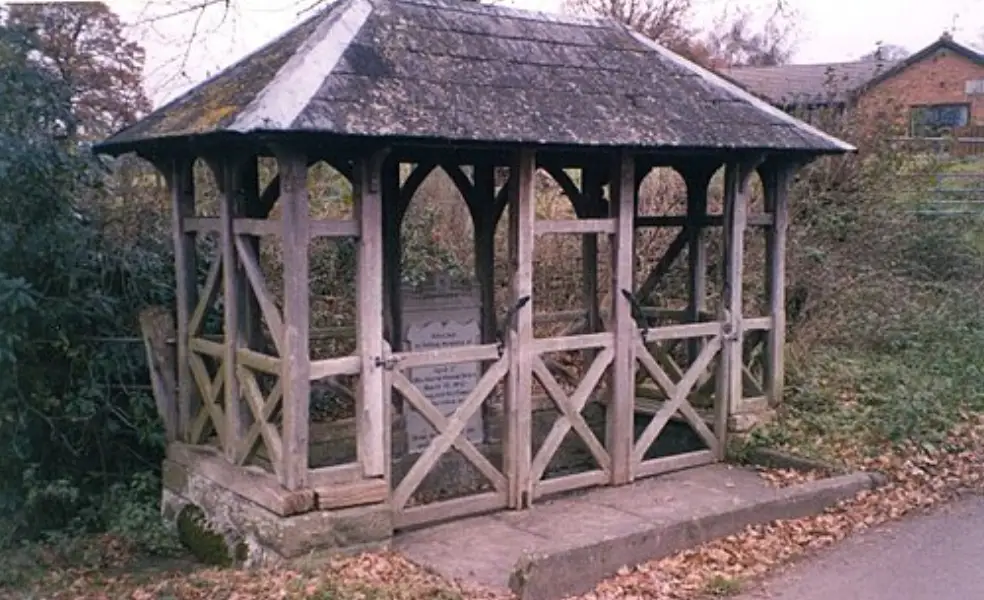
Cynidr's memory survived in the landscape as much as in books. The parish church of St Cynidr at Glasbury — St Kenider — commemorates his work, although the building now standing was constructed around 1088, on what its parishioners understood to be the site of his ministry. Beside the church ran another memorial of a different kind: a holy well in the town attributed to the saint, remembered as Cynidr's Well and in Welsh as Ffynnon Gynydd. Wells of this sort were places of local devotion, visited for prayer and for the needs of body and soul, and their dedication kept a founder's name alive when documents failed. Further down the valley of the Usk the village of Llangynidr still carries him in its name: llan, the Welsh word for church enclosure, joined to Gynidr, the mutated form of Cynidr. A bishop who left no writings and no dated acts is yet present in a church, a well, a village and a feast day — the ordinary and durable memorials of the early Welsh Church. Few figures of his generation can claim a longer reach through the place-names and parish life of one small region, and fewer still are remembered so locally and so constantly.
§ Veneration
Timeline
- 500
Born into the saintly kindred of St Gwladys and King Brychan in sixth-century South Wales
§ Family
- 500
Honoured by tradition as the first bishop of Glasbury in Powys
§ Introduction
- 1088
The present parish church of St Cynidr at Glasbury is constructed
§ Veneration
The Record
- Patron of
- Glasbury, Powys
- Canonization
- Pre-congregation; venerated as a saint of South Wales from the earliest times
Prayer
Bibliography
Show 4 sources
- Lives of the British Saints. Vol. 2, p. 258.
- Breverton, T. D. A Book of Welsh Saints. Cyhoeddiadau Glyndwr, 2000.
- Church at Llanigon.
- Baring-Gould, S. The Lives of the British Saints. Vol. 3.
Profile text adapted from the Wikipedia article, licensed CC BY-SA 4.0.
Pray with this saint every day
Save St. Cynidr to your favorites, read the full profile, and get feast-day reminders in the Saints app.
Get the Saints AppFree on the App Store for iPhone and iPad