
late 5th – 6th century·Feast July 17
St. Cynllo
Austere British Saint of Ceredigion and Powys
Overview
Cynllo was a British saint of the late fifth and early sixth centuries, generally described in the genealogies as a brother of the great St Teilo. The Bonedd y Saint makes him a son of Usyllt, while later genealogists counted him a grandson of the northern king Coel Hen, and his style Cynllo Vrenin, 'Cynllo the King', points to his holding the family lands before he entered the religious life. Wade-Evans identified him with Kentinlau, the companion who travelled with St Cadfan from Brittany to Ceredigion, and his birthplace is accordingly given as probably Brittany. He was remembered for the holiness of his daily life and the austere severity of his habits, and a Middle Welsh poem puts on the infant Taliesin's lips the promise that the prayer of Cynllo will never be in vain; knee marks said to have been pressed into rock by his devotions were shown near Llangoedmor. Churches across Gwerthrynion, Maelienydd and Ceredigion were dedicated to him, at Llangynllo, Nantcwnlle, Nantmel and Llangunllo among others, and his feast was settled on 17 July by the fifteenth century.
The Complete Life
Kindred of Kings and Saints
The genealogists disagree about Cynllo's parentage, but all of them place him in the highest company. The Bonedd y Saint, the medieval collection of the saints' pedigrees, describes him as a son of Usyllt and a brother of Teilo, himself among the greatest saints of Wales. Later genealogies promote a different ancestry, making him a grandson of Coel Hen, the legendary northern king remembered in the nursery rhyme as Old King Cole. Both lines serve the same purpose: to bind a local church saint into the royal and saintly houses from which the Welsh tradition believed its evangelisers came. Behind the pedigrees stands a cult spread across a wide, broken country of hills and coastal plain, which only a figure of real local weight could have gathered to himself. The epithet Cynllo Vrenin, Cynllo the King, preserved in the sources, suggests that he actually possessed his ancestral dominions before he devoted himself to the religious life — a prince who became a religious rather than a ruler. His birth is placed in the late fifth century, and his birthplace is given as probably Brittany, the Celtic land across the Channel whose churches and monasteries exchanged saints and scholars freely with Wales in this period.
§ Life
From Brittany to Ceredigion
One thread of the tradition ties Cynllo to the movement of saints between Brittany and western Wales. Wade-Evans judged him to be the Kentinlau whom tradition names as a companion of St Cadfan on the journey from Brittany into Ceredigion in the company of that saint. The identification is conjectural, but it fits the other evidence: a saint born, probably, in Brittany, dying in Wales, honoured along the Cardigan Bay coast and deep into the inland lordships of mid-Wales. The late fifth and early sixth centuries, to which his dates belong, were the age of the great Welsh monastic founders — Teilo, Cadfan, David, Illtud — and the genealogies make Cynllo Teilo's brother, planting him squarely in that company. The Dictionary of Welsh Biography, summarising the evidence, settles for saying only that he flourished around the middle of the sixth century, an honesty that matches the thinness of the record. Whatever the exact course of his life, the tradition agrees on the turn it took: away from the kingship his epithet implies and toward the ascetic religious life, in a country where royal kindreds routinely produced monks, hermits and bishops, and where the choice was neither unusual nor easily made.
§ Life
Churches Across Three Shires
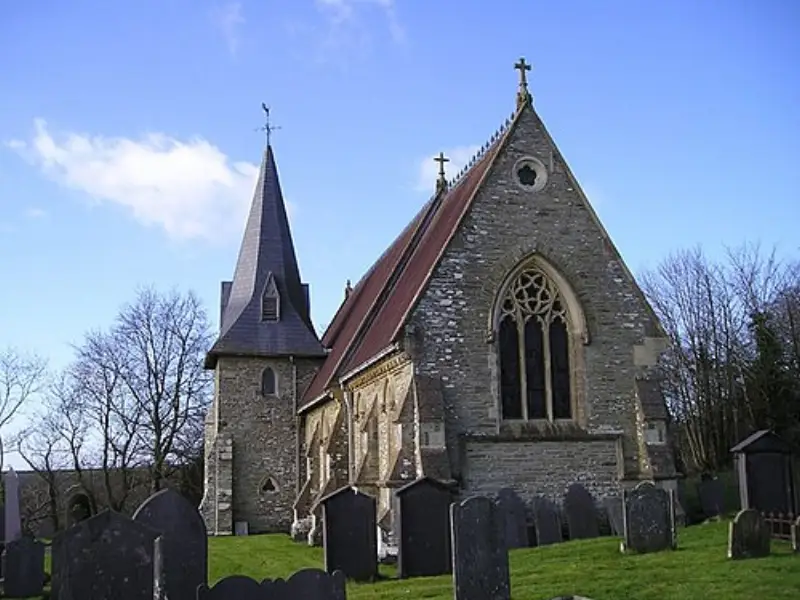
Cynllo's cult was unusually widespread. Several churches were dedicated in his honour, though no reliable account of his acts survives to explain the geography. Churches and chapels bore his name through nearly all of the two upland lordships, Gwerthrynion and Maelienydd, the upland lordships of what is now Powys, and on the Cardigan Bay coast: at Llangynllo in Ceredigion, believed to occupy the spot where his monastic cell once stood, and at Nantcwnlle nearby. Radnorshire had its own church of St Cynllo at Nantmel in his honour, and so did the church of St Cynllo at Llangynllo west of Knighton, a building almost totally rebuilt in the late eighteenth century. His popularity could outlast even conquest: when the Norman authorities rededicated the church at Rhayader to St Clement, the people went on keeping Cynllo's feast day there all the same. The pattern of dedication — a saint of the coast and the central Welsh hills, honoured over a broad swathe of country without a single great shrine — belongs to the earliest stratum of Welsh Christianity, when wandering ascetics founded cells that grew into parish churches.
§ Life
The Prayer That Is Not in Vain
Two memorials preserve the character the tradition gave Cynllo: a description and a stone. The older sources praise the holiness of his living and the severity of his discipline — a formula placing him among the ascetics rather than the scholars of the Welsh Church. Near the farm of Felin Gynllo, just outside Llangoedmor in Ceredigion, a rock was shown bearing imprints of knees, said to have been made by the saint as he said his devotions; legends of this kind marked the prayer-places of many Celtic saints and kept their intercession vivid for local people. A spring near the church of St Cynllo at Llanbister, called Pistyll Cynllo, belonged to the same devotional geography of well and cell. Most striking is the testimony of Welsh poetry: a Middle Welsh poem, the Consolations of Elffin, whose composition tradition ascribes to the child Taliesin, hands the reader a Welsh line, Ni bydd coeg gweddi Cynllo, promising that prayer offered by Cynllo is never wasted. However the poems are dated, the verse shows that Cynllo stood in the Welsh imagination as the very type of the effective intercessor, a man whose prayers were certain to be heard. A saint known by a promise about prayer, a spring, and a rock marked by his knees is known exactly as the ascetics of that age wished to be known.
§ Life
A Feast of Two Dates
Even Cynllo's feast day carries the marks of a cult that grew locally over many centuries. By the fifteenth century his feast had been settled on 17 July, the date kept at his churches; yet Baring-Gould, quoting the sixteenth-century Haford manuscript, records 8 August as the observance, and the two traditions ran side by side. Modern calendars have been less kind. Cynllo is absent from the Roman Catholic National Calendar for Wales, which notes that where no other indication is given a celebration is an optional memorial; nor does he appear in the new calendar produced for the Church in Wales in 2003, though both the Catholic and Anglican churches keep a general commemoration of Welsh saints in November. The parishes that continue to mark his feast conform to the older date of 17 July. Calendar reform has never been the test of a Welsh saint's standing; endurance in the places that bear his name is, and by that measure Cynllo has outlasted every revision that overlooked him. His cult, in other words, survives the way it began: locally, at the churches that carry his name — Llangynllo, Llangunllo, Nantmel — kept by the people of the places that never stopped calling themselves by his.
§ Feast day
Timeline
- 480
Born in the late fifth century, probably in Brittany
§ Life
- 550
Flourishes as a saint of mid-sixth-century Wales, per the Dictionary of Welsh Biography
§ Life
- 1400
By the fifteenth century Cynllo's feast is fixed on 17 July
§ Feast day
- 1500
The sixteenth-century Haford MS, cited by Baring-Gould, gives his feast as 8 August
§ Feast day
- 1780
The church of St Cynllo at Llangynllo west of Knighton is almost totally rebuilt in the late eighteenth century
§ Life
- 2003
The new Church in Wales calendar omits Cynllo, though a general commemoration of Welsh saints is kept in November
§ Feast day
In Their Own Words
the sanctity of his life and the austerity of his manners
Ni bydd coeg gweddi Cynllo
The Record
- Major works
- Churches dedicated to him across Gwerthrynion, Maelienydd and Ceredigion, including Llangynllo, Nantcwnlle, Nantmel and Llangunllo
- Canonization
- Pre-congregation; venerated in the Roman Catholic, Anglican and Orthodox churches
Prayer
Bibliography
Show 11 sources
- Hutchison-Hall, John (Ellsworth). Orthodox Saints of the British Isles, Vol. III, St. Eadfrith Press, 2014. ISBN 9780692257661
- Church of St Cynllo, Llangynllo.
- Lewis, Samuel. "Llangynllo", A Topographical Dictionary of Wales, S. Lewis, 1840.
- Alonso, Justo Fernandez. "San Cynllo", Santi e Beati, June 11, 2008.
- Baring-Gould, Sabine. The Lives of the British Saints: The Saints of Wales and Cornwall and Such Irish Saints as Have Dedications in Britain, Vol. 2, C. J. Clark, 1908, p. 263.
- Williams, Robert. A biographical dictionary of eminent Welshmen, W. Rees, 1852, p. 93.
- The Poetical Works of Lewis Glyn Cothi, Cymmrodorion, 1837, p. 326.
- Monks of Ramsgate. "Cynlio". Book of Saints, 1921. CatholicSaints.Info, 17 October 2012.
- Lloyd, John Edward (1959). "Cynllo (fl. 550?), saint". Dictionary of Welsh Biography. National Library of Wales.
- Hurlock, Catherine. Medieval Welsh Pilgrimage, c.1100–1500, Springer, 2018, p. 67. ISBN 9781137430991.
- "National Calendar for Wales", Liturgical Office England and Wales.
Profile text adapted from the Wikipedia article, licensed CC BY-SA 4.0.
Pray with this saint every day
Save St. Cynllo to your favorites, read the full profile, and get feast-day reminders in the Saints app.
Get the Saints AppFree on the App Store for iPhone and iPad