
c. 434 – late 5th century·Feast October 7
St. Cynog ap Brychan
Welsh Prince, Hermit Priest and Martyr
Overview
Cynog ap Brychan, also honoured as Saint Cynog or Canog, was an early Welsh saint and martyr, born around 434 into the royal house of Brycheiniog. Tradition makes him the son of the powerful prince St Brychan and of Benadulved, daughter of a prince of Powys, whom Brychan had met while a hostage at her father's court. As a young man he enjoyed hunting before withdrawing from the world to become a hermit priest and an itinerant missionary, planting churches through Wales, Ireland and Brittany, before he came back to Wales to live as a hermit. His legends show a cheerful ascetic: he is said to have driven a tribe of giant cannibals from the Welsh mountains by his prayers, and his willingness to do the humblest tasks won him the jealous hatred of certain monks. He was slain on the mountain called the Van by members of a hermit community resentful of his holiness and his rebukes, and has been revered as a martyr ever since. His relics rest at Merthyr Cynog, and a royal torc associated with him was recorded there by Gerald of Wales in 1188.
The Complete Life
A Prince of Two Kingdoms
Cynog's origins join the two great houses of early Wales. He was reportedly the son of St Brychan, the powerful prince of Brycheiniog whose enormous family filled the Welsh calendars with saints, and of Benadulved, whose father Benadyl ruled as a prince in Powys. The story of their union is characteristically tangled: Brychan, held as a hostage at the court of Benadyl, seduced his captor's daughter, and Cynog was the child of that liaison, born around 434. He is remembered in Old Welsh sources as Kennauc, and in Irish lands he would later be honoured under another name altogether, Mocheanog. As a boy and young man he belonged to the warrior class of the Britons: the tradition records that he enjoyed hunting, the pastime of princes, riding the hills of the country between Powys and Brycheiniog. That early life did not last. Somewhere in his youth the hunter turned ascetic, and the rest of his story belongs to the Church rather than to the court — though he never quite lost the marks of his royal origin, which clung to his memory in the form of the golden torc his devotees treasured for centuries.
§ Life
Hermit Priest and Travelling Missionary
Cynog became a hermit priest, and then something more restless: a travelling missionary who carried the faith across lands already partly Christian but still thin with old paganism. The tradition sends him founding churches in Wales, in Ireland and in Brittany — the triple circuit of the Celtic missionary world — before he returned at last to Wales to settle again into the eremitical life he had first embraced. In Ireland he is remembered as St Mocheanog, a name of endearment meaning roughly 'my young Canoc', and there he is credited with an ancient foundation at Kilmacanogue in County Wicklow, whose parish still honours him as patron. Some Irish sources go further, making him a disciple of St Patrick and crediting him with baptising the children of Lir, the children changed into swans in one of the saddest tales of Irish myth. A brother in the Irish tradition, St Mochorog, worked the same Wicklow country, founding churches at Kilmacurragh, Delgany and Enniskerry. Whatever weight one gives each legend, the picture is consistent: a Welsh prince's son who gave his considerable energy to the young Church on both sides of the Irish Sea.
§ Veneration in Ireland
Giant Cannibals and Humble Tasks
The legends of Cynog's mission show a saint at war with the powers of the wild and at peace with the humblest work of the household. On the one hand stands the tale of the ormests: a tribe of giant cannibals said to haunt the Welsh mountains and to prey on a defenceless community, and who were said to have been banished by Cynog's prayers — an ecclesiastical version of the hero's exploit, won not with sword and spear but with intercession. On the other hand stands a humbler and more revealing memory: Cynog was a cheerful doer of the humblest tasks about the community, work that a prince's son might have disdained, and he performed it with such grace that it earned him the enmity of some of the jealous monks around him. The pairing is deliberate in the tradition: the saint who could terrify monsters was also the saint who carried water and cleaned the cell. Both legends belong to the same portrait of sanctity — power used on behalf of others, humility spent without complaint — and both, in different ways, made him enemies among those who preferred easier lives.
§ Life
Murder on the Van
Cynog died not at the hands of pagans but of fellow Christians. In his last years he was living with a community of hermits on the mountain called the Van in the Bannau Brycheiniog, the central massif of the old kingdom of Brycheiniog. The hermits grew jealous of his holiness and resented his admonitions against their slothfulness; the rebuked ascetic had become a reproach to the lax. Their resentment turned murderous, and they killed him on the mountain. The Church judged the killing for what it was: Cynog was regarded as a martyr, a witness put to death for the demands of holiness, and his cult took root immediately in the country of his birth. His relics were gathered and honoured at the place afterwards called Merthyr Cynog — the martyrdom place of Cynog — which remains the chief centre of his memory. A saint murdered by envious monks stands as an uncomfortable reminder to every religious community, and it is perhaps for that reason that his cult, though strong in Brycheiniog, never spread as widely as those of gentler founders.
§ Life
The Torc of St Cynog
Cynog's memory lived chiefly in Brycheiniog, where a cluster of places keeps his name: Defynnog, Ystradgynlais, Penderyn, Battle, Llangynog and Merthyr Cynog, the last reputed his burial place. Across the Irish Sea, Kilmacanogue in County Wicklow honoured him as its founder, and a national school at Bray was later named for him. His most famous relic was neither a bone nor a book but a collar. In 1188 Gerald of Wales, travelling through Brycheiniog, saw and described a royal torc said to have been worn by Cynog: wrought in four round pieces joined together, cleft in the middle with a dog's head, its teeth outward, so heavy and gold-like that none dared swear falsely with it laid before them, and bearing the marks of blows from a man who had tried to break it for its gold and was struck blind for the attempt. Sir T. D. Kendrick judged the object, from Gerald's description, to be insular work of the Viking age, from the tenth or eleventh century — a relic perhaps later than the saint, but a witness to how deeply his name was revered.
§ Veneration
Timeline
- 434
Born in Wales about this year, reported son of St Brychan and of Benadulved, daughter of a prince of Powys.
§ Introduction
- 450
After a youth devoted to hunting, he became a hermit priest and travelling missionary founding churches in Wales, Ireland, and Brittany.
§ Life
- 470
Murdered on the mountain called the Van by jealous members of his hermit community during the fifth century; venerated as a martyr.
§ Life
- 950
Sir T. D. Kendrick judges the torc later called St Cynog's relic to be Welsh or Irish Viking-period work of the tenth or eleventh century.
§ Life
- 1188
Gerald of Wales, journeying through Brycheiniog, described the torc relic of Cynog, before which no man dared swear falsely.
§ Life
In Their Own Words
it is esteemed by the inhabitants so powerful a relic, that no man dares swear falsely when it is laid before him: it bears the marks of some severe blows, as if made with an iron hammer
The Record
- Major works
- Churches founded in Wales, Ireland and Brittany, including Kilmacanogue in County Wicklow
- Patron of
- Kilmacanogue, County Wicklow
- Symbols
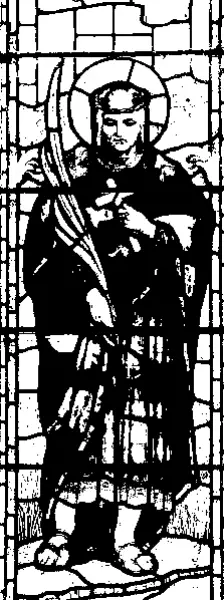
- A young man with gingery hair·A Celtic tonsure·A torc·A palm
- Canonization
- Pre-congregation; honoured as a martyr from the earliest times
Prayer
Bibliography
Show 8 sources
- "St. Canog - Saints & Angels". Catholic Online. Retrieved 12 June 2023.
- Moran, Patrick. Irish Saints in Great Britain. Gill (Dublin), 1879.
- Tristam, Simon K. Exciting Holiness. Hymns Ancient and Modern Ltd, 2007.
- "Kilmacanogue". Wicklow Uplands. 3 August 2017.
- Gerald of Wales. The Itinerary of Archbishop Baldwin through Wales, Chapter 2. Vision of Britain.
- Cooper, Matthew Franklin (7 October 2019). "The Heavy Anglophile Orthodox: Holy Monk-Martyr and Confessor Cynog of Powys".
- "EBK: St. Cynog". www.earlybritishkingdoms.com.
- Lloyd, John Edward. "Welsh Biography Online". National Library of Wales.
Profile text adapted from the Wikipedia article, licensed CC BY-SA 4.0.
Pray with this saint every day
Save St. Cynog ap Brychan to your favorites, read the full profile, and get feast-day reminders in the Saints app.
Get the Saints AppFree on the App Store for iPhone and iPad