
c. 210 – 258·Feast September 16
St. Cyprian of Carthage
Bishop, Martyr and Pre-eminent Latin Writer
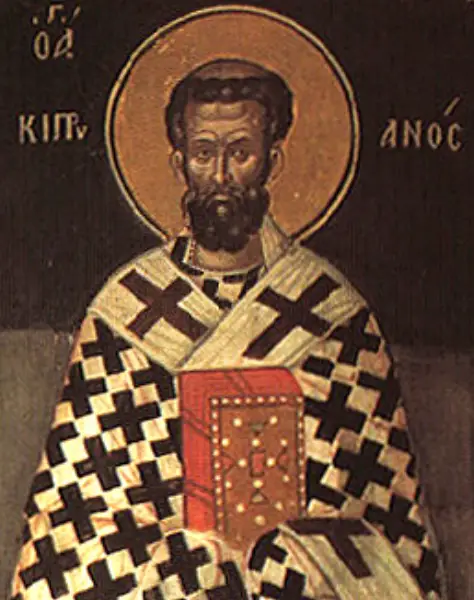
Overview
Cyprian, whose Latin name was Thascius Caecilius Cyprianus, was bishop of Carthage and the foremost Latin Christian writer of the third century, a man of Berber descent whose rhetorical skill made him the model for Western prose until the age of Jerome and Augustine. Born around 210 into a wealthy pagan Carthaginian family, he was trained as an orator and teacher of rhetoric before his conversion at about thirty-five; almost at once he gave a portion of his fortune to the poor and rose through the orders to become bishop in 249. His episcopate was consumed by crisis: the Decian persecution drove him into hiding, the question of reconciling Christians who had lapsed split his church, and rival bishops rose against him from both lax and rigorist parties. He steered a moderate course, wrote treatises on unity, penance, mortality and almsgiving, and led the city through plague and famine. Arrested under the emperor Valerian, he refused to sacrifice to the Roman gods and was beheaded at Carthage on 14 September 258 before a vast crowd, dying with the words 'Thanks be to God' on his lips.
The Complete Life
The Rhetorician of Carthage
Cyprian was born in the first years of the third century into a rich pagan family of Roman Africa, probably at Carthage itself, and he received the full classical education that city offered. His original name was Thascius; he added the name Caecilius later, in honour of the priest through whom he had found the faith. Before Christianity he was a prominent figure in one of the city's legal fraternities, an orator, an advocate arguing cases in court, and a teacher of rhetoric — the commanding profession of a Roman city. He admitted to a dissipated youth, and it was at about the age of thirty-five, around 245, that he was baptised. The change was immediate and visible: he gave a share of his fortune to Carthage's poor, as befitted a man of his standing, and turned his pen to Christian subjects. In those first years he wrote an Epistola ad Donatum on the grace of God and the Testimoniorum Libri III, works that followed the models of Tertullian, the master whose style and thinking shaped his own. The Latin he had perfected in the courts would now serve the Gospel.
§ Early life
A Contested Election
Conversion carried Cyprian rapidly up the orders of the Church: he was ordained deacon, and a priest not long after. Between July 248 and April 249 the see of Carthage fell vacant, and Cyprian was elected bishop — the favourite of the city's poor, who recalled his generosity, though his rapid rise displeased the senior clergy, an opposition that never entirely vanished during his episcopate. He had barely settled into office when the whole community was put to a severe test. The Church of North Africa had known no persecution for a generation and had grown assured and lax; in early 250 the emperor Decius ordered sacrifices to the gods across the empire. Cyprian elected to withdraw into hiding instead of risking execution. Some clergy called the decision cowardice, and he defended himself to the end of his life: he had fled, he said, so that the faithful would not be left shepherdless, and he went on directing them by letter and envoy from a distance, appealing to the example of Christ and the apostles, who had taught that in persecution one may depart and flee until the hour appointed for the crown.
§ Contested election as bishop of Carthage
The Lapsed and the Unity of the Church
The persecution was especially severe at Carthage. Many Christians fell away — the lapsi, the fallen — most having bought certificates testifying to a sacrifice they had never offered, and some having truly offered it, whether under torture or freely. Cyprian demanded that the libellatici, as the certificate-holders were called, and all the lapsed undergo public penance before readmission. In his absence some priests disregarded him, admitting the fallen to communion with little or no penance, some brandishing second certificates supposedly signed by martyrs and confessors; hundreds, perhaps thousands, were readmitted against his wishes and those of the majority of his clergy. When he returned after fourteen months he defended his flight in letters to the other North African bishops, issued the tract De Lapsis, and convoked a council at Carthage in 251 to settle both the treatment of the lapsed and the schism of Felicissimus. The council in the main supported his middle course between Novatus of Carthage, who would welcome all back without penance, and Novatian of Rome, who would reconcile none. The schism continued regardless: the laxists elected Fortunatus as a rival bishop, and the Roman rigorists elected Novatian against Pope Cornelius while backing a rival, Maximus, at Carthage. Cyprian found himself pressed between laxists and rigorists, yet the polarisation wore his opponents down and strengthened his hand. His leadership through a great plague and famine won him still more support; he wrote De Mortalitate to console the dying, De Eleemosynis to summon the faithful to charity, and the apologia Ad Demetrianum against pagans who blamed Christians for the public calamities.
§ Controversy over the lapsed
Sacraments and the One Chair
Cyprian was not a speculative theologian; his writing always served his pastoral office. On the sacraments he held that baptism was to be given to infants, and with it infant communion, but he denied that baptism administered by heretics had any effect and required those it touched to be baptised again, holding that the Eucharist could not be validly consecrated apart from the Church. He was among the earliest Fathers to state plainly the doctrine of baptismal regeneration: while attributing all saving power to the grace of God, he regarded the water of the font as God's instrument for the new birth, whereby a person receives fresh life and strips off the old self. Above all he taught the unity of the Church. He believed the see of Rome the direct heir of Peter, yet held all the apostles equal and all bishops their successors; the unity he defended was the single chair founded on Peter — the others were what Peter was, but a primacy was given to Peter to make clear that there is one Church and one chair, one flock nourished by every apostle in concord. On other questions he was amillennial; Augustine credited him with teaching the gift of perseverance; and he argued that each day of creation in Genesis spanned a thousand years.
§ Theology
Trial and Martyrdom
Late in 256 a new persecution broke out under the emperor Valerian, and Pope Sixtus II was executed in Rome. In Africa Cyprian prepared his people for the expected edict with his De Exhortatione Martyrii, and set the example himself: on 30 August 257 he was brought before the proconsul Aspasius Paternus, would not offer sacrifice to the Roman gods, and confessed Christ without wavering. The proconsul banished him to Curubis, modern Korba, where the saint believed he saw his approaching fate in a vision. A year later he was summoned back and kept virtually a prisoner in his own villa, awaiting the effects of a new and harsher imperial edict that Christian writers later claimed ordered the execution of all Christian clerics. On 13 September 258 he was arrested at the command of the new proconsul, Galerius Maximus, and examined by him the following day. The exchange has been preserved: asked whether he was Thascius Cyprianus, he answered 'I am'; commanded to conform to the Roman rites, 'I refuse'. With evident reluctance the proconsul pronounced sentence of death by the sword, and the bishop answered only, 'Thanks be to God.' The execution followed immediately, in an open spot close to the city walls. An enormous crowd walked with him to the place of death; he took off his clothes unaided, knelt, prayed, blindfolded himself, and was beheaded. Christians buried his body near the place of execution, and eight of his disciples soon followed him to martyrdom at Carthage.
§ Persecution under Valerian
A Martyr Honoured from the Beginning
Cyprian was never canonised, for he died centuries before any formal process existed; the Church's recognition of his sanctity was immediate and popular. Basilicas rose above his tomb and above the scene of his death, though in later centuries both were destroyed by the Vandals. His grave, like that of Martin of Tours, came to be regarded as a contact point between heaven and earth, and became the centre of a redefined Christian urban community. A surviving homily of Augustine preached on Cyprian's feast day shows that his cult was already spread across Africa by the fourth century. The Catholic Church celebrates his feast with that of his friend Pope Cornelius on 16 September; in the Catholic Middle Ages the Sarum use kept his memory on 14 September, the day he died. The Orthodox East remembers him on 31 August, Lutherans on 16 September, and Anglicans on the 13th or 15th of September, according to the local calendar. Charlemagne is said to have had his bones translated to France, and Lyon, Arles, Venice and Compiègne, together with Roenay in Flanders, all claimed to hold parts of the martyr's relics.
§ Veneration
Writer, Pastor, and Model Bishop
Cyprian's reputation rests on three foundations. The first is his writing: he ranks as the greatest Latin writer of Western Christianity before Jerome and Augustine, and his works fill volumes 3 and 4 of Migne's Patrologia Latina. They include Ad Donatum on his conversion, the Testimonia, De Lapsis, De Ecclesiae Catholicae Unitate — written during his exile and his most famous treatise — De Mortalitate, De Eleemosynis, Ad Demetrianum, his treatise on the Lord's Prayer, and some sixty letters, together with some of the letters he received; doubtless only part of his output survives. The second foundation is his conduct: pastoral skill and steady nerve through the dispute with the Novatianists and through the plague named after his own account of it, and a martyrdom at Carthage that confirmed a sanctity his lifetime had already displayed. The third is his influence on doctrine and order: his teaching on the unity of the Church, baptismal regeneration, the sacraments and the chair of Peter shaped Latin Christianity for centuries. His name later attracted a shadow: confused with the Cyprian of Antioch who had been a magician before turning to Christ; magical handbooks such as the Libellus Magicus were accordingly misassigned to him. Pontius the deacon's Life and Passion of St. Cyprian preserves the memory of his life, his acts and his death.
§ Writings
Timeline
- 210
Born into a wealthy pagan family at Carthage in Roman North Africa
§ Introduction
- 245
Baptized around the age of thirty-five after a dissipated youth, then gives away part of his wealth to the poor
§ Early life
- 248
Elected bishop of Carthage between July 248 and April 249, popular with the poor but opposed by senior clergy
§ Contested election as bishop of Carthage
- 250
The Decian persecution begins; Cyprian goes into hiding to keep guiding his flock from a distance
§ Contested election as bishop of Carthage
- 251
Returns after fourteen months, issues De Lapsis, and chairs a council of North African bishops on the lapsed
§ Controversy over the lapsed
- 256
A new persecution under Emperor Valerian breaks out late in the year; Pope Sixtus II is executed
§ Persecution under Valerian
- 30 Aug 257
Interrogated by proconsul Aspasius Paternus, refuses sacrifice, and is banished to Curubis
§ Persecution under Valerian
- 13 Sep 258
Jailed at the command of the incoming proconsul, who is identified as Galerius Maximus
§ Persecution under Valerian
- 14 Sep 258
Tried, sentenced, and beheaded by the sword near Carthage after refusing to sacrifice to the Roman gods
§ Persecution under Valerian
In Their Own Words
But after that, with the help of the water of new birth, the stain of my former life was washed away, and a light from above, serene and pure, was infused into my reconciled heart... a second birth restored me to a new man.
Thanks be to God.
No one can have God for his Father, who has not the Church for his mother.
There is no salvation outside the Church.
For the helmsman is recognized in the tempest; in the warfare the soldier is proved.
It is a persistent evil to persecute a man who belongs to the grace of God. It is a calamity without remedy to hate the happy.
Men imitate the gods whom they adore, and to such miserable beings their crimes become their religion.
The Record
- Major works
- Ad Donatum (his account of his own conversion)·Testimonia ad Quirinum (Testimoniorum Libri III)·De Lapsis (On the Fallen)·De Ecclesiae Catholicae Unitate (On the Unity of the Catholic Church)·De Mortalitate·De Eleemosynis·Ad Demetrianum·De Exhortatione Martyrii·Treatise on the Lord's Prayer·Some sixty extant letters
- Patron of
- North Africa·Berbers
- Canonization
- Pre-congregation; venerated as a martyr since the early Church in the Catholic, Orthodox, Lutheran and Anglican traditions
Prayer
Bibliography
Show 7 sources
- Chapman, Henry Palmer (1908). "St. Cyprian of Carthage". In Herbermann, Charles (ed.). Catholic Encyclopedia. Vol. 4. New York: Robert Appleton Company.
- Butler, Alban. "St. Cyprian, Archbishop of Carthage, Martyr", The Lives of the Saints, Vol. IX, 1866.
- Frend, W. H. C. (1984). The Rise of Christianity. Fortress Press, Philadelphia. p. 319. ISBN 978-0-8006-1931-2.
- Clarke, Graeme (2005). Third-Century Christianity. In The Cambridge Ancient History, Volume XII: The Crisis of Empire. Cambridge University Press. ISBN 0-521-30199-8.
- Foley, Leonard O.F.M., "St. Cyprian", Saint of the Day, revised by Pat McCloskey O.F.M., Franciscan Media.
- Bévenot, Maurice, SJ (translator), St. Cyprian. The lapsed. The unity of the Catholic Church, 1957 (Ancient Christian Writers, 25). ISBN 9780809102600.
- Lanzi, Fernando (2004). Saints and Their Symbols: Recognizing Saints in Art and in Popular Images. Liturgical Press. p. 80. ISBN 9780814629703.
Profile text adapted from the Wikipedia article, licensed CC BY-SA 4.0.
Pray with this saint every day
Save St. Cyprian of Carthage to your favorites, read the full profile, and get feast-day reminders in the Saints app.
Get the Saints AppFree on the App Store for iPhone and iPad