
c. 1336 – 1406·Feast September 16
St. Cyprian, Metropolitan of Kiev
Hesychast Metropolitan of Kiev and All Rus'
Overview
Cyprian (c. 1336 – 16 September 1406), a churchman born in Bulgaria, served as Metropolitan of Kiev, Rus' and Lithuania from December 1375 and then as Metropolitan of Kiev and all Rus' until his death, within the Ecumenical Patriarchate of Constantinople. Born, by tradition, into the aristocratic Tsamblak family of Tarnovo, he was formed as a hesychast: he studied at the monastery of Kilifarevo near Tarnovo, traveled to Constantinople in 1363, and continued his formation at Mount Athos, where he befriended the future Patriarch Philotheus Kokkinos. Sent to Rus' as the patriarch's envoy, he was consecrated Metropolitan of Kiev, Rus' and Lithuania in 1375 on the condition that he succeed Alexius in all Rus'. When Alexius died in 1378, Grand Prince Dmitri Donskoi instead deposed him and set up rivals, and Cyprian had to wait out a decade of exile in Lithuania and Constantinople before a patriarchal council vindicated him in 1389 and Grand Prince Vasili II received him in Moscow in 1390. He held the see until his death, working to preserve a single metropolis across Muscovy and Lithuania. A leading figure of the Tarnovo Literary School, he oversaw chronicles, rewrote the Life of Metropolitan Peter, corrected biblical books, and translated Greek works into Old Church Slavic. He was canonized in the fifteenth century.
The Complete Life
A Son of Tarnovo
Cyprian came from the Bulgaria of the last imperial century, a clergyman of Bulgarian origin supposed to have been born into the aristocratic Tsamblak family of the capital, Tarnovo. His formation placed him at the center of one of the great spiritual renewals of medieval Orthodoxy. As a young man he studied at Kilifarevo, just south of Tarnovo, at the hesychast monastery founded by Theodosius of Tarnovo, a disciple of Gregory of Sinai; there he may have accepted his monastic vows, and there he met the future Bulgarian patriarch Euthymius, then a fellow student of hesychasm and later counted among the towering figures of Bulgaria's middle ages. The school of Kilifarevo sent its monks outward, and in 1363 Cyprian made the journey that carried him out of Bulgaria for good: together with Euthymius, Theodosius, and two of Theodosius' followers, he reached Constantinople, where Patriarch Callistus I received the company and Cyprian passed several months in study at the Monastery of Stoudios. When Theodosius died that November, Cyprian continued his studies on Mount Athos, the heartland of the hesychast movement, where his formation in the contemplative tradition was completed and where the friendships that would later shape his extraordinary career were formed.
§ Early life
Monk of Constantinople and Athos
Cyprian's vocation unfolded along the axis that joined Bulgaria, Constantinople, and the Holy Mountain. His upbringing and education made him a hesychast in conviction, a man of the prayer of stillness that the fourteenth-century Byzantine world had fought to defend. The dating of his formal monastic profession is debated: one tradition places his vows at Kilifarevo in his youth, while the historian Dimitri Obolensky holds that he became a monk only in the early 1370s, in Constantinople. What is certain is the company he kept. On Mount Athos he befriended Philotheus Kokkinos, the foremost hagiographer of Gregory Palamas and twice patriarch of Constantinople, and at the beginning of the 1370s, after Philotheus returned to the patriarchal throne, Cyprian became the monk nearest to him. This intimacy with the patriarchate transformed a Bulgarian contemplative into a man of affairs. The Byzantine church of the 1370s was deeply involved in the affairs of Rus', where the metropolis of Kiev and all Rus', seated since 1325 in Moscow, was contested by Lithuanian claims to a separate hierarchy, and it was precisely this intersection of prayer, learning, and diplomacy that called the monk of Athos out of his monastery and onto the road north, first as envoy and then as bishop.
§ Early life
The Hesychast on the Throne of Kiev
Cyprian was the only metropolitan of Kiev and all Rus' formed in the strict school of fourteenth-century hesychasm, and the fact explains much about the style of his long and embattled tenure. His education and worldview belonged to the movement of Gregory of Sinai and Theodosius of Tarnovo, the tradition of unceasing prayer that Kilifarevo had planted and that Mount Athos had perfected. From Tarnovo he also inherited the literary discipline of the Tarnovo Literary School, of which he is counted an alumnus and later a principal ornament: reverence for the purified text, the careful copying and correcting of books, and the conviction that the life of the mind was a form of worship. As an administrator he joined this contemplative inheritance to an almost modern understanding of church order, insisting that the unity of the Rus' metropolis depended on canonical order and the authority of Constantinople rather than on the will of princes. He could excommunicate a grand prince and his advisors when they obstructed him, and he could spend a decade in exile without relinquishing his claim, but the sources remember him not as a quarrelsome prelate. He is remembered as wise and experienced, an editor, translator, and book copyist for whom the governance of a persecuted church and the correction of a biblical text belonged to the same vocation.
§ Early life
Envoy, Metropolitan, and Exile
The mission that defined Cyprian's public life began as an attempt to prevent schism. The grand duke of Lithuania, Algirdas, had attacked Muscovy three times between 1368 and 1372 in support of Mikhail of Tver, partly to advance his demand for a metropolis independent of Moscow. The patriarch dispatched Cyprian as a trusted envoy to the Rus' princes of the Lithuanian and Muscovite lands, charged with bringing the princes of Lithuania and Tver back into peace with Metropolitan Alexius and preventing the total division of the Church between Vilnius and Moscow. He traveled the disputed lands, possibly visiting Kiev for the first time, attended the consecration of the Bishop of Tver on March 9, 1374, and returned to Constantinople carrying the request of the Orthodox Lithuanian-Ruthenians for a metropolitan of their own. Fearing the Catholicization of the Grand Duchy of Lithuania, Patriarch Philotheus I satisfied the petition: on December 2, 1375, he consecrated Cyprian as Metropolitan of Kiev, Rus' and Lithuania, on the condition that he become Metropolitan of Kiev and all Rus' upon the death of Alexius. The condition was honored by everyone except the lay power. When Alexius died in February 1378, Grand Prince Dmitri Donskoi deposed Cyprian without consulting Constantinople and installed Pimen, and later Dionysius, in his place; for his resistance, the prince and his advisors were excommunicated. Cyprian withdrew to Lithuania or Constantinople and waited.
§ Hostilities between Lithuania and Muscovy
Vindication and the United Metropolis
The decade of dispossession ended in 1389, when Patriarch Antony IV of Constantinople gathered a council that reunited the metropolis, acknowledging Cyprian as lawful bishop over all Rus'. In 1390 the new grand prince, Vasili II, received him in Moscow as the legitimate Metropolitan of Kiev and all Rus', and he held the title until his death. The long struggle fixed the agenda of his final years: to preserve a single metropolis across the lands of Muscovy and Lithuania, and to secure peace with Lithuania — aims in which he is judged to have been mainly responsible for holding the Church together across two rival grand duchies. Opposition did not cease: Novgorod the Great, especially its archbishops Aleksei and Ioann II, resisted his efforts to adjudicate ecclesiastical cases there and claim the court fees of his judicial sessions. Cyprian gave these years a literary monument as well, overseeing the Troitskaia Chronicle and beginning in 1390 the Book of Degrees, which arranged the Russian rulers by generation. He died on September 16, 1406, and was buried in the Assumption Cathedral of the Moscow Kremlin, the church at the heart of the metropolis he had spent thirty years defending.
§ Metropolitan of Kiev and all Rus'
Veneration
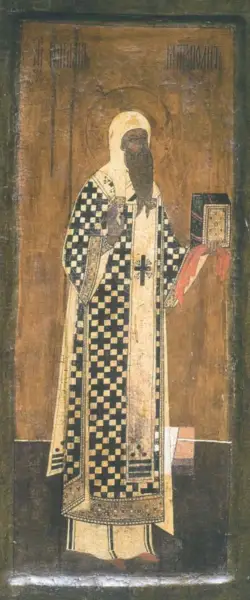
The Russian Orthodox Church canonized Cyprian in the fifteenth century, within living memory of the institution he had led and of the men he had contended with. His cult took the dual form common for hierarchs of the period: he is commemorated on September 16 (O.S.), the anniversary of his repose, and again on May 27, and he is venerated across the Eastern Orthodox Church, whose liturgical tradition keeps his memory as that of a wise and suffering bishop. His icon, a seventeenth-century image, is preserved in the Assumption Cathedral in the Moscow Kremlin, beside the tomb where his relics rest. The ecumenical reach of his memory matches the reach of his career: he served as metropolitan within the Ecumenical Patriarchate of Constantinople, was consecrated in the imperial capital, and belonged by birth and formation to the Bulgarian church, and the Orthodox of all these lands honor him. In the Roman Catholic Church as well he is listed among the venerated, an unusual tribute to a hierarch whose life was spent resisting the Catholicization of Lithuania even while keeping its Orthodox faithful within one church with Moscow. His feast of September 16 closes the cycle of his commemoration each year in the Eastern Orthodox calendar.
§ Death
Books, Chronicles, and a Mountain in Antarctica
Cyprian's most durable legacy is literary. An erudite alumnus of the Tarnovo Literary School, he directed the copying and composition of a body of work that anchored Russian historical writing: the Troitskaia Chronicle, and probably the Metropolitan Justice, a legal compendium known in Old Russian as Pravosudiye metropolich'ye. He rewrote the Life of Metropolitan Peter, originally composed around 1327, giving the Moscow see the polished vita of its most beloved early hierarch; he corrected the text of biblical books; and he translated a number of ecclesiastical works from Greek into Old Church Slavic, carrying the Bulgarian passion for the purified word into the Slavic East. The Book of Degrees, the great genealogical register grouping the Russian monarchs generation by generation, was started by him in 1390, though its completion came only in 1563, more than a century and a half after his death. His administrative achievement outlasted every rival: the unity of the Russian church across Muscovy and Lithuania, which he defended through deposition and exile, was the unity his successors inherited. His name has even reached the far south of the world, for St. Kiprian Peak on Greenwich Island in the South Shetland Islands, Antarctica, is named in his honor.
§ Achievements
Timeline
- 1336
Born around this year into the Tsamblak family of Tarnovo, capital of the Second Bulgarian Empire
§ Early life
- 1363
Arrives in Constantinople with Euthymius and Theodosius of Tarnovo, is received by Patriarch Callistus I, and studies at the Monastery of Stoudios
§ Early life
- Nov 1363
After Theodosius of Tarnovo dies on 27 November, continues his studies on Mount Athos and becomes a hesychast
§ Early life
- 9 Mar 1374
As the patriarch's envoy to the Rus' princes, attends the consecration of Bishop Euthymius of Tver and visits Kiev
§ Hostilities between Lithuania and Muscovy
- 2 Dec 1375
Consecrated at the Council of Constantinople as Metropolitan of Kiev, Rus' and Lithuania, with the right to succeed Alexius
§ Hostilities between Lithuania and Muscovy
- 6 Jun 1376
Arrives at his residence in Kiev, but fails to win recognition from Grand Prince Dmitri Donskoi
§ Metropolitan of Kiev and all Rus'
- 12 Feb 1378
Alexius dies; the Grand Prince deposes Cyprian and installs rival metropolitans, and Cyprian withdraws to Lithuania or Constantinople
§ Metropolitan of Kiev and all Rus'
- Feb 1389
A council convened by Patriarch Antony IV of Constantinople restores unity by acknowledging Cyprian as true bishop of all Rus'
§ Metropolitan of Kiev and all Rus'
- 1390
Returns to Moscow and is recognized as legitimate Metropolitan of Kiev and all Rus' by Grand Prince Vasili II; starts the Book of Degrees
§ Metropolitan of Kiev and all Rus'
- 16 Sep 1406
Dies on 16 September and is buried in the Assumption Cathedral of the Moscow Kremlin
§ Death
- 1450
Canonized by the Russian Orthodox Church during the fifteenth century
§ Death
The Record
- Major works
- Troitskaia Chronicle (oversaw its creation)·Metropolitan Justice (Pravosudiye metropolich'ye), probably·Rewritten Life of Metropolitan Peter·Corrections of biblical books and translations from Greek into Old Church Slavic·Book of Degrees (Stepénnaya kniga), begun 1390
- Canonization
- Canonized by the Russian Orthodox Church in the 15th century
Prayer
Bibliography
Show 10 sources
- Jean W. Sedlar, East Central Europe in the Middle Ages, 1000-1500, A History of East Central Europe, University of Washington Press, 2013, ISBN 029580064X, p. 438.
- Shabuldo, F. Cyprian (КИПРІЯН). Encyclopedia of History of Ukraine. 2007
- Graham Speake, A History of the Athonite Commonwealth: The Spiritual and Cultural Diaspora of Mount Athos, Cambridge University Press, 2018, ISBN 1108425860, p. 132.
- John Meyendorff, Byzantium and the Rise of Russia: A Study of Byzantino-Russian Relations in the Fourteenth Century, Cambridge University Press, 2010, ISBN 0521135338, p. 129.
- "Repose of St Cyprian the Metropolitan of Moscow and All Russia", Orthodox Church in America
- Rowell, S. C. (1994). Lithuania Ascending: A Pagan Empire Within East-Central Europe, 1295–1345. Cambridge Studies in Medieval Life and Thought: Fourth Series. Cambridge University Press. ISBN 978-0-521-45011-9.
- Majeska, George P. (1984). Russian Travelers to Constantinople in the Fourteenth and Fifteenth Centuries. Dumbarton Oaks. ISBN 0-88402-101-7.
- Droblenkova, N. F. and Prokhorov, G. M., "Kiprian (ok. 1330-16.IX.1406) Mitropolit Kievskii i vseia Rusi," in D. S. Likhachev, Slovar knizhnikov i knizhnosti drevnei Rusi, vol. 2, pt. 1, pp. 473-474.
- "St Cyprian, Metropolitan of Kiev. - September 15"
- Андреев В.Ф. Из истории Русской Церкви XIV-XV веков. Митрополит св. Киприан. Великий Новгород, 2008.
Profile text adapted from the Wikipedia article, licensed CC BY-SA 4.0.
Pray with this saint every day
Save St. Cyprian, Metropolitan of Kiev to your favorites, read the full profile, and get feast-day reminders in the Saints app.
Get the Saints AppFree on the App Store for iPhone and iPad