
476 – 546·Feast October 3
St. Cyprian of Toulon
Bishop of Toulon and Biographer of Caesarius
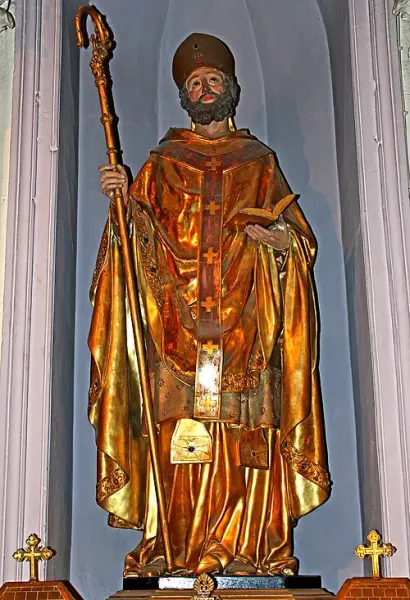
Overview
Cyprian of Toulon (Cyprianus Tolonensis) was bishop of Toulon during the sixth century, born at Marseille in 476 and formed in the school of St. Caesarius of Arles, of whom he was the favorite pupil. Caesarius ordained him to the diaconate in 506 and consecrated him for the see of Toulon in 516. As a bishop he took his place in the councils of the Frankish church: he seems in 524 to have sat in the synod of Arles, and over the years that followed to have taken part in a series of further assemblies, among them the Council of Marseilles, where he stood out as a determined adversary of the Semipelagian party. Tradition credits him with the conversion to Catholicism of two Visigoth chiefs, Mandrier and Flavian, who afterward became anchorites and martyrs on the peninsula that bears Mandrier's name. After the death of Caesarius in 543, Cyprian wrote a life of his teacher in two books, undertaken at the entreaty of Abbess Caesaria the Younger; it remains one of the most valuable biographical works of the sixth century. He died on October 3, 546, the date later kept as his feast. A letter of his to Bishop Maximus of Geneva, discussing disputed theological questions of the age, was published in 1892.
The Complete Life
A Pupil of Caesarius
Cyprian was born at Marseille in 476, into the world of southern Gaul only a generation after the end of Roman administration in the west. The decisive circumstance of his early life was his attachment to St. Caesarius of Arles, the most influential churchman of the region, of whom he became the favorite pupil. Under Caesarius he received the training that would shape his entire career: formation in doctrine, in discipline, and in the pastoral tradition of the Provençal church, which in those decades was fighting on two fronts, against the remnants of pagan practice and against the theological movement known as Semipelagianism. The relationship between the two men was closer than that of master and student; Cyprian belonged to the household of the archbishopric of Arles, and the confidence Caesarius placed in him appeared in the offices he confided to him. Nothing else in the record survives about his family or his childhood, but the fact that a boy of Marseille could rise through the schools of the church to a bishopric says something about the society he entered, in which education and ecclesiastical service were the recognized path for men of ability, and in which the great sees of the Rhône valley trained the bishops of the surrounding towns.
§ Life
Diaconate and Episcopal Consecration
Cyprian's advance through the orders of the church was entrusted to the hands of his own teacher. In 506, Caesarius of Arles ordained him to the diaconate, binding him to the service of the altar and giving him a formal place in the clerical rank of the Provençal church. A decade of service followed, during which the pupil must have proved himself in the ordinary and extraordinary work of a great metropolitan see; then, in 516, Caesarius consecrated him as bishop of Toulon. The gesture was remarkable in its economy: the most celebrated bishop of southern Gaul personally placed his favorite disciple over a neighboring see, and the church of Toulon received a bishop formed entirely in the Arlesian tradition. Toulon, a port town on the Mediterranean between Marseille and the Alpine passes, was a modest see compared with Arles, but it lay within the orbit in which Caesarius' influence ran strongest, and its bishop was expected to take his place in the collective life of the Gallic episcopate. Cyprian did so from the first years of his tenure, appearing among the bishops assembled in council and carrying the theological positions of his school into the debates of the Frankish church.
§ Life
Councils and the Fight Against Semipelagianism
The recorded work of Cyprian's episcopate lies in the assembly halls of the Gallic church. He seems to have sat in the synod of Arles in 524, and in the years afterward to have taken part in a whole series of councils, the Council of Marseilles among them. At all these gatherings the tradition records a single distinguishing mark: he proved a resolute enemy of the Semipelagian cause, the teaching associated with the monastery of Lérins and the school of Marseilles, which held that the first movements of faith and the desire for salvation could arise in the human will unaided by grace. The controversy had divided southern Gaul for a century, and Caesarius of Arles had made its settlement the cause of his life. In Cyprian the cause found a loyal second: the pupil carried his master's Augustinian conviction into the councils, where the question of grace was debated by bishops from across the Frankish kingdoms. The same missionary confidence appears in a tradition preserved of his episcopate, that he brought two Visigoth chieftains, Mandrier and Flavian, to the Catholic faith. The two converts became anchorites and afterward martyrs on the peninsula of Mandrier, near Toulon, a memory that ties the bishop's work to the evangelization of the still-pagan Visigothic population of Provence.
§ Life
The Life of Caesarius
The great labor of Cyprian's last years grew out of a death. When Caesarius of Arles died in 543, the abbess Caesaria the Younger, who had headed the convent at Arles since 529, entreated the old pupil to write the life of the teacher both women had served. Cyprian undertook the work and produced a life in two books. He did not write alone: two friends of Caesarius among the episcopate, Firminus and Viventius, assisted him in the task, together with a priest called Messianus and a deacon named Stephen. The collaboration is visible in the finished text, but everything down to chapter forty of book one is, in all likelihood, from Cyprian's own hand, drawn from a lifetime of watching the man whose deacon and bishop-consecrate he had been. The result stands among the richest biographical documents that survive from the sixth century, a document through which the religious history of southern Gaul — its monasteries, its councils, its plague, its theology — is still read. Cyprian did not long survive the work; he died on October 3, 546, scarcely three years after his teacher, and the date of his death became the feast the church has kept for him ever since.
§ Life
A Legacy in Ink
Cyprian's legacy has reached the present almost entirely through his writings. The life of Caesarius reached print at the hands of d'Achery and Mabillon in the Acta Sanctorum Ordinis S. Benedicti, published at Venice in 1733, and again by the Bollandists in the Acta Sanctorum under the date of August 27; a modern English translation by W. E. Klingshirn, Caesarius of Arles: Life, Testament, Letters, appeared at Liverpool in 1994 in the Translated Texts for Historians series. Through these editions, the pupil's portrait of his teacher has outlived the walls of every church either man served, and historians of the sixth century continue to depend on it as one of the richest documents the age produced. To it scholarship has added a second text: in 1892 the Monumenta Germaniae Historica published a letter of Cyprian's to St. Maximus, bishop of Geneva, which takes up certain of the era's contested theological questions and shows the bishop of Toulon engaged in the doctrinal correspondence of the Frankish church. His feast falls on October 3, and he is venerated in the Roman Catholic Church. Two Visigoth chiefs who became anchorite martyrs, a biography that fixed the memory of a saint, and a handful of conciliar interventions: these constitute the record of a quietly consequential life.
§ Life
Timeline
- 476
Born at Marseille
§ Life
- 506
Ordained to the diaconate by St. Caesarius of Arles, his teacher
§ Life
- 516
Consecrated bishop of Toulon by Caesarius
§ Life
- 524
Appears to have been present at the synod of Arles
§ Life
- 530
Attends further councils in the following years, including the Council of Marseilles, opposing Semipelagianism
§ Life
- 543
Soon after the death of Caesarius, writes a life of his teacher in two books at the urging of Abbess Caesaria the Younger
§ Life
- 3 Oct 546
Dies on October 3, the date later kept as his feast
§ Life
- 1733
His biography of Caesarius is printed at Venice by d'Achery and Mabillon in the Acta Sanctorum Ordinis S. Benedicti
§ Life
- 1892
The Monumenta Germaniae Historica publishes his letter to Bishop Maximus of Geneva
§ Life
The Record
- Major works
- Life of St. Caesarius of Arles, in two books·Letter to St. Maximus of Geneva on disputed theological questions
- Canonization
- Pre-congregation; venerated in the Roman Catholic Church from antiquity
Prayer
Bibliography
Show 4 sources
- Meier, Gabriel. "St. Cyprian." The Catholic Encyclopedia Vol. 4. New York: Robert Appleton Company, 1908. Retrieved 30 September 2021.
- "Saint Cyprian". New Catholic Dictionary. CatholicSaints.Info. 16 September 2012
- Klingshirn, W. E. Caesarius of Arles: Life, Testament, Letters. Translated Texts for Historians, 19 (Liverpool, 1994).
- d'Achery and Mabillon (eds.), Acta Sanctorum Ord. S. Benedicti, Venice 1733, vol. i. p. 636ff; also in the Bollandists' Acta Sanctorum under date of Aug. 27.
Profile text adapted from the Wikipedia article, licensed CC BY-SA 4.0.
Pray with this saint every day
Save St. Cyprian of Toulon to your favorites, read the full profile, and get feast-day reminders in the Saints app.
Get the Saints AppFree on the App Store for iPhone and iPad