
died 303·Feast August 8
St. Cyriacus
Deacon Martyr of Rome and Holy Helper
Overview
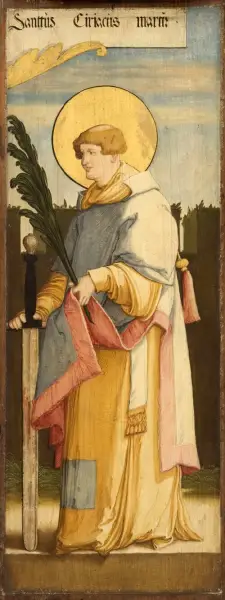
Cyriacus (Greek Kyriakos, fl. 303) is a Christian martyr killed in the Diocletianic Persecution, one of no fewer than twenty-seven saints bearing the name, of whom only seven are specifically named in the Roman Martyrology. Of the Cyriacus venerated with Saints Largus and Smaragdus on August 8, the certain facts are few: their names, their martyrdom, and their resting place by the seventh milestone of the Ostian road on that day. Legend fills out the figure: a Roman nobleman converted in adulthood, who renounced his wealth to the poor and spent his remaining years ministering to the slaves who labored in the Baths of Diocletian. Tradition credits him with exorcizing demons from two noble girls — Artemisia, daughter of Diocletian, whose conversion with her mother Serena followed, and a Persian princess whose story the chronology does not survive. Under Emperor Maximian, Cyriacus was tortured and beheaded in 303 on the Via Salaria, together with Largus, Smaragdus, and some twenty companions, men and women whose names the martyrologies preserve. Honored as one of the Fourteen Holy Helpers, invoked against deathbed temptation and eye disease and as a patron of viticulture, he kept a titulus church in Rome from the fifth century until 1587, and his feast was carried into the Americas by a hurricane named for it in 1899.
The Complete Life
A Nobleman Converted
History can say little about the origins of Cyriacus beyond his name, but the legend that grew around the martyr gives him a dramatic conversion story. He is portrayed as a Roman nobleman, a man of the senatorial class who encountered Christianity as an adult and embraced it with the totality of a true convert. The first fruit of his new faith was renunciation: he gave away his material wealth to the poor, dissolving in a single act the fortune that had defined his rank. This is a familiar shape for a Roman saint — the aristocrat who surrenders the world — but in Cyriacus' case the tradition attaches to it an unusual field of labor. He did not withdraw to a hermitage or found a monastery; he went where the empire's misery was most concentrated, to the great public baths that Diocletian had raised in Rome, where gangs of slaves performed the ceaseless labor of heating and maintaining the largest bath complex in the world. To these workers, men and women who belonged to no one and were owned by everyone, the former nobleman devoted the rest of his life. Whatever the legend's historical texture, it records how the early church remembered him: a patrician who became a servant of slaves.
§ Life
Ministry in the Baths of Diocletian
The ministry that Cyriacus undertook in the Baths of Diocletian left a permanent mark on his cult. He is depicted liturgically as a deacon, and the tradition of the church at Rome remembered his service among the bath slaves as the defining work of his vocation. The titulus that eventually bore his name — Sanctus Ciriacus in Thermis Diocletiani, Saint Cyriacus in the Baths of Diocletian — was a former titulus church of the city, and the very title 'Cyriac' in Greek signifies simply 'patron,' the word by which early Roman churches were commonly named after their lay benefactors. Bishops across the centuries, it has been suggested, more likely took their name in remembrance of Saint Cyriacus at the Baths than of any other saint called Cyriacus. The ministry to the slaves also explains the exorcisms that tradition attached to him: he was credited with expelling demons from two girls of the highest rank, Artemisia or Artemia, daughter of Diocletian himself, whose conversion followed together with that of her mother Serena, and a daughter of the Persian king Shapur I, whose conversion brought her father's entire household into the church — a story the chronology refutes, though it may point to a princess of a later Persian king, Narseh or Hormizd II.
§ Life
Martyrdom on the Via Salaria
Cyriacus died in the great assault on the church that closed the age of persecutions. Under Maximian, Diocletian's co-emperor in the West, he was seized, tortured, and put to death by beheading in the year 303, on the Via Salaria, the salt road leading out of Rome, where his body was subsequently buried. He did not die alone. Largus and Smaragdus suffered beside him, together with some twenty fellow confessors whose names the tradition carefully keeps: Crescentianus, Sergius, Secundus, Alban, Victorianus, Faustinus, Felix and Sylvanus, and four women whose names were Memmia, Juliana, Cyriacides and Donata. Of the whole group, all that can be known for sure, beyond their names and the bare fact that they won the martyrs' palm, comes to the place and date of their burial: they were buried by the seventh milestone of the Via Ostiensis on August 8, the date on which the church still keeps their memory. The Roman Martyrology specifically mentions, among this fellowship, Crescentianus, Memmia, and Juliana alongside the three leaders. Cyriacus thus belongs to the company of Rome's first-collected martyrs, a deacon of the church who outlived his patronage of the poor only to share their sufferings and their grave.
§ Life
From the Tridentine Calendar to the Martyrology
Cyriacus' liturgical rank has shifted with the reforming centuries of the Roman church. The Tridentine calendar included the feast of Cyriacus, Largus and Smaragdus on August 8 as a Semidouble; in 1955 the rank was lowered to a Simple, and the 1962 Calendar issued with Pope John XXIII's Roman Missal reduced the celebration further, to a Commemoration. The 1970 reformed Calendar of the Roman Rite, issued under Pope Paul VI, omitted them altogether — but the saints did not disappear from the church's books. The Roman Martyrology carries all three of them, alongside Memmia, Juliana and Smaragdus, and are thereby recognized saints of the Catholic Church, canonized in the pre-congregation era when their martyrdom was itself their canonization. His veneration long ago escaped the calendar's control: the Eastern Orthodox Churches keep his feast on June 7, the Church of the East on July 15, and the Catholic Church on August 8, while the Oriental Orthodox churches also honor him. He is venerated as one of the Fourteen Holy Helpers, the company of saints invoked against plague and peril whose joint cult flourished in the aftermath of the Black Death, and his relics are claimed by Santa Maria in Via Lata in Rome and by the abbey of St Cyriaque in Altorf in Alsace.
§ Veneration
Churches, Vineyards, and a Hurricane
Cyriacus' cult spread from Rome to the ends of the Christian world. In the Holy Land, monasteries were dedicated to him in Majdal Yaba, a now-destroyed Arab village in Israel, and in Al-Fasayil near Jericho, which still stands; the inhabitants of the two places honored him in the Byzantine age. In Italy he is the patron saint of the city of Cirié, and his intercession was sought against temptation on the deathbed, against disease of the eyes, and for the success of the grape harvest — a patronage of viticulture honored in the Electorate of the Palatinate and at Saint-Cierges in Switzerland, places where his name is woven into the wine country. His Roman church endured for a thousand years: the titulus of S. Ciriaco alle Terme di Diocleziano, certainly attested in 494 when Marcianus was its cardinal priest under Pope Gelasius I, was suppressed in 1477, restored by Alexander VI in 1493, and definitively suppressed in 1587 by Sixtus V. Even the weather of the Atlantic carries his memory: on his feast day, August 8, 1899, a category four hurricane struck the shores of Puerto Rico and took his name — the Hurricane San Ciriaco, the most destructive storm in the island's recorded history.
§ Veneration
Timeline
- 303
Tortured and beheaded on the Via Salaria under Emperor Maximian, with Largus, Smaragdus and some twenty fellow martyrs
§ Life
- 8 Aug 303
Buried with his companions at the seventh milestone of the Via Ostiensis, the origin of their August 8 commemoration
§ Life
- 494
Marcianus attested as cardinal priest of the title S. Ciriaco alle Terme di Diocleziano, under Pope Gelasius I
§ Veneration
- 1477
Pope Sixtus IV suppressed the title in favor of Saints Ciro and Giulitta
§ Veneration
- 1493
Pope Alexander VI brought the name of S. Ciriaco back into use
§ Veneration
- 1587
Sixtus V definitively ended the title, giving a church of Sts Quirico e Giulitta into the keeping of Cardinal Ferdinando de' Medici
§ Veneration
- 8 Aug 1899
A category four hurricane, San Ciriaco, made landfall on Puerto Rico on his feast day and took his name
§ Veneration
- 1955
The August 8 feast of Cyriacus, Largus and Smaragdus, a Semidouble in the Tridentine calendar, was lowered to a Simple
§ Veneration
The Record
- Patron of
- against temptation on the deathbed·viticulture (in the Electorate of the Palatinate and at Saint-Cierges, Switzerland)·against eye disease·patron saint of the Italian city of Cirié
- Symbols
- depicted as a deacon·book of exorcism·with Artemia
- Canonization
- Pre-congregation; recognized as a saint of the Catholic Church through his inclusion in the Roman Martyrology
Prayer
Bibliography
Show 8 sources
- Antonio Borrelli, "San Ciriaco di Roma"
- Martyrologium Romanum (Libreria Editrice Vaticana 1969, ISBN 88-209-7210-7)
- Calendarium Romanum. Libreria Editrice Vaticana. 1969. p. 133.
- Butler, Alban (1866). The Lives of the Fathers, Martyrs, and Other Principal Saints. J. Duffy. p. 123.
- Cirignano, Florindo (2018). San Ciriaco. Un santo tra storia, leggenda e arte (in Italian). ISBN 978-88-95742-50-2.
- General Roman Calendar of Pope Pius XII
- Martyrologium Romanum (Libreria Editrice Vaticana 2001, ISBN 88-209-7210-7)
- Salvador Miranda, "The Cardinals of the Holy Roman Church," s.v. "St. Gelasius I (492–496)"; "Annuaire Pontifical Catholique", 1926
Profile text adapted from the Wikipedia article, licensed CC BY-SA 4.0.
Pray with this saint every day
Save St. Cyriacus to your favorites, read the full profile, and get feast-day reminders in the Saints app.
Get the Saints AppFree on the App Store for iPhone and iPad