
448 – 557·Feast September 29
St. Cyriacus the Anchorite
Hesychast Hermit of the Palestinian Wilderness
Overview
Kyriakos the Anchorite (448–557), also known as Cyriacus the Hermit, was a Greek Christian monk who spent more than ninety years in the monasteries and deserts of Palestine and died at the age of one hundred eight. Born in Corinth to a priest named John and his mother Eudoxia, and related to Bishop Peter of Corinth, he was still a youth when a sermon on Matthew 16:24 — denying oneself, taking up the cross, following Christ — sent him straight from church to the harbor and on a ship for Jerusalem. He passed through the monastery near Sion under Abba Eustorgius, was tonsured by Euthymius the Great and formed by Gerasimus at the Jordan, and after Gerasimus' death withdrew into a solitude so complete that he spent ten years in total silence. Ordained deacon at thirty-seven and priest at the Souka monastery of Chariton, where he served eighteen years as canonarch, he then passed seven decades moving ever deeper into the wildernesses of Natoufa, Rouva, and Sousakim, healing the sick who found him out and fighting the Origenist movement by prayer and word, strengthened, Orthodox tradition says, by an appearance of the Theotokos. He died in 557 in the cave of St. Chariton, having blessed his brethren to the end.
The Complete Life
From Corinth to Jerusalem
Kyriakos was born in Corinth in 448 into a church household: his father John was a priest and his mother was named Eudoxia, and he numbered Bishop Peter of Corinth among his relatives. Peter made the boy a reader in church, the first step of the ecclesiastical life, and his studies of the scriptures nourished in him the longing for the pure and holy life his world esteemed. The decisive moment came before his eighteenth year. At a church service on the words of Matthew 16:24, whoever wishes to come after Christ must deny himself, take up his cross, and walk after him — the young reader was so deeply moved that he did not go home: he went to the harbor, boarded a ship, and set off for Jerusalem. Having visited the holy places of Christianity, he stayed a number of months in a monastery close to Sion, in obedience to the Hegumenos Abba Eustorgius. Eustorgius helped him onward to the wilderness Lavra of Euthymius the Great, where the aged abbot, impressed by him, gave him the monastic schema and set him under the direction of Gerasimus, who sent him to take up the ascetic struggle at the Jordan, in the house of Theoctistus.
§ Early life
Apprentice of Gerasimus, Master of Silence
Gerasimus judged Kyriakos still too young for solitude and kept him in the common life of the brethren, taking the young monk under his wing as a mentor and imparting the Holy Mysteries to his disciple each Sunday. The apprenticeship fixed the pattern of a long life: fervent prayer, little sleep, food only every other day, and nourishment of bread and water. After Gerasimus died, the twenty-seven-year-old intended to return to the Lavra of Euthymius, but Euthymius too had died, and so Kyriakos asked instead for a solitary cell, pursuing asceticism in silence. For a time he communicated only with the monk Thomas; when Thomas was sent to Alexandria and consecrated bishop, even that contact ended, and a full decade of silence followed. At thirty-seven he was ordained to the diaconate. When a split divided the monasteries of Euthymius and Theoctistus, he withdrew to the Souka monastery of Chariton, a house so strict that even tonsured monks were received as novices — and so was Kyriakos received, without rank or privilege. There he was eventually ordained priest and chosen canonarch, an obedience he performed for eighteen years, spending thirty in all at Chariton's monastery.
§ Early life
The Psalter at Midnight
Even among the Lavra's ascetics, Kyriakos stood out for the strictness of his fasting and devotion, and the account of his habits gives a portrait of the hesychast ideal in practice. Night after night in his cell he made his way through the Psalter, pausing only for the midnight office in church; he slept very little; he kept the rule of bread and water and of eating on alternate days that he had learned under Gerasimus. His speech was measured by the same discipline. He had passed a decade in complete silence before his diaconate, and in later years he repeatedly fled conversation itself: when crowds began to seek him out for healing, his response was always withdrawal, deeper into the Natoufa wilderness, then to Rouva, then to the hidden Sousakim, where two dried-up streams passed by his dwelling. Yet the tradition does not portray his solitude as misanthropy. In the desert the hermits lived on bitter herbs that hagiographers say were rendered edible; when a boy was brought to him, he healed him; when the sick still came, he helped whom he could. Solitude, for Kyriakos, was not flight from charity but its hidden engine, a life so ordered around God that whatever it gave away was given from abundance.
§ Early life
Against Origenism, For the Brethren
Kyriakos' most consequential public work was his resistance to Origenism, the speculative religious movement that troubled the monasteries of sixth-century Palestine. He worked against it by prayer and by word, drawing many away from it into a firmer Orthodox belief; Eastern Orthodox tradition relates that the Theotokos showed herself to him, lending him strength in the struggle. The movement's spread ceased after the deaths of Nonnus and Leontius, deaths which it is said Kyriakos had predicted — a prophecy that marked him in the eyes of his contemporaries as a man who stood within the counsels of God. The same authority operated quietly on behalf of ordinary people. In the Natoufa wilderness, after five years, one of the local inhabitants discovered the ascetics and brought his son to him, and Kyriakos reportedly healed the boy; from that time many approached the monk with their needs. Seven years into his retreat at Sousakim, monks from the Souka monastery sought him out in the midst of debilitating hunger and illness, beseeching his spiritual help; when his intercession appeared to ease their plight, they urged him to come back. At ninety-nine, in Susakim, the legends multiply: he was said to save people from lions, and his prayers to bring rain.
§ Early life
The Last Two Years
Kyriakos spent his final two years away from the desert, back at the monastery and settled once more into the cave Chariton had lived in, the dwelling that had become his home between his wilderness flights. To the very end he kept up both prayer and labor without ceasing, an extraordinary claim for a man past one hundred years of age who had entered monastic life before reaching eighteen. His death, when it came in 557, was prepared with the same deliberateness that had ordered his whole ascent: he summoned the brethren and blessed them all, and then he died in the cave of St. Chariton in Palestine, one hundred eight or one hundred nine years old. The hagiographers who recorded his passing counted his life not in miracles but in durations — ten years of silence, eighteen years as canonarch, thirty years at Chariton, five and five and seven and more years in successive wildernesses — as if longevity itself, sanctified, were the miracle. He had outlived every figure of his formation, Euthymius, Gerasimus, the persecutors and the heretics alike, and died in the same land he had reached as a boy of Corinth by way of a Jerusalem ship.
§ Early life
Veneration
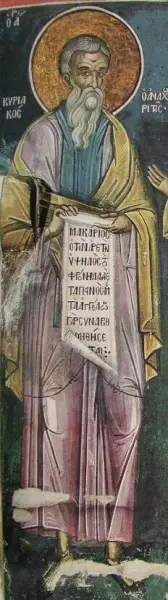
Kyriakos was never canonized by any process, for he belongs to the company of pre-congregation saints whose veneration arose from the memory of the monasteries that preserved his life. He is venerated across the Eastern Orthodox Church, the Eastern Catholic Churches, and the Oriental Orthodox Churches. His principal feast falls on September 29 in the Eastern Orthodox and Eastern Catholic calendars; the Coptic Orthodox Church keeps his memory on November 10, and the Armenian Apostolic Church on January 21 — three dates that trace the spread of his cult through the different liturgical families of eastern Christianity. His image survives in the wall paintings of the Orthodox world: a fresco of the saint appears in the Dionysiou Monastery on Mount Athos, and another in the Panagia tou Araka church in Cyprus, testifying to the reach of his cult beyond the Palestinian deserts where he lived. In the Orthodox East he is honored with the title of Venerable, the rank of the monastic saints, and his life is read in the synaxaria on his feast, where the church celebrates the man who came to Jerusalem as a runaway youth and remained in its wildernesses for ninety years.
§ Veneration
The Saint of the Grape Harvest
The most vivid survival of Cyriacus' cult is agricultural. In Serbia, the feast of Saint Cyriacus closes the season of the grape gathering, and it is kept with a Slava, the distinctive Serbian custom of the ritual keeping of a family's patron saint. The association of an anchorite of the Judean wilderness with the vineyards of the Balkans shows how a saint's calendar could be transplanted and put to work: the day of a desert ascetic became the fixed point by which the Serbian vintage was measured, and the family feasts of Velika Hoca and other villages kept his name alive long after the memory of the desert had faded. That this legacy belongs to a man who owned nothing — who gave up Corinth, family, and finally speech itself — is one of the quiet ironies of hagiographic history. His cult also reached the artists of the Orthodox world, who painted him in the frescoes of Dionysiou on Mount Athos and Panagia tou Araka in Cyprus, and the synaxaria of the Greeks, Copts, and Armenians each set his feast on their own calendars. The boy who fled a church service in Corinth to follow the Gospel ended by giving the church of three nations a day on which to stop working and give thanks.
§ Veneration
Timeline
- 448
Born at Corinth in Greece, son of the priest John and his mother Eudoxia; his kinsman Bishop Peter of Corinth made him a reader in church.
§ Introduction
- 465
Before his eighteenth year a service on Matthew 16:24 so moved him that he went straight to the harbour and sailed for Jerusalem.
§ Early life
- 466
After visiting the holy places and months at a monastery near Sion under Abba Eustorgius, he reached the Lavra of Euthymius, who tonsured him and placed him under Gerasimus.
§ Early life
- 475
At twenty-seven, after his mentor Gerasimus died and Euthymius too had passed away, he received a solitary cell for silent asceticism.
§ Early life
- 485
At thirty-seven years of age, after ten years of total silence, he was ordained to the diaconate.
§ Early life
- 490
When a split divided the monasteries of Euthymius and Theoctistus, he withdrew to the Souka monastery of Chariton, later serving eighteen years as canonarch.
§ Early life
- 518
At seventy years old he withdrew into the Natoufa wilderness with his disciple John, where the hermits fed on bitter herbs.
§ Early life
- 528
In his eightieth year, seeking complete solitude from the crowds seeking his help, he fled to the hidden Sousakim wilderness.
§ Early life
- 535
Seven years after his arrival, the Souka brethren begged his help during a time of debilitating hunger and illness; he then settled in Chariton's cave.
§ Early life
- 547
At ninety-nine he went out again to Susakim with his disciple John, a period rich in legends of men saved from lions and rain won by prayer.
§ Early life
- 555
For the two final years of his life he returned to the monastery and settled again in the cave once lived in by Chariton.
§ Early life
- 557
He summoned the brethren, blessed them all, and died at about one hundred and eight years of age in the Cave of St Chariton in Palestine.
§ Early life
The Record
- Patron of
- end of the grape harvest (in Serbia, where his feast is kept with a Slava)
- Canonization
- Pre-congregation; venerated in the Eastern Orthodox, Eastern Catholic, and Oriental Orthodox churches
Prayer
Bibliography
Show 6 sources
- "Ὁ Ὅσιος Κυριακὸς ὁ Ἀναχωρητής" [Saint Kyriakos the Anchorite]. Synaxarion.gr (in Greek).
- "Sept. 29 Our Venerable Father Cyriacus the Anchorite". St. Mary Byzantine Catholic Church.
- "Cyriacus the Hermit of Palestine". Greek Orthodox Archdiocese of America.
- "Saint Cyriacus the Anchorite Solemnly Celebrated in Velika Hoca". Serbian Orthodox Church. 13 October 2011.
- Kettern, Bernd. "Kyriakos". Biographisch-Bibliographisches Kirchenlexikon (BBKL). Vol. 4. pp. 871–873.
- "Venerable Kyriakos the Anchorite". Orthodox Church in America.
Profile text adapted from the Wikipedia article, licensed CC BY-SA 4.0.
Pray with this saint every day
Save St. Cyriacus the Anchorite to your favorites, read the full profile, and get feast-day reminders in the Saints app.
Get the Saints AppFree on the App Store for iPhone and iPad