
c. 376 – 444·Feast 27 June (Catholic, Coptic, Lutheran); 18 January and 9 June (Eastern Orthodox); 28 January (Western Rite Orthodoxy)
St. Cyril of Alexandria
Patriarch of Alexandria; Doctor of the Church
Overview
Cyril led the church of Alexandria at the height of its power and used every ounce of that power in the theological battles that would decide what Christians would believe about Christ. Born around 376 into a family tied to the patriarchate — his maternal uncle Theophilus held the see before him — he received the standard elite education in grammar, rhetoric and biblical study, and in 403 accompanied Theophilus to the Synod of the Oak that deposed John Chrysostom. He succeeded his uncle as patriarch in October 412, taking office amid rioting against a rival candidate, and quickly showed how firmly he intended to rule: he closed Novatianist churches, quarrelled with the pagan prefect Orestes, and presided over a city in which the Jewish community was attacked and largely expelled and in which the philosopher Hypatia was murdered by a Christian mob. His name is most securely attached to the controversy with Nestorius, the Patriarch of Constantinople, who refused to call Mary Theotokos, the Mother of God. Cyril answered with letters, anathemas and a torrent of treatises arguing that the divine Word genuinely suffered in the flesh he had assumed; when Emperor Theodosius II convoked a general council at Ephesus in 431, Cyril presided over it, saw Nestorius deposed, and survived his own deposition by the counter-council of John of Antioch. He died in 444, leaving behind writings his adversaries could never hope to equal, and a Christology that both the Council of Chalcedon and the Oriental Orthodox traditions would claim as their own. Leo XIII named him a Doctor of the Church in 1883.
The Complete Life
Origins and Rise
The record of Cyril's first decades is thin, but its outlines are secure. He was born around 376 at Didouseya in the Nile delta, the town now called El-Mahalla El-Kubra, and his future was shaped when his mother's brother Theophilus climbed to the patriarchal throne of Alexandria. Under that powerful patron he received the conventional pagan-then-Christian curriculum of the age: grammar between twelve and fourteen, rhetoric and the humanities to twenty, theology and Scripture after that. His writings show him steeped in Eusebius, Origen, Didymus the Blind and the Alexandrian exegetical tradition. In 403 he went with his uncle to Constantinople for the Synod of the Oak, where Theophilus, having marched against Egyptian monks he branded Origenists, assembled twenty-nine suffragan bishops to draw up charges against John Chrysostom. Chrysostom refused to be judged by his enemies and was deposed; the episode gave the young Cyril a firsthand lesson in the collision of sees and the use of councils as weapons.
§ Early life
Patriarch in a Violent City
Theophilus died in the autumn of 412; three days afterward, amid rival claims, Cyril was enthroned, but only after street fighting between his adherents and those of the archdeacon Timotheus. The see he inherited stood nearly equal to the imperial prefecture in a cosmopolitan capital whose pagan, Jewish and Christian populations lived in chronic friction. Cyril moved first against the Novatianists, closing their churches and confiscating their vessels, and then collided with the prefect Orestes, who resisted every ecclesiastical encroachment on civil authority. The killing of a proclamation gathering turned ugly when Cyril's lector Hierax was publicly tortured on the prefect's order; violence between Christians and Jews followed, and after a night ambush that left Christians dead in the streets, Cyril had the Jewish community expelled from the city and their property pillaged. Nitrian monks who came to intimidate Orestes only made matters worse — one of them, Ammonius, struck the prefect with a stone and died under torture, honored by the patriarch as a martyr to the embarrassment of most Christians. In the same poisoned season, during Lent of 415, a mob led by the lector Peter dragged the philosopher Hypatia, Orestes's ally, from her carriage and killed her in the Kaisarion; no ancient source but the anti-Christian Damascius names Cyril himself as responsible, yet the shame of the murder fell on the Alexandrian church, and the emperors responded by stripping the parabalani, the patriarch's notorious corps of attendants, of much of their power.
§ Dispute with the Prefect
The Battle over the Mother of God
The quarrel that fixed Cyril's place in history began in 428 when Nestorius, a preacher of the Antiochene school, became Archbishop of Constantinople and declined to silence a priest who attacked the title Theotokos for Mary. Nestorius offered Christotokos, Mother of Christ, instead, and spoke of the divine Word and the man Jesus in a way Cyril regarded as splitting the one subject of the Incarnation in two. For Cyril the heart of the matter was not devotion to Mary but the suffering of Christ: the Word made flesh truly suffered in that flesh, and the one who walked the streets of Nazareth was God. At Easter 429 he alerted the Egyptian monks to Nestorius's teaching; a strident correspondence followed; and in 430 Cyril issued his Twelve Anathemas, condemning anyone who would not confess Mary as Theotokos. Theodosius II called a general council to Ephesus, a city devoted to the Virgin, for 431. Cyril opened it before the Antiochene bishops arrived, and the council deposed Nestorius in his absence; when John of Antioch's party arrived they held a counter-council that condemned and deposed Cyril, calling him a monster bred for the church's destruction. The emperor briefly arrested Cyril, who escaped to Egypt, bribed the court, and unleashed a mob of monks under the hermit Dalmatius on the palace until Theodosius yielded and sent Nestorius into exile. Reunion with John of Antioch came in 433 on a formula both sides could sign, though the peace lasted only until the controversies that produced Chalcedon.
§ Conflict with Nestorius
Theology and Mariology
Cyril's theology rests on a single intuition of immense consequence: the embodiment of God in Jesus is so powerful that it streams outward from the God-man to reconstitute human nature itself in a graced and deified condition, promising immortality and transfiguration to believers. Against Nestorius's morally instructive incarnation, Cyril insisted that God walked the streets of Nazareth. He confessed one incarnate nature of God the Word — the phrase the Oriental Orthodox would make their banner — while teaching one divine ousia in three hypostases, Father, Son and Holy Spirit. He distinguished the Word's state before the enfleshing from the state of the enfleshed Word, arguing for an unbroken continuity of subject: the Logos was really present in the flesh, not merely associated with the man Jesus. His Mariology flowed from this Christology rather than preceding it. Before 429 he scarcely used the title Theotokos; controversy compelled him to develop it, and at Ephesus his homilies — above all Homily IV, with its hails to the Virgin as container of the uncontained and place of the infinite — gave Marian devotion some of its earliest and most influential liturgical language. The Second Council of Constantinople in 553 later crowned his memory, declaring that Cyril had announced the right faith of Christians.
§ Theology
Works and Legacy
Cyril wrote the way other men breathed. His exegetical years produced commentaries on the Old Testament, the Gospel of John, the Gospel of Luke and the Letter to the Hebrews, the Thesaurus, the Discourse Against Arians and the Dialogues on the Trinity; the Nestorian years added the three epistles to Nestorius, the five books against his blasphemies, On the Unity of Christ, the Formula of Reunion and the polemic Against Julian the Apostate. His output grew so voluminous during the controversy that his adversaries could not answer it all. The cost of his greatness is the shadow beside it: the same will that crushed Nestorius presided over a city torn by communal violence, and historians still argue how much of the Alexandrian bloodletting of 415 clings to his name. Yet the judgment of the churches has been constant. East and West venerate him as the Pillar of Faith and Seal of the Fathers; the Oriental Orthodox took his formula as their watchword; and when Leo XIII proclaimed him Doctor of the Church in 1883, he did so precisely as the doctor of the Incarnation.
§ Works
Timeline
- 376
Born around this year at Didouseya in Egypt, into the family circle of his uncle, the future patriarch Theophilus
§ Introduction
- 18 Oct 412
Made Patriarch of Alexandria on 18 October, three days after Theophilus died, following a riot against his rival Timotheus
§ Patriarch of Alexandria
- 415
Feud with prefect Orestes erupts after the public torture of the lector Hierax; the Jews of Alexandria are attacked and banished
§ Dispute with the Prefect
- Mar 415
During Lent, a Christian mob led by the lector Peter murders the philosopher Hypatia in the former Kaisarion
§ Murder of Hypatia
- 429
At Easter writes to the Egyptian monks warning against the teaching of Nestorius on the Theotokos
§ Conflict with Nestorius
- 430
Composes the twelve anathemas condemning anyone who refuses to call Mary Theotokos
§ Mariology
- 431
Presides over the Council of Ephesus, which deposes Nestorius; a rival council deposes Cyril, who is arrested but escapes and prevails
§ Conflict with Nestorius
- 444
Dies in Alexandria after a patriarchate lasting from 412, leaving the christological controversies still unresolved
§ Conflict with Nestorius
- 553
The Second Council of Constantinople honors him with the declaration that he announced the right faith of Christians
§ Mariology
- 1883
Pope Leo XIII names him a Doctor of the Church under the title Doctor Incarnationis
§ Introduction
In Their Own Words
That anyone could doubt the right of the holy Virgin to be called the Mother of God fills me with astonishment. Surely she must be the Mother of God if our Lord Jesus Christ is God, and she gave birth to him! Our Lord’s disciples may not have used those exact words, but they delivered to us the belief those words enshrine, and this has also been taught us by the holy fathers.
We affirm that the natures are different that are united in one true unity, but from both has come only one Christ and Son; not because, due to their unity, the difference in their natures has been eliminated, but rather, because divinity and humanity, reunited in an ineffable and indescribable union, have produced for us one Lord and Christ and Son. We will profess only one Christ and Lord, not in the sense that we worship the man together with the Logos, in order not to suggest the idea of separation by saying "together', but in the sense that we worship only one and the same, because he is not extraneous to the Logos, his body, with which he also sits at his Father's side, not as if "two sons" are sitting beside him but only one, united with his own flesh.
For the faith of Christ we are ready to suffer everything: chains, prison, all the inconveniences of life and death itself.
The Record
- Major works
- Commentaries on the Old Testament·Thesaurus·Discourse Against Arians·Commentary on the Gospel of John·Dialogues on the Trinity·Second Epistle to Nestorius·Third Epistle to Nestorius (with the twelve anathemas)·Five Tomes Against Nestorius·That Christ is One·Formula of Reunion with John of Antioch·Commentary on the Gospel of Luke·Against Julian the Apostate·Glaphyra on the Pentateuch·Commentary on the Twelve Prophets·Festal Letters
- Patron of
- Alexandria
- Symbols
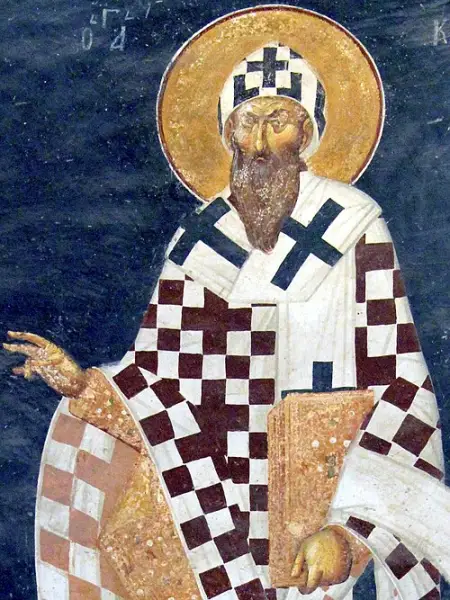
- Bishop's vestments with phelonion and omophorion·Head covered in the manner of Egyptian monastics, sometimes with a polystavrion pattern·Gospel Book or scroll·Right hand raised in blessing
- Canonization
- Venerated as a saint since antiquity by the Catholic, Eastern Orthodox and Oriental Orthodox Churches; declared a Doctor of the Church by Pope Leo XIII in 1883 under the title Doctor Incarnationis
Prayer
Bibliography
Show 8 sources
- Henry Palmer Chapman (1908). "St. Cyril of Alexandria". In Catholic Encyclopedia. 4. New York: Robert Appleton Company.
- Chisholm, Hugh, ed. (1911). "Cyril (bishop of Alexandria)". Encyclopædia Britannica. 7 (11th ed.). Cambridge University Press. p. 706.
- Russell, Norman (2002). Cyril of Alexandria: The Early Church Fathers. Routledge. ISBN 9781134673377.
- Farmer, David Hugh (1997). The Oxford Dictionary of Saints (4th ed.). Oxford University Press. ISBN 978-0-19-280058-9.
- Wessel, Susan (2004). Cyril of Alexandria and the Nestorian Controversy: The Making of a Saint and of a Heretic. Oxford: Oxford University Press. ISBN 9780199268467.
- Watts, Edward J. (2017). Hypatia: The Life and Legend of an Ancient Philosopher. Oxford: Oxford University Press. ISBN 978-0190659141.
- Haas, Christopher (1997). Alexandria in Late Antiquity: Topography and Social Conflict. Baltimore: The Johns Hopkins University Press. ISBN 978-0-8018-5377-7.
- McGuckin, John A. (1994). St. Cyril of Alexandria: The Christological Controversy: Its History, Theology, and Texts. Leiden: Brill. ISBN 9789004312906.
Profile text adapted from the Wikipedia article, licensed CC BY-SA 4.0.
Pray with this saint every day
Save St. Cyril of Alexandria to your favorites, read the full profile, and get feast-day reminders in the Saints app.
Get the Saints AppFree on the App Store for iPhone and iPad