
1337 – 1427·Feast June 9 (Russian Orthodox Church)
St. Cyril of Beloozero
Russian Monk; Founder of the Kirillo-Belozersky Monastery
Overview
Cyril of Beloozero, born Kozma into the orbit of Moscow's boyar elite in 1337, traded a life of privilege for one of the strictest monastic rules Russia has known, and planted in the northern forests the monastery that grew larger than any other in the Russian North. Orphaned young and connected to the Velyaminov boyar family, he entered Moscow's Simonov Monastery around 1380 and took the name Cyril. There he came under the influence of Sergius of Radonezh, the great reformer of Russian monasticism. When his superior Feodor was made Bishop of Rostov in 1387, Cyril succeeded him as archimandrite — and then walked away from the office, finding that rule over a great monastery demanded too much entanglement in public affairs. He stepped down, lived awhile as a plain monk elsewhere, and finally withdrew with the monk Therapont toward Lake Beloye in the far north. Following Sergius's advice he first dug himself a cave, then raised a wooden chapel of the Dormition and huts for other monks. Therapont, finding Cyril's discipline too harsh, soon left to found his own house, but Cyril's settlement grew into the Kirillo-Belozersky Monastery, whose first hegumen he remained, buying vast lands until it stood as the largest monastery of northern Russia. He died there in 1427 at the age of ninety. The Russian Church canonized him at the Makaryev councils of 1547, and his feast is kept on June 9.
The Complete Life
From Boyar Moscow to the Simonov Cloister
Kozma's birth in Moscow in 1337 placed him, though the details of his parentage remain obscure, near the boyar family of Velyaminov, one of the great houses of the grand princely court. His parents died while he was still a child, and the orphan's path led not to inherited rank but to the cloister: around 1380 he received the habit at the Simonov Monastery, one of Moscow's principal houses, under the new name Cyril. There he fell under the spiritual influence of Sergius of Radonezh, whose revival of monastic life — combining strict asceticism with the foundation of new communities in the wilderness — was reshaping Russian spirituality. It was the pattern Cyril's own life would follow.
§ Biography
Founder in the Wilderness
In 1387 the archimandrite Feodor was elevated to the bishopric of Rostov and Cyril, apparently his trusted deputy, took his place as head of the Simonov Monastery. The office suited him poorly. He judged that governing a great monastery entangled a monk too deeply in public affairs, resigned, moved to a neighboring house as an ordinary monk, and then resolved on the radical step of total withdrawal. With Therapont, a fellow monk of Simonov who shared the longing, he set out for Lake Beloye in the country's far north. On arrival, he took the advice of Sergius of Radonezh and began as a hermit, digging a cave; only afterwards did a wooden chapel in honor of the Dormition and log huts for other monks rise around him. The partnership with Therapont did not last — that holy man found Cyril's regime excessively strict and within a year withdrew to found the Ferapontov Monastery nearby — but Cyril held to his rule without softening. As first hegumen of what became the Kirillo-Belozersky Monastery he directed the purchase of large estates, and under his government the house began the growth that would make it the greatest monastery in the Russian North.
§ Biography
Death and Veneration
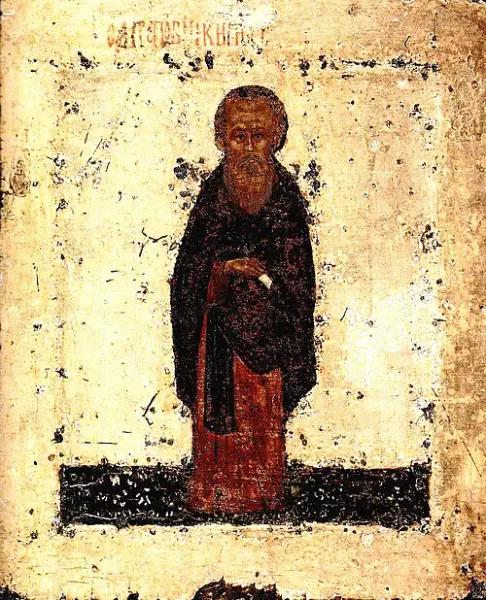
Cyril died in 1427 at the age of ninety, in the monastery he had carved out of the northern forest. The community he left behind grew into the largest monastery of northern Russia, a spiritual and economic power whose white walls still rise above Lake Siverskoye. The Russian Orthodox Church formally recognized his sanctity at the Makaryev councils of 1547, the great century of Russian canonizations, and his memory is kept on June 9. Several churches in Russia bear his name today, and the icon of him attributed to Dionisius Glushitsky, painted as early as 1424, preserves the face the first generation of his monks knew.
§ Biography
Timeline
- 1337
Born as Kozma in Moscow to a family tied to the Velyaminov boyars; orphaned in childhood
§ Biography
- 1380
Receives monastic tonsure at Moscow's Simonov Monastery, taking the name Cyril
§ Biography
- 1387
Succeeds Feodor as archimandrite of Simonov when Feodor is made Bishop of Rostov, then resigns the burdensome office
§ Biography
- 1397
Founds the Kirillo-Belozersky Monastery beside Lake Beloye, having withdrawn north with the monk Therapont
§ Introduction
- 1398
Therapont departs within a year, finding Cyril's rule too strict, and establishes the nearby Ferapontov Monastery
§ Biography
- 1427
Dies at the monastery he founded, aged ninety, having made it the largest in northern Russia
§ Biography
- 1547
Makaryev Sobors of the Russian Orthodox Church recognize him as a saint
§ Biography
The Record
- Symbols
- Monastic habit of the northern Russian hesychast tradition·Kirillo-Belozersky Monastery
- Canonization
- Canonized by the Makaryev Councils of the Russian Orthodox Church in 1547
Prayer
Bibliography
Show 4 sources
- Голубинский, Евгений Евсигнеевич. Преподобный Кирилл Белозерский (in Russian). Голубинский. Настоящая история Церкви. Retrieved 12 November 2011.
- Orthodox Calendar, Saint Herman Press Calendar, Orthodox Liturgical Calendar of The St. John of Kronstadt Press, Holy Trinity Orthodox Church, Baltimore MD.
- "Преподобный Кирилл, игумен Белоезерский", Orthodox Calendar, Pravoslavie.RU, in Russian.
- "Кирилл, преподобный белозерский". Brockhaus and Efron Encyclopedic Dictionary (in Russian). 1906.
Profile text adapted from the Wikipedia article, licensed CC BY-SA 4.0.
Pray with this saint every day
Save St. Cyril of Beloozero to your favorites, read the full profile, and get feast-day reminders in the Saints app.
Get the Saints AppFree on the App Store for iPhone and iPad