
c. 313 – 386·Feast 18 March (Catholic Church, Church of England, Byzantine Christianity); 7 May (Byzantine Christianity, miracle of the cross); Paremhat 22 (Coptic Church)
St. Cyril of Jerusalem
Bishop of Jerusalem; Confessor of the Faith; Doctor of the Church
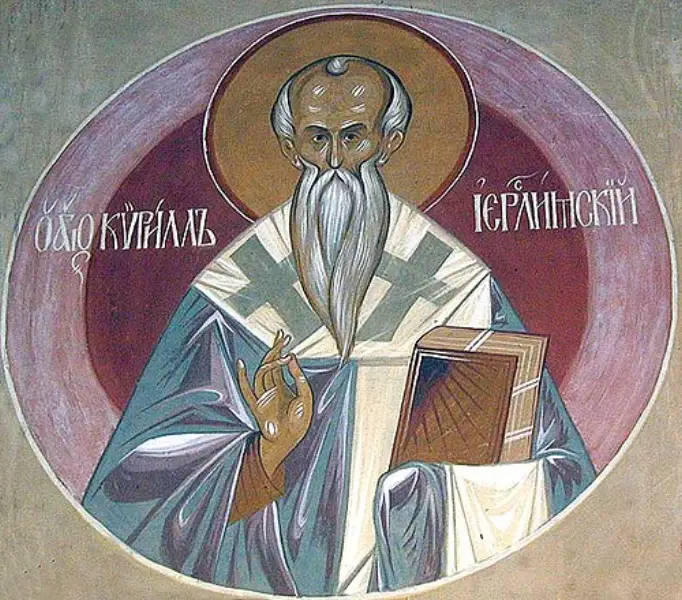
Overview
Cyril of Jerusalem shepherded the most contested city in Christendom through four decades of Arian emperors, exiles and earthquakes, and left behind the clearest window anyone possesses into how fourth-century Christians were taught the faith and initiated into its mysteries. Born around 313, probably in or near the Holy City, he was ordained deacon by Bishop Macarius around 335 and priest by Bishop Maximus some eight years later. Toward the end of 350 he succeeded Maximus as Bishop of Jerusalem. His episcopate was repeatedly wrecked by the hostility of Acacius, the Arian-leaning metropolitan of Caesarea, who prosecuted him for selling church treasures — reportedly to feed the city's starving poor — and secured his deposition in 357. Restoration in 359 was reversed in 360; Julian's accession brought him home in 361; Valens banished him again in 367; and only after Valens died in 378 did Cyril hold his see undisturbed until his death in 386. In 381 he attended the First Council of Constantinople, which confirmed his jurisdiction over Jerusalem, and there he voted to accept the homoousion, the same Nicene creed he had long approached with caution. His enduring monument is the set of twenty-three catechetical lectures delivered in the basilica Constantine built and, in Easter week, in the Church of the Anastasis — documents of such precision that liturgists still reconstruct the Jerusalem initiation rites from them. Leo XIII declared him a Doctor of the Church in 1883.
The Complete Life
Early Life and Ordination
Almost nothing is recorded of Cyril before his episcopate, and even the year of his birth rests on conjecture, with the traditional date around 313 or a little later. Butler's account has him born at or near Jerusalem itself, widely read in the fathers of the church and in the Greek philosophers alike. Macarius, bishop of the city, ordained him deacon around 335; Maximus, Macarius's successor, ordained him priest roughly eight years after that. In those years as a presbyter he carried the bishop's delegated duty of instructing the candidates who presented themselves each Lent for baptism at Easter — the ministry that produced the lectures on which his fame rests. The pilgrim Egeria would later describe him as both preacher and liturgist of the Jerusalem church.
§ Life and character
Exiles and Returns
Cyril's episcopate cannot be separated from his long duel with Acacius of Caesarea, the metropolitan on whom Jerusalem's see formally depended. Orthodox historians paint Acacius as a leading Arian and trace the enmity to doctrine; Sozomen adds that Acacius resented the rank Nicaea had given Jerusalem and watched with alarm as the city became the empire's premier destination for pilgrims. The charge that finally stuck was the sale of church property. When famine gripped Jerusalem, Sozomen and Theodoret report, Cyril secretly disposed of the church's sacramental ornaments and even a gold-threaded robe that Constantine had given the bishop for baptisms, apparently so that the population might be fed. He refused Acacius's summons to answer for it for two years, until a packed council deposed him in his absence in 357 and he fled to Silvanus of Tarsus. The Council of Seleucia reinstated him in 359 and deposed Acacius instead; Constantius reversed everything in 360; the pagan emperor Julian, oddly Cyril's benefactor, allowed his return in 361; Valens drove him out again in 367; and Valens's death in 378 at last ended the expulsions. The First Council of Constantinople in 381, which Cyril attended in person, expressly confirmed his jurisdiction over Jerusalem, and there he cast his vote for the homoousios, the one-nature term Nicaea had coined — a conversion emblematic of the many Eastern bishops who first distrusted Nicaea and lived to defend it.
§ Episcopacy
The Catechetical Lectures
The twenty-three lectures by which Cyril is known divide naturally in two. The first eighteen, the Catechetical Lectures proper, were preached in the Martyrion, Constantine's basilica, to those still in the final preparation for baptism — traditionally dated to about 350 or, if Cyril was still a priest deputizing for Maximus, to 348. Each lecture takes a text of Scripture as its base and expounds, in warm pastoral language rather than academic argument, the faith as the Jerusalem church then received it, including the text of the creed, alongside vigorous polemic against pagan, Jewish and heretical error. The thirteenth lecture, on the crucifixion and burial of Jesus, insists that Christ went to his death knowingly and willingly, forgiving his betrayers and executioners to the end. The final five, the Mystagogic Catecheses, instructed the newly baptized during Easter week in the Church of the Anastasis on the sacraments they had now received — baptism, confirmation and the Eucharist. Their authorship has been contested, some scholars assigning them to Cyril's successor John, though the prevailing view now returns them to Cyril, written perhaps in the 370s or 380s. For historians of liturgy the lectures are priceless: they preserve the fullest surviving account of how catechumens were actually taught and initiated in the fourth century.
§ Catechetical lectures
Theology and Eschatology
Cyril's theology moved from cautious indefinite phrasing to a firm and thorough adherence to Nicene orthodoxy. Even where he avoided the contested term homoousios he expressed its meaning, steering equally clear of Patripassianism, Sabellianism and the Arian claim that once the Son did not yet exist. He stood with the Eastern Fathers on the freedom of the will, taught that sin is the consequence of freedom rather than a condition of nature, the body its instrument rather than its cause, and repentance its remedy, and he made high moral living essential to genuine Christianity. His writing is filled with the forgiving, healing character of God and the gentleness of the Holy Spirit, and he bore no visible ill will toward the men who repeatedly drove him from his see. Soon after becoming bishop he wrote to Emperor Constantius describing a cross of light that shone over Golgotha in 351, seen by all Jerusalem, which the Greek church still commemorates on 7 May; he read it as heaven's endorsement of the emperor and as an announcement of the Second Coming, toward which his whole eschatology oriented Jerusalem — he saw the Lord's coming written even in Julian's Persian war, the earthquake of 363, and the discord between the sees of Caesarea and Jerusalem.
§ Theological position
Veneration and Legacy
Cyril died in 386 and was venerated across the divided church of later centuries: Catholic, Eastern Orthodox, Oriental Orthodox, Anglican and Lutheran calendars all carry his name, on 18 March in the West and in Byzantine use, and on Paremhat 22 among the Copts. Leo XIII raised him to the rank of Doctor of the Church in 1883, the same year he so honored Cyril of Alexandria — the two Cyrils, bishop of the Holy City and patriarch of the Nile, honored together as teachers of the incarnate and confessing faith. His practical legacy is the catechumenate itself: every reconstruction of how a fourth-century Christian moved from the Enrollments through Lenten scrutiny to the lights of the Easter vigil runs through his lectures, and his witness to a bishop who sold the sacred vessels rather than let his people starve, and who forgave his persecutors through sixteen years of exile, has kept his memory green wherever the church is tested by power.
§ Introduction
Timeline
- 313
Born, probably at or near Jerusalem or Caesarea Maritima, though one tradition assigns his birth to 315 on conjecture alone.
§ Introduction
- 335
Ordained a deacon of the church of Jerusalem by Bishop Macarius.
§ Life and character
- 343
Ordained a priest by Bishop Maximus, some eight years after his diaconate.
§ Life and character
- 348
His twenty-three catechetical lectures to those preparing for baptism are variously placed in this year, while he was still a priest, or in his early episcopate.
§ Catechetical lectures
- 350
Succeeded Maximus as Bishop of Jerusalem toward the end of the year.
§ Life and character
- 7 May 351
Recorded in his Letter to Constantius a cross of light over Golgotha seen by all Jerusalem, a miracle the Greek church keeps on this day.
§ Eschatology
- 357
Deposed in his absence by a council held under Acacius of Caesarea's influence, after two years resisting summons over sold church goods; he took refuge with Silvanus of Tarsus.
§ Episcopacy
- 359
Reinstated by the Council of Seleucia, which instead deposed Acacius.
§ Episcopacy
- 360
Constantius reversed the Seleucia decision, and a further year of banishment from his see followed for Cyril.
§ Episcopacy
- 361
Allowed to return to Jerusalem on the accession of Emperor Julian.
§ Episcopacy
- 363
Jerusalem was struck by an earthquake while Julian attempted to rebuild the temple, a sign Cyril read apocalyptically.
§ Eschatology
- 367
Banished once more from Jerusalem by the Arian emperor Valens.
§ Episcopacy
- 375
The Mystagogic Catecheses for the newly baptized are dated by many scholars to his later years, in the 370s or 380s, rather than to his time as priest.
§ Mystagogic Catecheses
- 378
Returned to Jerusalem after Valens's death, remaining undisturbed for the rest of his life.
§ Episcopacy
- 381
Present at the First Council of Constantinople, which confirmed his jurisdiction over Jerusalem and where he voted for the term homoousios.
§ Episcopacy
- 386
Died in Jerusalem at about seventy-three years of age.
§ Introduction
- 1883
Pope Leo XIII declared him a Doctor of the Church.
§ Introduction
In Their Own Words
The Spirit comes with the tenderness of a true friend to save, to heal, to teach, to counsel, to strengthen and to console.
The Record
- Major works
- Procatechesis (introductory lecture to catechumens)·Catechetical Lectures (eighteen Lenten lectures)·Mystagogic Catecheses (five lectures on the sacraments, authorship debated)·Letter to Constantius (351)·Homily on the Paralytic at the Pool of Bethesda
- Canonization
- Venerated as a saint since antiquity; declared a Doctor of the Church by Pope Leo XIII in 1883
Prayer
Bibliography
Show 7 sources
- Galadza, Daniel (2018). Liturgy and Byzantinization in Jerusalem. Oxford University Press. p. 278. ISBN 978-0-19-881203-6.
- "March 18: St. Cyril of Jerusalem". Catholic Telegraph. 17 March 2022. Retrieved 15 March 2023.
- Walsh, Michael, ed. (1991). Butler's Lives of the Saints. HarperCollins Publishers: New York, pp. 83.
- Henry Palmer Chapman (1908). "St. Cyril of Jerusalem". In Catholic Encyclopedia. 4. New York: Robert Appleton Company.
- Drijvers, Jan Willem (2004). Cyril of Jerusalem: Bishop and City. Supplements to Vigiliae Christianae. Vol. 72. Brill.
- Doval, Alexis James (2001). Cyril of Jerusalem, Mystagogue: The Authorship of the Mystagogic Catecheses. Washington, D.C.: Catholic University of America Press. ISBN 0-8132-1079-8.
- Wilkinson, John: Egeria's Travels. Oxbow Books, Oxford 2015. ISBN 978-0-85668-710-5.
Profile text adapted from the Wikipedia article, licensed CC BY-SA 4.0.
Pray with this saint every day
Save St. Cyril of Jerusalem to your favorites, read the full profile, and get feast-day reminders in the Saints app.
Get the Saints AppFree on the App Store for iPhone and iPad