
fifth century·Feast December 16
St. Dabheog
Fifth-century abbot and patron of Lough Derg
Overview
Dabheog stands at the head of the spiritual history of Lough Derg, the lake in County Donegal whose island sanctuary became one of the great pilgrimage places of Europe. Local records remember him as abbot of Lough Derg in the fifth century, and the historian John Healy records that he was born in Wales, a son of King Breca, also called Brychan, the celebrated father of a whole generation of Welsh saints. The tradition ranks him among the companions of St. Patrick, entrusting to his care the site that would become known as St. Patrick's Purgatory on one of the lake's islands; he also took charge of a church and hermitage in Tirhugh. A firmly rooted tradition holds that during Patrick's own lifetime Dabheog presided over, and perhaps established, the monastery on the island. His name fixed itself on the surrounding country: a seat on the lake's southern shore, the townland of Seedavoc, a mountain, and an island all carry it still. Over the following centuries the Clan McGrath, hereditary overseers of Lough Derg, honoured him as their patron, and modern pilgrims continue to climb to his Chair and pray in a cell dedicated to him.
The Complete Life
A Welsh Prince Among Irish Saints
The origins of Dabheog lie across the Irish Sea. The antiquary John Healy, writing his study of St. Patrick, states plainly that the saint was born in Wales, and identifies his father as King Breca, or Brychan — a king remembered less for his reign than for a progeny so numerous and holy that Welsh tradition calls him the father of the saints. To be counted among Brychan's children is to stand within one of the most prolific saint-making families of the early Celtic world, and Dabheog's placement in that line explains how a British Christian came to cross into Ireland in the age of its conversion. The sources are otherwise silent about his childhood and the circumstances of his journey, and the extraordinary variety of his recorded names — Dabeoc, Davog, then Davoc or Daboc, Beoc, Mobeoc with Mobheog, and finally Daveoc and Daveog — reflects the uncertainty that hangs over his biography. Scholars attribute this profusion of forms to the absence of standardised spelling in the Irish language and to the genuinely obscure character of the period in which he lived. What the tradition preserves without hesitation is the essential movement of his life: from a royal Welsh household to an island in a Donegal lake, where he would spend his days in Patrick's service.
§ Biography
Disciple of Patrick, Keeper of the Purgatory
Everything that is distinctive about Dabheog's vocation flows from his connection to St. Patrick. The tradition counts him among the patrician disciples, and to him fell a responsibility unique in the history of Irish spirituality: the care of the site on one of Lough Derg's islands that came to be known as St. Patrick's Purgatory. Whatever form the place took in the fifth century, it was destined to become the most celebrated penitential sanctuary of medieval Europe, drawing pilgrims from every corner of Christendom. Alongside this island charge, Dabheog accepted responsibility for a church and hermitage in Tirhugh, extending his ministry onto the mainland. A tradition recorded with unusual firmness holds that during Patrick's lifetime the saint presided over — and may well have established — the monastery that stood on the island site. The picture that emerges is of a trusted lieutenant rather than an independent operator: a foreign-born disciple to whom the apostle of Ireland could confide one of the holiest places in his mission. In an age when the church of Ireland was being organised from the ground up, Dabheog's work at Lough Derg gave the sanctuary its founding charism, and the penitential character for which the place became famous descends from the discipline he instituted there.
§ Biography
Abbot of Lough Derg
The local records of County Donegal speak of Dabheog simply as an abbot of Lough Derg in the fifth century, and it is in that office that his historical substance consists. Monastic abbot, guardian of a pilgrimage site, and pastor of a mainland church at Tirhugh — these were the three strands of his responsibility. The island monastery of which he had charge stood at the beginning of a tradition that would make Lough Derg a byword for penance throughout Europe, and the medieval writers who traced the sanctuary's origins unanimously reached back to him. His authority was exercised during the lifetime of Patrick himself, which places his abbacy among the earliest in the Irish church. Beyond the monastery walls his name settled into the geography of the region with remarkable tenacity: St. Dabheoc's Chair marks the southern bank of the lake; the townland of Seedavoc preserves the memory of his Seat; Seavadog Mountain keeps his name on the skyline; and one of the lake's islands, possibly the one now called Saints Island, bore his name from the early centuries. A landscape so thoroughly inscribed with one man's name testifies to a founder whose presence was decisive and whose memory the people of the region refused to surrender.
§ Biography
Pilgrims, Clans, and a Saint's Heath
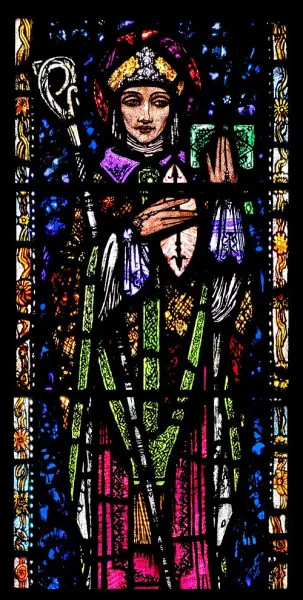
Dabheog's afterlife in the devotion of Lough Derg has been extraordinarily durable. From the thirteenth to the seventeenth century the Clan McGrath served as Coarbs — hereditary overseers — of Lough Derg, and they regarded Dabheog as their patron saint, binding their own family fortunes to his intercession. Modern Catholic pilgrimage at the lake continues to centre on him in concrete ways: pilgrims make the short climb to a pre-Christian Bronze Age burial mound on the hill above the lake, known as Dabheog's Chair or Seat, and they meditate in one of the beehive cells on Station Island that is dedicated to him. Even the boats that ferry penitents across to Station Island carry his name, as does the valley that looks down on Lough Erne. Botany, too, remembers him: the heath plant Daboecia took its scientific name from St. Dabheog's heath, a living monument peculiar among the saints. In stained glass at St. Joseph's in Carrickmacross and at St. Macartan's Cathedral his figure appears, designed by the Harry Clarke Studios. For a saint about whom so little can be historically asserted, the density of these memorials — liturgical, familial, topographical, and artistic — is remarkable, and it makes him the indispensable patron of Ireland's holiest lake.
§ Biography
Timeline
- 450
Healy makes him Welsh-born, a son of King Breca, himself progenitor of a crowd of saints in Wales.
§ Biography
- 450
A disciple of Patrick, he was entrusted with the site later known as Saint Patrick's Purgatory and with the Tirhugh church and hermitage.
§ Biography
- 450
He led the island monastery on Lough Derg, perhaps founding it himself, while Patrick still lived; fifth-century records call him abbot.
§ Biography
- 1200
The Clan McGrath, hereditary Coarbs of Lough Derg from the thirteenth century onward, honoured Dabheog as their patron saint.
§ Biography
The Record
- Major works
- Founding and presiding over the monastery on an island in Lough Derg·Care of the church and hermitage of Tirhugh
- Patron of
- Patron saint of Lough Derg·Patron of the Clan McGrath, hereditary coarbs of Lough Derg
- Canonization
- Pre-congregation; venerated from the earliest centuries of Irish Christianity
Prayer
Bibliography
Show 5 sources
- Healy, John. The Life and Writings of St. Patrick. M. H Gill & Son Ltd., 1905.
- Harbison, Peter. Pilgrimage in Ireland: The Monuments and the People. Syracuse, NY: Syracuse University Press, 1995.
- Archdall, Mervyn. Monasticon Hibernicum. W. B. Kelly, 1873, p. 206.
- McGuinne, Joseph: "St. Patrick's Purgatory: Lough Derg", page 18. Columba Press, 2003.
- Saint Patrick; Aeterna Press (10 August 2016). Saint Patrick Collection [2 Books]. Aeterna Press. p. 363. GGKEY:GZW8BL31F9D.
Profile text adapted from the Wikipedia article, licensed CC BY-SA 4.0.
Pray with this saint every day
Save St. Dabheog to your favorites, read the full profile, and get feast-day reminders in the Saints app.
Get the Saints AppFree on the App Store for iPhone and iPad