
died 552·Feast January 14
St. Dacius
Bishop of Milan and defender of orthodoxy in the Gothic War
Overview
Dacius, known in Italian as Dazio and also called Datius, governed the church of Milan as its bishop from about 530 until his death in 552, a period that spanned the most catastrophic decades in the ancient city's history. A monk before his elevation, he assumed the see on the eve of the Gothic War and immediately faced the terrible famine of 535–6, persuading the praetorian prefect Cassiodorus to release grain for free distribution to the poor. When Milan was besieged for supporting the Byzantines he travelled to Rome to plead its cause before General Belisarius; the city's subsequent destruction in 539 — with thirty thousand men killed and the women enslaved — he survived only because he was absent, and he never returned. The remaining years of his life were spent in the East as a stubborn opponent of Emperor Justinian's edict against the Three Chapters, standing beside Pope Vigilius when nearly all the Eastern bishops had yielded. He urged the pope never to compromise, shared his sanctuary in Constantinople when imperial officers assaulted them, and died at Chalcedon on 5 February 552. Gregory the Great records his fearless confrontation of a demon in Corinth, and his relics rest at San Vittore al Corpo in Milan.
The Complete Life
From the Cloister to the See of Milan
The first thing the record tells us of Dacius is that he was a monk before he became a bishop — a formation that would shape everything about his later conduct. His election to the church of Milan took place on or about the year 530, and it placed him at the head of one of the great sees of northern Italy at precisely the moment its fortunes collapsed. The call to govern Milan was, in effect, a call to catastrophe: within a few years the worst period of the city's history had begun, inaugurated by the famine of 535–6 and deepened almost immediately by the outbreak of the Gothic War between the Ostrogoths and the Byzantine Empire. A shepherd trained in monastic discipline proved better suited to such an hour than a courtier would have been. His instincts ran toward the corporal works of mercy first — he went in person to the praetorian prefect Cassiodorus and secured grain, given freely, for the starving population — and toward political courage second. When the war reached Milan and the citizens placed their hopes in the Byzantine cause, it was their bishop who carried their petition to the imperial command, staking his own future on the city's liberation.
§ The Gothic War
Famine, War, and the Destruction of Milan
Dacius sided decisively with the Byzantine Empire when the Gothic War engulfed his diocese. Late in 537, perhaps at the opening of 538, he travelled to Rome in the company of envoys representing the Milanese, to lay their plea before General Belisarius: a thousand soldiers under the officer Mundilas, sent to deliver their city from Gothic control. At first the intervention succeeded, but the triumph was brief. The Gothic commander Uraias, reinforced by an alliance with the Burgundians, turned on Milan in retaliation for what he regarded as the city's treachery, and the siege that followed ended in catastrophe: Milan capitulated in the March of 539, and in retaliation Uraias levelled the city, massacred thirty thousand of its men, and sold the women into slavery. It was one of the great atrocities of the war, and the city never recovered its ancient standing. Dacius lived through it all only because he was in Rome — a survival that reads almost as an exile. From that year forward he never set foot in his see again. The shepherd of Milan finished his life a wanderer, without a city to shepherd, his cathedral a ruin and his flock scattered or dead.
§ The Gothic War
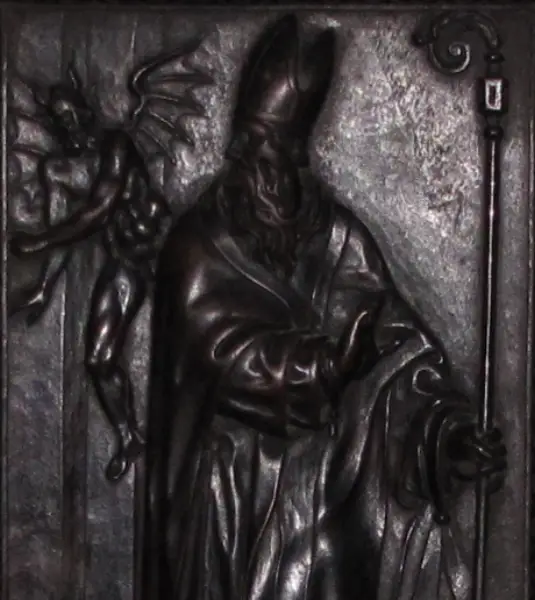
The Exorcist of Corinth
The most vivid portrait of Dacius's sanctity comes not from a chronicler of Milan but from Gregory the Great, who devotes a passage of the Dialogues to him. Travelling toward Constantinople on matters of religion, Dacius stopped at Corinth and searched for lodging large enough for himself and his company. Only one great house could be found, and the townspeople warned him that it had stood empty for years because it was haunted by the devil. His answer became proverbial: if the wicked spirit had taken possession of it and would not let men dwell there, then all the more reason for men of God to lodge in it. He ordered the house prepared and went in without fear. In the dead of night the demon filled the darkness with a pandemonium of imagined beasts — roaring lions, bleating sheep, braying asses, hissing serpents, grunting hogs, screeching rats. Dacius rose from sleep and rebuked the ancient enemy to his face, recalling the words of Isaiah against Lucifer — the ambition to set a seat in the north and be like the Most High — and mocking the creature's fall into the likeness of hogs and rats. The spirit was shamed into silence and never troubled the house again; from that day Christians lived there. The story shows the man: undramatic courage before the powers of darkness.
§ Legacy
The Three-Chapter Controversy and Death at Chalcedon
In 544–5 Dacius found himself in Constantinople, where he witnessed Emperor Justinian promulgate the edict anathematizing the Three Chapters — certain writings of Theodore of Mopsuestia, Theodoret of Cyrus, and Ibas of Edessa. Justinian hoped thereby to reconcile the non-Chalcedonian churches with the empire, but most bishops discerned in the anathema a threat to the Creed of Chalcedon itself. The Eastern bishops collapsed in resistance almost at once; the Latin-speaking bishops, Dacius among them, stood firm, and he never yielded. When the emperor summoned Pope Vigilius to Constantinople to sign the anathema, the pontiff delayed his journey as long as he could, lingering in Sicily where Dacius briefly joined him. In 550 Dacius came to the capital and urged the pope to make no agreement with the emperor. The pressure grew physical: in August 551 the two took sanctuary in the Basilica of St. Peter in Constantinople, where Vigilius was beaten, and on 23 December both escaped again to the Church of St. Euphemia at Chalcedon, from which the pope issued his encyclical denouncing his treatment. There, far from the ruined see he could never revisit, Dacius died on 5 February 552 — a confessor whose resistance outlasted him.
§ The Three-Chapter Controversy
Relics in Milan, a Pseudo-History, and Cult
Dacius was laid to rest far from his cathedral, but his body did not remain in the East. His remains were eventually brought back from the East: they reached Milan and were laid to rest in the church of San Vittore al Corpo, which honours Saint Victor Maurus, and pilgrims still venerate them there — a wall and urn marking the saint's resting place for those who seek him out. A late and baseless tradition attempted to attach him to Milan's noble family of the Agliati, an invention with no historical foundation. His name also became entangled with a literary forgery: the Datiana Historia Ecclesiae Mediolanensis, a legendary history of Milan's first bishops down to Maternus, was wrongly credited to him, though modern scholarship assigns the work to Landulf, an eleventh-century historian of the city. The church's memory of his virtues has proved more durable than these confusions. He is honoured as a saint both in the Catholic Church and in the Orthodox Church, his feast kept on 14 January, and Gregory the Great's account of the exorcism at Corinth assured that his fearlessness would be remembered wherever the Dialogues were read. As a churchman he is remembered as an active political figure and an ally of Vigilius; as a saint, as the bishop who stood firm for orthodoxy against the errors that troubled his age.
§ Legacy
Timeline
- 530
Elected Bishop of Milan on or about this year, after his earlier life as a monk.
§ The Gothic War
- 535
Confronted the terrible famine of 535 to 536 by obtaining grain from Cassiodorus for free distribution to the poor of Milan.
§ The Gothic War
- 537
At the end of the year he went to Rome with Milanese envoys to ask Belisarius for troops; Mundilas's thousand men freed the city from the Ostrogoths.
§ The Gothic War
- Mar 539
Milan surrendered in March, after which Uraias razed the city and killed thirty thousand men; Dacius, safe in Rome, never returned to Milan.
§ The Gothic War
- 544
In Constantinople in 544 and 545 he witnessed Justinian's edict anathemizing the Three Chapters, and stood firm among the resisting Latin bishops.
§ The Three-Chapter Controversy
- Nov 545
After Pope Vigilius left Rome in November he lingered in Sicily, where Dacius briefly joined him on the enforced journey east.
§ The Three-Chapter Controversy
- 550
Joined Vigilius in Constantinople and urged the Pope not to reach any agreement with the Emperor over the edict.
§ The Three-Chapter Controversy
- Aug 551
In August he and the Pope took sanctuary in the Basilica of St Peter in Constantinople, where the Pope was beaten.
§ The Three-Chapter Controversy
- 23 Dec 551
On 23 December he and Vigilius escaped and took refuge in the Church of St Euphemia at Chalcedon.
§ The Three-Chapter Controversy
- 5 Feb 552
Died, probably at Chalcedon, on 5 February, his term as bishop ended and his defence of orthodoxy complete.
§ Introduction
- 552
His remains were eventually brought back from Chalcedon to Milan, finding a resting place at San Vittore al Corpo.
§ Legacy
In Their Own Words
"so much the sooner," quoth the venerable man, "ought we to lodge in it, if the wicked spirit hath taken possession thereof, and will not suffer men to dwell in it."
Thou art served well, thou wretched creature: thou art he that diddest say: I will place my seat in the north, and I will be like to the highest: and now through thy pride, see how thou art become like unto hogs and rats; and thou that wouldest needs unworthily be like unto God, behold how thou dost now, according to thy deserts, imitate brute beasts.
The Record
- Major works
- Datiana Historia Ecclesiae Mediolanensis (a legendary history of Milan's first bishops wrongly attributed to him; the text is now assigned to Landulf of Milan, eleventh century)
- Symbols
- Depicted as an exorcist
- Canonization
- Pre-congregation; venerated in the Catholic Church and the Orthodox Church
Prayer
Bibliography
Show 5 sources
- Casari, Mario (1989). "Dazio, santo (sec. VI)". Dizionario della Chiesa Ambrosiana. Vol. 2. Milano: NED. pp. 995–996. ISBN 88-7023-102-X (in Italian).
- Ruggeri, Fausto (1991). I Vescovi di Milano. Milano: NED. p. 18. ISBN 88-7023-154-2 (in Italian).
- Cazzani, Eugenio (1996). Vescovi e arcivescovi di Milano. Milano: Massimo. pp. 36–38. ISBN 88-7030-891-X (in Italian).
- Tolfo, Maria Grazia. "Il Sestiere di Porta Romana - I prodromi della catastrofe". Storia di Milano. Retrieved 28 Nov 2011 (in Italian).
- "Gregory the Great, Dialogues (1911) Book 3. pp. 105-174". CCEL. Archived from the original on 17 September 2009. Retrieved 30 Oct 2011.
Profile text adapted from the Wikipedia article, licensed CC BY-SA 4.0.
Pray with this saint every day
Save St. Dacius to your favorites, read the full profile, and get feast-day reminders in the Saints app.
Get the Saints AppFree on the App Store for iPhone and iPad