
died 679·Feast December 23
St. Dagobert II
Merovingian king of Austrasia martyred by his nobles
Overview
Dagobert II was a Merovingian king of the Franks whose Austrasian reign lasted from 675 or 676 up to his assassination in 679, and who remains one of the most obscure figures of his dynasty. Son of King Sigebert III, he was deprived of the succession on his father's death in 656: the mayor of the palace Grimoald had him tonsured — rendering him, by Frankish custom, unfit to reign — and shipped him off to Ireland, where tradition later placed him at the monastery of Slane. He lived there as an exile and a monk until the murder of King Childeric II in 675 opened the Austrasian throne, whereupon his friends and kinsmen arranged his return through Bishop Wilfrid of York. His brief reign was eventful: war with Neustria, a celebrated peace pact with the Lombards in 676, the reintroduction of gold coinage on a new Byzantine model, and the preservation in his sole surviving charter of the monastery of Stavelot-Malmedy. The Life of Wilfrid, hostile to his memory, depicts him as a tax-imposing tyrant at odds with his bishops. He was assassinated late in 679 by a conspiracy of the greatest nobles, reputedly killed by his own godson while hunting in the Woëvre, and honoured as a martyr in the Ardennes before the century's end.
The Complete Life
A Tonsured Prince
Dagobert was the son of Sigebert III, king of Austrasia from 632 to 656, by a woman whose name the sources do not preserve; it is considered unlikely that he was the child of Sigebert's only known wife, Chimnechild, making him the half-brother of Bilichild, Chimnechild's daughter. He was named for his grandfather, the great Dagobert I. His childhood ended in political catastrophe. The Book of the History of the Franks, compiled in 727, records that when Sigebert died the mayor of the palace, Grimoald — the most powerful official in the kingdom — had the prince shorn in the tonsure and handed over to the keeping of Dido, bishop of Poitiers. In the Merovingian world the act was decisive: kings wore their hair long, and a shorn prince was disqualified from the throne. Dido then shipped the child to Ireland. These events are usually assigned to 656, though some scholars would date them as early as 651. Grimoald set his own son Childebert on the Austrasian throne in the displaced boy's stead, but the coup ultimately failed; the Neustrians seized Grimoald and executed him in Paris for acting against his rightful lord. The exiled Dagobert, however, did not return, and for the better part of two decades the succession he had lost was occupied by others.
§ Exile
The Irish Years
No contemporary source describes what Dagobert did during his long sojourn in Ireland, and the silence has invited legend. The first writer to attach him to a specific place was the eighteenth-century antiquary Mervyn Archdall, who recorded a local oral tradition placing the exiled prince in the monastery of Slane — an identification that some modern scholars have accepted. Whatever the truth of the Slane tradition, the Ireland that received him was a land of flourishing monasteries that had long maintained ties with the Frankish aristocracy, and the fate of a tonsured Merovingian — technically a cleric, politically dead — naturally disposed him to monastic life. The later hagiography of St. Dagobert presents his years across the sea as the seedbed of his sanctity: a prince formed in exile, far from the courts that had discarded him. When Childeric II was murdered along with his queen and son in 675, the political landscape of Austrasia collapsed into civil war, and Dagobert's chances revived. His recall was arranged from outside Ireland — the biography of Wilfrid credits the king's "friends" and "relatives", possibly the mayor Wulfoald, possibly Pippin of Herstal and Martin, possibly the Irish abbot Ultan of Saint-Maur-des-Fossés — with the English bishop Wilfrid of York charged with conducting him home.
§ Exile
King in Austrasia, 675–679
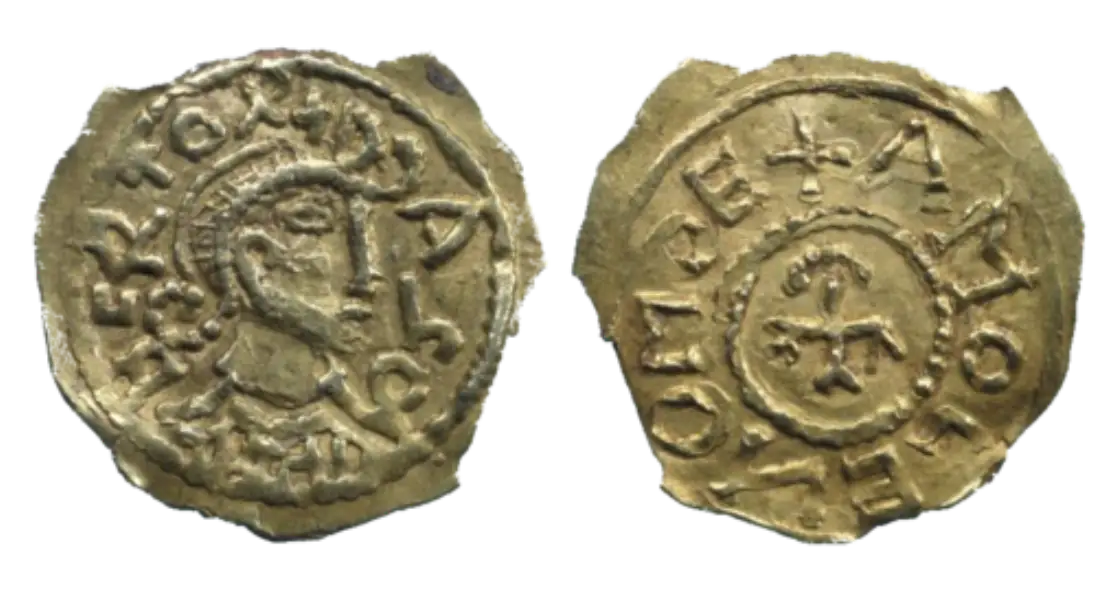
The exact date of Dagobert's accession is uncertain: Childeric II fell in 675, and Dagobert was certainly on the throne by July 676. His reign is sparsely documented, and what documentation exists is often hostile. The Neustrian Book of the History of the Franks never mentions his return at all, and Paul Fouracre has suggested its author either disbelieved in his kingship or preferred to conceal it. Yet the reign's record, thin as it is, shows an active ruler. He signed a "most firm pact of peace" with the Lombards in 676, datable precisely because Paul the Deacon's History of the Lombards connects it with the great comet of that August — though Paul mistakenly assigns the event to the earlier reign of Grimoald. He reintroduced the minting of gold, suspended under Childeric II, copying the cross potent of contemporary Byzantine solidi for his tremissis, and he was the last Merovingian in whose name coins were struck at Marseille. His single surviving charter confirms the possessions of Stavelot-Malmedy, invoking his father's donations without a word about Grimoald, the monastery's founder and the man who had exiled him. War with his cousin Theuderic III of Neustria broke out during these years, reaching deep into Burgundy and suggesting that for a time Dagobert held the initiative.
§ Reign
Wilfrid's Visit and the King's Murder
In 679, while journeying to Rome for a church council, Bishop Wilfrid of York stayed at Dagobert's court. The king, who owed his restoration to the bishop's mediation, offered him the diocese of Strasbourg, described in the Life of Wilfrid as the chief bishopric of the realm; Wilfrid declined, and Dagobert equipped him with arms and companions for the road to Italy. It was the last recorded act of the reign. Shortly afterward, late in 679, Dagobert was assassinated. The Life of Wilfrid — the only narrative source for the murder — blames "treacherous dukes" acting with the consent of the bishops, and paints the dead king in the blackest terms: a destroyer of cities who scorned the counsel of the magnates, crushed his people with taxation, and held God's churches and their bishops in contempt. A much later tradition, drawn from Ado's martyrology, supplies the scene's details: the king, full of the Holy Spirit, was hunting in the forest of the Woëvre when his own godson, a boy named John, killed him at a place called Scortias, some three miles from his villa, on 10 January in the calendar's reckoning — the traditional date of 23 December resting on late but widely accepted testimony. He was succeeded by his cousin Theuderic III, the very king against whom he had waged war.
§ Reign
The Martyr of the Ardennes
Dagobert was never formally canonized in the modern manner; he is a pre-congregation saint, honoured by custom rather than decree. His veneration as a martyr is attested in the Ardennes before the ninth century had closed — corroboration, in its way, of the assassination the Life of Wilfrid alone records. The circumstances of his burial are disputed: the early eighth-century Life of Bishop Audoin of Rouen places his grave in the church of Saint Peter at Rouen, beside Childeric II and his family, while the much later Life of Dagobert, written in the 890s and confused in places with Dagobert III, insists on Stenay, in the church of Saint Remigius, at the centre of old Austrasia. What is certain is the act of 10 September 872, when Charles the Bald had the king's relics translated to a specially constructed basilica at Stenay, staffed with its own canons — a gesture closely tied to Charles's efforts to establish himself in Lotharingian territory newly acquired by the Treaty of Meerssen. His feast of 23 December appears in the Life of Dagobert, in the lost calendar made for Queen Emma, and in local additions to the Martyrology of Usuard, though one source gives 11 September. The cult never spread far beyond Stenay, where it survived, with interruptions, into the modern age.
§ Martyr cult
Relics, Basilica, and the Test of Science
The cult of St. Dagobert gathered around Stenay for centuries, and its material traces have been examined with a modern eye. The endowment of the Basilica of Saint Dagobert is documented in a charter of 1124 from the cartulary of Gorze; when the canons slackened in discipline, the house passed to the Benedictines as a priory. Relics moved with the politics of the region: the deed of 1069 by which the church of Stenay passed to Gorze already refers to them, and a charter of Bishop Lietbert from 1070 shows portions of them deposited at Saint-Ghislain. In 1570 an altar still stood dedicated to Dagobert at Stenay, but the Protestant sack of the buildings in 1591 dispersed the relics. Recovery followed: the cult was restored in 1608; in 1645 the town walked in procession behind bones held to be his — the humerus, the sacrum, the tibia; and from at least 1658 the collegiate church of Saint Waltrude has claimed his skull among its treasures. That skull, recently examined, tells a characteristic story — the cut in the bone matches a medieval axe strike, yet radiocarbon testing places the relic in the thirteenth century, not the seventh. The failure of the relic does not, however, touch the historical core: a king murdered by his grandees, revered within a century as a martyr, and remembered at Stenay for a thousand years.
§ Martyr cult
Timeline
- 656
Tonsured on his father Sigebert III's death and shipped off to Ireland to live as a monk, an exile usually dated to this year.
§ Exile
- 662
Childeric II was set on the Austrasian throne in his absence, marrying Dagobert's half-sister Bilichild under Chimnechild's regency.
§ Exile
- 675
The murder of Childeric II, his queen and son plunged Austrasia into civil war and opened the way for Dagobert's recall.
§ Exile
- Jul 676
Restored from his Irish exile through the agency of Bishop Wilfrid of York, he was back reigning in Austrasia by this month.
§ Return from exile
- Aug 676
Concluded a most firm pact of peace with the Lombard kingdom, an alliance datable by the great comet of this month.
§ Reign
- 679
Welcomed Wilfrid at his court on the bishop's way to a Roman council, offering him the see of Strasbourg, which he declined.
§ Reign
- 23 Dec 679
Assassinated late in the year, traditionally on this date while hunting in the Woëvre, reportedly by his own godson John, in a conspiracy of the highest nobility.
§ Reign
- 10 Sep 872
Charles the Bald transferred his remains to a newly erected basilica at Stenay, staffed with its own canons, reviving his martyr cult.
§ Martyr cult
- 1069
Beatrice, wife of Godfrey III, Duke of Lower Lorraine, left the endowment of the Basilica of Saint Dagobert to the abbey of Gorze.
§ Martyr cult
- 1070
A charter of Bishop Lietbert recorded some of his relics as deposited in the church of Saint-Ghislain.
§ Martyr cult
- 1124
The endowment of the Basilica of Saint Dagobert is documented in a charter of this year preserved in the Gorze cartulary.
§ Martyr cult
- 1570
An altar dedicated to Dagobert stood at Stenay, a sign that some relics still remained there.
§ Martyr cult
- 1580
The priory of Stenay, custodian of his cult, was suppressed in this year.
§ Martyr cult
- 1591
The buildings of the basilica at Stenay were sacked by Protestants, and its relics dispersed.
§ Martyr cult
- 1608
The saint's cult was reinstated at Stenay.
§ Martyr cult
- 1609
The Abbey of Juvigny possessed a cervical vertebra and a femur believed to be his.
§ Martyr cult
- 1645
A humerus, sacrum and tibia venerated as his were borne in solemn procession through Stenay.
§ Martyr cult
- 1658
Saint Waltrude Collegiate Church had claimed possession of his skull by this date at the latest.
§ Martyr cult
In Their Own Words
destroyer of cities, despising the counsels of the magnates, reducing the people with taxation
The Record
- Major works
- Only surviving authentic charter confirming the possessions of the monastery of Stavelot-Malmedy·Reintroduction of Merovingian gold coinage
- Canonization
- Pre-congregation; revered as a martyr since at least the ninth century
Prayer
Bibliography
Show 6 sources
- Fouracre, Paul J. (2008). "Forgetting and Remembering Dagobert II: The English Connection". Frankland: The Franks and the World of the Early Middle Ages. Manchester: Manchester University Press. pp. 70–89.
- Wood, Ian N. (1994). The Merovingian Kingdoms, 450–751. Harlow: Longman.
- Fouracre, Paul J.; Gerberding, Richard A., eds. (1996). Late Merovingian France: History and Hagiography, 640–720. Manchester: Manchester University Press.
- Picard, Jean-Michel (1991). "Church and Politics in the Seventh Century: The Irish Exile of King Dagobert II". In Ireland and Northern France, AD 600–850. Dublin: Four Courts. pp. 27–52.
- Folz, Robert (1963). "Tradition hagiographique et culte de saint Dagobert, roi des Francs". Le Moyen Âge. 4: 17–35.
- Beauthier, Jean-Pol; Dierkens, Alain; Polet, Caroline; Beauthier, François; Lefèvre, Philippe (2025). "Le crâne attribué au saint roi mérovingien Dagobert II: Étude historique et anthropologique". Archives of Legal Medicine. 16 (1).
Profile text adapted from the Wikipedia article, licensed CC BY-SA 4.0.
Pray with this saint every day
Save St. Dagobert II to your favorites, read the full profile, and get feast-day reminders in the Saints app.
Get the Saints AppFree on the App Store for iPhone and iPad