
died 254 or 304·Feast December 5
St. Dalmatius of Pavia
Venerated evangelizer of Pedona in Piedmont
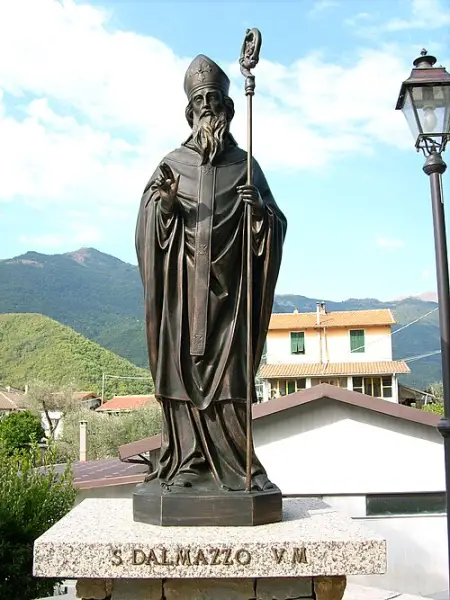
Overview
Dalmatius of Pavia, honored by the Roman Catholic Church as Saint Dalmazzo, belongs to the shadowy company of early Italian evangelizers whose cult is old but whose history is nearly irrecoverable. The date of his death is given variously as 254 or 304, and even the century in which he lived and the manner of his dying are uncertain; one judgment holds that he may simply have been a local preacher of northern Italy. What is certain is the antiquity of his veneration at Pedona, today's Borgo San Dalmazzo in Piedmont. A Life of the saint was put together in the seventh or eighth century, its author perhaps a Lombard monk at Pedona's monastery, who worked from oral tradition. It places his birth at Forum Germarzorum, the present San Damiano Macra, and makes him a churchman and evangelizer at Pedona. Later legend enlarged his field, sending him through the towns of Piedmont, Emilia, and Gaul and giving him a martyr's death in 254 or 304. The Roman Martyrology, following faulty episcopal lists, describes him as a bishop of Pavia and keeps his feast on December 5.
The Complete Life
A Saint Almost Beyond Recovery
Almost everything about the origins of Dalmatius must be prefaced with a caveat. The century in which he lived and the way in which he died are unknown, and the sober suggestion survives that he may have been nothing more than a local preacher of northern Italy. The story that has come down belongs instead to hagiography: a biography written between the seventh and eighth centuries, credited perhaps to a Lombard monk of Pedona's monastery, working from a tradition that had passed from mouth to mouth for centuries before it was set in writing. According to that Life, Dalmatius was born at Forum Germarzorum, identified with the present San Damiano Macra in the mountains of what is now the province of Cuneo. From there the legend carries him to Pedona, today's Borgo San Dalmazzo, at the foot of the Alps, where he became a churchman and an evangelizer. The gap between the composition of the Life, perhaps four centuries after its subject, and any verifiable memory of the man is wide. What the earliest records do establish is a place of cult: Dalmatius was venerated at Pedona from early times, and the devotion of that place, not the details of his career, is the historical bedrock beneath the later legends of his birth, his journeys, and his martyrdom.
§ Dalmatius of Pavia
Preacher of Piedmont, Emilia, and Gaul
The picture of Dalmatius as a worker for the gospel grows steadily richer the further it stands from his own century. The earliest layer, the medieval Life, makes him a churchman and evangelizer at Pedona, a mission station in the Alpine foothills whose monastery kept his memory. In France a tradition dating from the ninth century went further and held that he had died a martyr. The later legends then unfold a wide apostolate: in them he preaches through numerous towns of Piedmont, Emilia, and Gaul, and dies for his faith in either 254 or 304, two dates whose coexistence measures how little solid chronology survived. Both proposed martyrdoms would fall within the eras of persecution before Constantine, which is perhaps why the tradition settled on them; neither can be checked against independent evidence, and both survive strictly as legend. Even his reputation as a bishop belongs to this uncertain stratum: the Roman Martyrology describes Dalmatius as a bishop of Pavia, but this rests on erroneous episcopal lists rather than on any contemporary record. What may be said with confidence is that a preacher of the early church in northern Italy was remembered, honored, and eventually clothed with the martyr's crown by communities that treasured his name.
§ Dalmatius of Pavia
Relics, Inscription, and a Town's Name
The cult of Dalmatius endured long after the details of his life had faded, and its physical trace is unusually concrete. In the tenth century, when Muslim raids devastated the region around Pedona, his relics were carried away to Quargnento for safety, and the tomb raised there bore an inscription that still identified the occupant: the body of Saint Dalmatius, laid to rest by Audace, bishop of Asti. That inscription is among the few fixed points in his whole tradition, and it testifies both to the movement of his relics and to the esteem of a neighboring bishop who saw to their burial. Back at Pedona, the connection between saint and place proved permanent: the town that succeeded the ancient settlement took the name Borgo San Dalmazzo, so that the evangelizer remembered only by legend nonetheless gave his name to the community that guarded his grave. The Roman Catholic Church keeps his feast on December 5, the date the Roman Martyrology assigns him, even while listing him with the doubtful rank of bishop of Pavia. He is honored as the patron of Borgo San Dalmazzo. His history, then, is a history of devotion rather than documentation: a name held fast by a town, a monastery, a tomb, and a yearly feast across some fifteen centuries.
§ Dalmatius of Pavia
Timeline
- 254
Later legend gives this as the year he was killed for his faith, the earlier of two competing dates.
§ Introduction
- 304
A second legendary tradition places his martyrdom in this year rather than 254.
§ Introduction
- 700
His biography was composed in the seventh or eighth century, perhaps by a Lombard monk of Pedona drawing on oral tradition.
§ Introduction
- 850
A tradition arising in ninth-century France held that Dalmatius had suffered death as a martyr.
§ Introduction
- 900
During Muslim raids that devastated Pedona, his relics were transferred for safety to Quargnento.
§ Introduction
In Their Own Words
[H]ic requiescit corpus sancti Dalmatii repositum ab Audace episcopo Astensi
The Record
- Patron of
- Borgo San Dalmazzo (patron)
- Canonization
- Pre-congregation; venerated by the Roman Catholic Church from the early cult at Pedona, feast on December 5.
Prayer
Bibliography
Show 2 sources
- "San Dalmazio (Dalmazzo) di Pavia".
- "Patron Saints Index: Saint Dalmatius of Pavia", archived from the original on 26 January 2008.
Profile text adapted from the Wikipedia article, licensed CC BY-SA 4.0.
Pray with this saint every day
Save St. Dalmatius of Pavia to your favorites, read the full profile, and get feast-day reminders in the Saints app.
Get the Saints AppFree on the App Store for iPhone and iPad