
died 605·Feast June 25
St. Damian of Alexandria
Coptic Pope and Tireless Defender of Miaphysite Faith
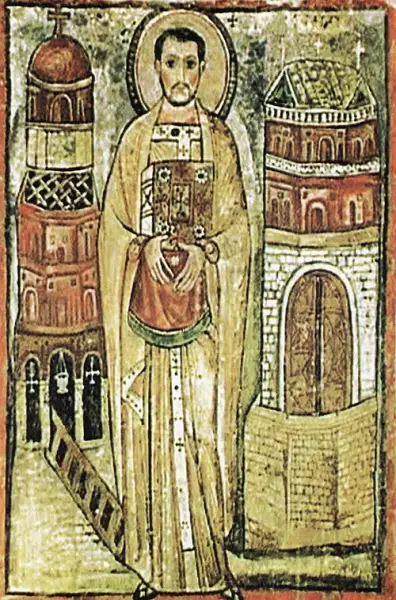
Overview
Damian of Alexandria served as Coptic pope and patriarch of the See of St. Mark from 576 until his death in 605, a pontificate of nearly thirty-six years. A Syrian by birth, whose brother held the office of prefect in Edessa, he embraced monastic life while still young. He spent sixteen years among the ascetics of the desert of Scete, was ordained deacon in the monastery of St. John the Short, and afterwards continued his strict discipline at a monastery near Alexandria. His holiness and ability brought him to the notice of Pope Peter IV, who made Damian his private secretary and valued him greatly. When Peter died, the bishops unanimously chose Damian to occupy the patriarchal throne. His long reign was spent in zealous defense of the non-Chalcedonian position: he composed many epistles and discourses, reaffirmed the miaphysite teaching of his church, and contended against tritheism, the Melitians, the Agnoetae, the Acephali and many other parties he judged heretical. A secretive journey to Antioch to install a rival patriarch failed and forced him to flee, and a quarrel with Patriarch Peter of Antioch left the Alexandrian and Antiochene churches divided for years after his death. He was buried at the Ennaton monastery near Alexandria.
The Complete Life
A Syrian Born to the Desert
Damian's story begins far from the city whose church he would one day lead. He was born in Syria, and his brother had risen to the influential post of prefect in Edessa, one of the great centers of the Syrian theological world. Whatever prospects family connections offered, Damian chose another road. While still in his early years he became a monk, and he made his way to Egypt, the cradle of monasticism, settling in the desert of Scete. There he remained for sixteen years, formed in the austere discipline of the desert fathers, learning prayer, fasting and the endurance that the solitary life demanded. In time he received diaconal ordination at the house of St. John the Short, among the best-known communities of Scete. His formation did not end in the desert. He moved afterwards to a monastery near Alexandria and continued the ascetic practices he had cultivated at Scete, joining the contemplative rigor of the desert to proximity with the patriarchal city. This double schooling, in the cell and near the pulpit, prepared him for a life that would join deep theological conviction with the administration of one of the most ancient sees in Christendom.
§ Introduction
From Cell to Secretariat
Damian's passage from monastic obscurity to church leadership came through the confidence of his patriarch. When Peter IV was enthroned on the See of St. Mark, he chose Damian as his private secretary, a post that placed the desert-trained monk at the center of Alexandrian church life. In that service Damian earned much esteem for his goodness, a rare testimony to character recorded alongside his administrative gifts. The years at Peter's side schooled him in the affairs of the patriarchate and in the theological controversies that agitated the non-Chalcedonian world. When Peter died, the bishops of the church did not hesitate: they unanimously agreed to ordain Damian a patriarch. The choice of a monk and secretary, rather than a career hierarch, reflected the esteem his goodness had won. He was enthroned on 26 June 576, and would reign for almost thirty-six years, one of the longest pontificates in the history of the Coptic church. The author of many epistles and discourses, he used his office to reaffirm the miaphysite and non-Chalcedonian convictions of his communion, carrying forward the theological line he had served under his predecessor.
§ Introduction
A Patriarch in Controversy
Damian's pontificate was relentlessly combative. He regarded it as his duty to fight every teaching he considered heretical, and his list of opponents was long: tritheism and the Melitians, Julian of Halicarnassus and the Agnoetae, the Acephali and the Gaianites, Leo's Tome and the Chalcedonians, together with Stephen of Alexandria and Paul of Beth Ukame. His zeal sometimes outran prudence. Hoping to finish what his predecessor had begun, the drive to unseat Paul II of Antioch, he made his way to that city in secret to set up a rival. Though not all the Syrian bishops supported the plan, he gathered enough backing to convene a meeting and choose a candidate, but the Chalcedonian patriarch, probably Gregory of Antioch, came upon the plot and stopped it, and Damian with his companions had to run for safety. From there he made his way to Constantinople, ordaining bishops and taking part in a synod whose decisions he afterwards disowned. In one controversy recounted in his Synaxarium entry, he persuaded some Melitians, who drank wine before Communion on a novel reading of the Last Supper, that the first cup was that of the Jewish passover, voided by the second, the rest, refusing his instruction, were expelled from the community.
§ Controversies
The Theologian of the Trinity
Beneath the polemics stood a monk's spirituality and a serious theological mind. Damian's formation in Scete gave his patriarchy an ascetic backbone: he wrote from the conviction that right worship and right teaching were inseparable, and his epistles and discourses strove to anchor the faith of his flock in the teaching of Scripture and the early Fathers. The sharpest test of his theology came in his dialogue with Patriarch Peter of Antioch. Damian accused his colleague of tritheism, the teaching that the three persons of the Trinity are three distinct gods, while Peter in turn accused Damian of Sabellianism, the collapsing of the persons into one. Damian built his Trinitarian position on Scripture and the witness of the early Fathers, arguing it with learning and persistence, but he was never able to persuade Peter. The rupture ran deep enough that Damian ordered Peter's name withheld from the Divine Liturgy while Peter lived, leaving the churches of Alexandria and Antioch estranged for close to ten years beyond Damian's own death. The episode shows both his tenacity and the limits of controversy: conviction, in his hands, was a form of devotion.
§ Controversies
Last Years and a Divided Legacy
The closing years of Damian's long reign were shadowed by the quarrels that had marked it. His order to suppress the name of Peter of Antioch in the liturgy left the two ancient churches estranged, and the schism outlived him, lasting almost a decade beyond his death before the breach was healed. Even the monastic world felt the strains of the age: it was in Damian's time that the Barsanuphians separated from the Acephali and established their own episcopal hierarchy, another sign of how the non-Chalcedonian communion was fragmenting into parties even as its patriarch fought to define its doctrine. Damian died on 25 June 605, after almost thirty-six years on the throne of St. Mark, and was buried at the Ennaton monastery near Alexandria, the monastic neighborhood whose ascetic life had shaped him since his days at Scete. The Coptic church preserved his memory in its Synaxarium, which records the controversies of his episcopate and assigns his feast to 25 June, the 18th day of the month of Paoni in the Coptic calendar. The manner of his passing, in the city he had governed so long and the monastic surroundings he preferred, closed a life that had carried him from a Syrian boyhood to the summit of one of the oldest churches in Christendom.
§ Introduction
Memory in the Coptic Church
Damian was never canonized by any formal process; his veneration belongs to the ancient pattern in which a bishop's sanctity is received by the church that prayed with him. The Coptic Orthodox Church enrolled him among its popes and remembered him liturgically, and the Synaxarium preserves a full entry recounting his departure and the two theological controversies that defined his episcopate: his dispute with the Melitians over the cups of the Last Supper and his running debate with Peter of Antioch over the doctrine of the Trinity. His feast is kept on 25 June, corresponding to the 18th of Paoni in the Coptic calendar, the anniversary of his death. He stands in the unbroken list of Coptic Orthodox popes between Peter IV and Anastasius, honored as one of the long-reigning shepherds of the See of St. Mark and as a champion of its miaphysite confession in a fractious age. No relics of formal process attach to him; he is remembered as the shepherd the church chose and kept, an ascetic raised to office whose memory survived in the liturgical books and annual feast of the people he served for thirty-six years.
§ Introduction
A Lost Corpus and a Living Influence
Most of Damian's writings are lost, a fact that has dimmed the reputation of one of the most active theologians of his generation. What survives is his influence. He shaped many writers of his own time, above all John of Parallos, who like Damian devoted his energies to combating heresy. Through such disciples his method, the patient amassing of scriptural and patristic arguments against rival readings of the Trinity and the Incarnation, passed into the intellectual life of the non-Chalcedonian world. The Barsanuphian separation from the Acephali under his pontificate shows how consequential his era was for the shape of eastern monasticism. Historians of doctrine, notably Alois Grillmeier and Theresia Hainthaler in their survey of Christ in Christian Tradition, have given his reign sustained attention as a decisive chapter in the history of the anti-Chalcedonian churches. For the Coptic church he remains a model of the scholar-bishop: a desert monk who carried the rigor of Scete into the government of a patriarchate and never stopped writing, arguing or teaching in defense of the faith as he received it.
§ Controversies
Timeline
- 569
Peter IV of Alexandria dies, and the bishops unanimously agree to ordain Damian a patriarch in his place
§ Introduction
- 26 Jun 576
His papacy as Coptic pope and patriarch of Alexandria begins on this date
§ Introduction
- 25 Jun 605
Dies after a reign of almost thirty-six years and is buried at the Ennaton monastery near Alexandria
§ Introduction
In Their Own Words
This is My Blood
The Record
- Major works
- Epistles and discourses in defense of the miaphysite and non-Chalcedonian position (mostly lost)
- Patron of
- Coptic Orthodox Church
- Symbols
- Patriarchal vestments·Gospel book·Omophorion
- Canonization
- Pre-congregation; venerated in the Coptic Orthodox Church, with an entry in the Coptic Synaxarium
Prayer
Bibliography
Show 5 sources
- Alois Grillmeier, Theresia Hainthaler, O.C. Dean, Christ in Christian Tradition, Vol. 2, Pt. 4, pp. 75-81
- Walsh, Michael J., "Damian of Alexandria", A New Dictionary of Saints: East and West, Liturgical Press, 2007. ISBN 9780814631867
- "The Departure of St. Damianos", Synaxarium readings at the Coptic Orthodox Church Network, accessed 20 July 2010
- Arieh Kofsky (2004), "What Ever Happened to the Monophysite Monasticism of Gaza?", in Brouria Bitton Ashkelony; Arieh Kofsky (eds.), Christian Gaza In Late Antiquity, Brill, p. 191
- البابا داميانوس [Pope Damian] (in Arabic), Official website of St. Takla Haymanot's Church, retrieved 2011-02-13
Profile text adapted from the Wikipedia article, licensed CC BY-SA 4.0.
Pray with this saint every day
Save St. Damian of Alexandria to your favorites, read the full profile, and get feast-day reminders in the Saints app.
Get the Saints AppFree on the App Store for iPhone and iPad