
died 1227·Feast October 13
St. Daniel and Companions
Franciscan martyrs beheaded at Ceuta in 1227
Overview
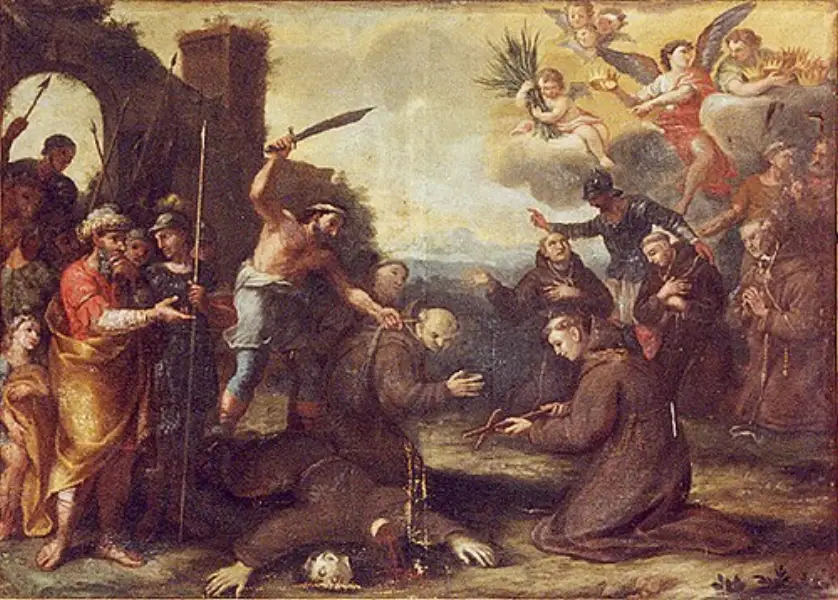
Daniel and his six companions were Friars Minor who, according to the Franciscan Chronicle of the Twenty-Four Generals, gave their lives at Ceuta on the North African coast on 10 October 1227. The year after Francis of Assisi died, six religious of Tuscany asked Elias of Cortona, vicar-general of the Order, for leave to carry the faith to the Muslims of the Maghreb. Crossing first into Spain, they were joined by Daniel, Minister Provincial of Calabria, who became their superior. Sailing from Spain, they landed near Ceuta in late September and, on a Sunday morning, entered the city and began to preach Christ and to denounce Islam openly. Arrested and brought before the sultan, they were judged mad and imprisoned; brought before him again, they withstood promises and threats alike. Each was beheaded, and each approached Daniel first for his blessing and permission to die. Their cult was confirmed when Leo X canonized the group in 1516, and the Franciscan Order keeps their feast on 13 October. Modern scholarship, however, regards the story as likely legendary, noting that the companions' names are drawn from the genuine passion of Berard of Carbio and his fellows of 1220, and that the martyrs themselves most probably never existed.
The Complete Life
Zeal Kindled by the Martyrs of 1219
The story of Daniel and his companions begins, as the Chronicle of the Twenty-Four Generals tells it, with the death of an earlier group of Franciscan missionaries. In 1219 Berard of Carbio and his brothers had been martyred while preaching in Muslim Spain and Morocco, and their fate set fire to the imagination of the young Order: many friars longed to follow them to the lands of Islam and to win the same crown. Among these were six religious of Tuscany, Agnellus, Samuel, Donulus, Leo, Hugolinus, and Nicholas. In 1227, the very year after Francis of Assisi's own death, they laid before Elias of Cortona, the Order's vicar-general, their request to carry the faith to the Muslims of the Maghreb. Permission granted, they traveled first into Spain, where their company gained its seventh member and its leader: Daniel, Minister Provincial of Calabria, a friar of sufficient standing to govern a province and willing to trade that office for the uncertainties of mission. Under his guidance the little band prepared to cross the strait between Europe and Africa, carrying nothing but the Franciscan habit and the message of Christ.
§ Story
Preaching and Prison in Ceuta
Setting sail from Spain, the seven friars reached the coast of Africa on 20 September 1227. Rather than enter the Saracen city at once, they waited a few days in a village of mostly Christian traders just outside Ceuta's walls, gathering what courage and counsel the delay afforded. Then, very early on a Sunday morning, they crossed into the city and immediately began their work, preaching the gospel and denouncing Islam in words too public to be ignored. The reaction was swift: they were seized and brought before the sultan, who concluded that men so reckless must be mad and ordered them cast into prison rather than killed. There they remained for a week. On the following Sunday they stood before the sultan again, and this time he tried persuasion as well as menace, offering promises and holding threats over them in the effort to make them deny the Christian religion. The attempt failed completely. The seven were executed one by one, and the chronicle preserves a detail of touching discipline in their deaths: each friar, as his turn came, went to Daniel their superior to ask his blessing and his permission to die for Christ, and all were beheaded on 10 October 1227.
§ Story
Canonization, Feast, and the Question of History
The Franciscan Order embraced the seven as martyrs, and in 1516 Pope Leo X canonized Daniel and his companions; their feast is kept in the Order on 13 October. Their story rests, however, on a single late source, the order's own Chronicle of the Twenty-Four Generals, set down around 1370, nearly a century and a half after the supposed martyrdom. Modern scholarship has looked at that distance and drawn conclusions the medieval chroniclers did not anticipate. The historian Christopher MacEvitt observes that it is most likely the martyrs themselves never existed, judging the account a legend or fabrication. The strongest evidence is in the names: Daniel's six companions bear the same names as the companions of Berard of Carbio, whose martyrdom of 1219 was authentically recorded, suggesting that the later story borrowed its cast from the earlier, certain one. Yet the cult is real regardless of the history. The Catholic Church venerates Daniel and his companions as saints, their canonization of 1516 has never been revoked, and their memory forms part of the long Franciscan dream of mission to the Maghreb, alongside Ceuta's own record of sieges, conquests, and changing faiths.
§ Story
Timeline
- 1219
The martyrdom of Berard of Carbio and his fellows stirs Franciscans with longing to preach among non-Christians.
§ Story
- 1227
Six Tuscan religious petition Elias of Cortona, the order's vicar-general, for leave to preach to the Muslims of the Maghreb.
§ Story
- 1227
At a stop in Spain, Daniel, Minister Provincial of Calabria, joins the six missionaries and becomes their superior.
§ Story
- 1227
Entering Ceuta on a Sunday morning to preach, the friars are seized and thrown into prison by the sultan's order.
§ Story
- 20 Sep 1227
Sailing from Spain, the seven friars reach the African coast and lodge near Ceuta among Christian merchants.
§ Story
- 10 Oct 1227
Brought again before the sultan, the seven refuse to deny Christ and are beheaded, each taking Daniel's blessing first.
§ Story
- 1370
The Chronicle of the Twenty-Four Generals, set down about this time, preserves their martyrdom as its only source.
§ Story
- 1516
Pope Leo X canonizes Daniel and his companions; the Franciscans keep their feast on 13 October.
§ Story
The Record
- Symbols
- Franciscan habit·Palm of martyrdom
- Canonization
- Canonized by Pope Leo X in 1516
Prayer
Bibliography
Show 3 sources
- Christopher MacEvitt, "The Franciscans", in Paul Middleton (ed.), The Wiley Blackwell Companion to Christian Martyrdom (John Wiley & Sons, 2020), pp. 365–380. doi:10.1002/9781119100072.ch22
- Father Candide Chalippe (1 June 2007). The Life and Legends of Saint Francis of Assisi. Echo Library. pp. 164–. ISBN 978-1-4068-4456-6. Retrieved 8 July 2013.
- Donovan, Stephen. "St. Daniel and Companions." The Catholic Encyclopedia Vol. 4. New York: Robert Appleton Company, 1908. 2 August 2018
Profile text adapted from the Wikipedia article, licensed CC BY-SA 4.0.
Pray with this saint every day
Save St. Daniel and Companions to your favorites, read the full profile, and get feast-day reminders in the Saints app.
Get the Saints AppFree on the App Store for iPhone and iPad