
1261 – 1303·Feast March 17 and September 12
St. Daniel of Moscow
Right-believing prince and founder of Moscow's first monasteries
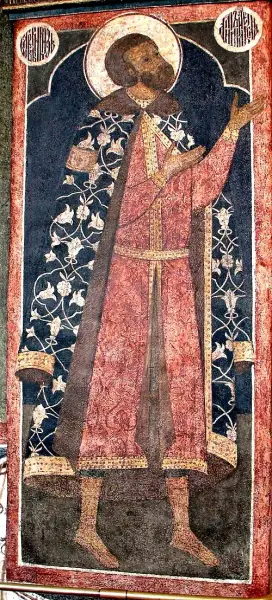
Overview
Daniil Aleksandrovich, the youngest son of Alexander Nevsky, was born at Vladimir in late 1261 and left fatherless at the age of two when the prince-saint died in 1263. From the least valuable of his father's patrimonies, the town of Moscow, he built a dynasty: every later Prince of Moscow descended from him, and his line took the name Daniilovichi. He ruled Moscow from about 1282 until his death in 1303, founding the city's first monasteries, the Epiphany Monastery and the Danilov Monastery by the Moskva, and raising within the Kremlin the first church built of stone. In the tangled politics of the Golden Horde's suzerainty he generally preferred alliance to aggression, standing with Mikhail of Tver to defend young Ivan of Pereslavl-Zalessky's inheritance against Prince Andrey of Gorodets, and repelling Andrey's attempts to take the town by force. In 1301 he outmaneuvered the prince of Ryazan and gained the fortress of Kolomna, giving Moscow control of the whole Moskva River; in 1302 he inherited Pereslavl-Zalessky from his nephew Ivan. Before dying in early March 1303 he received the monastic habit and willed burial in the common cemetery of his own monastery, an act of humility. The Russian Orthodox Church canonized him in 1791.
The Complete Life
The Orphan Who Received Moscow
Daniil was born toward the end of 1261 at Vladimir on the Klyazma, the capital town of Vladimir-Suzdal, the fourth and youngest son of Alexander Nevsky by his wife, the princess remembered as Vassa or Alexandra of Polotsk. He was named after Daniel the Stylite, the fifth-century ascetic whose long life on a pillar near Constantinople had made his name a byword for holy endurance. The boy was two years old when his father died on 14 November 1263, and the division of the patrimonies treated him as a child of least account: he received Moscow, then a minor town on the river's edge, while his brothers took the greater inheritances. Until he came of age he was governed by his paternal uncle, Prince Yaroslav of Tver, whose death in 1271 left the orphaned appanage drifting; Daniil does not appear as an independent ruler until 1282. What looked like a slight became the making of his line. The town nobody wanted would become the seat of the Daniilovichi, the dynasty of Moscow, and the youngest son whom the chronicles barely watched would stand as forefather of every Prince of Moscow who followed him.
§ Early life
A Builder of Monasteries in a Wooden Town
Daniil's rule of Moscow is remembered less for battles than for foundations. He has been credited with founding the first monasteries in Moscow: the Epiphany Monastery within the growing town, and the Danilov Monastery, Saint Daniel's own, set on the right bank of the Moskva River about five miles from the Kremlin, whose first wooden church stood no later than 1282. In a city where sacred and civic life had hardly yet learned to be distinct, these communities gave Moscow its first houses of prayer and learning and attached the young principality to the monastic tradition of the Rus' lands. In the 1280s he also raised the first stone church in the Moscow Kremlin, dedicated to Demetrius of Thessaloniki, marking the town's emergence from timber into masonry. The choice of patron reflects the devotions of his family, which bore the names of the great saints of the eastern Church. His deepest instinct, however, appeared at the end rather than the middle of his life: before he died he became a monk, and by his own will he was buried not in a princely tomb but in the common cemetery of his Saint Daniel Monastery, an open grave shared with ordinary Christians, deliberately chosen as a demonstration of humility.
§ Government
Politics Under the Horde: The Defense of Pereslavl
Daniil's reign unfolded under the suzerainty of the Golden Horde, whose warlords Nogai and Tokhta dominated the steppe in the late 1280s and 1290s and played the Rus' princes against one another. Daniil took part in the struggle between his brothers Dmitri of Pereslavl and Andrey of Gorodets for the grand princely throne of Vladimir. When the khan's summons came in 1293, Daniil stood with Dmitri and Mikhail of Tver in refusing to travel to Sarai and recognize Tokhta, and the reprisal fell hard: Tokhta and his Rus' allies attacked Vladimir, Moscow, and Tver and devastated the countryside. After Dmitri's death in 1294 resolved the dispute in Andrey's favor, Daniil allied himself with Mikhail of Tver and with Ivan of Pereslavl-Zalessky, Dmitri's son, against Andrey's claim to reign over Pereslavl-Zalessky. At the assembly of 1296, before Tokhta's representative and the bishop of Sarai, Ivan's inheritance was upheld with Daniil's support. Andrey tried twice more, in 1296 and again in 1298, to seize the town by force, and was repelled both times by Tverians and Muscovites together. It proved the last time Moscow and Tver fought on the same side, and one source credits Daniil with defeating a Mongol-backed attempt by the prince of Ryazan near Pereslavl.
§ Struggle for Pereslavl-Zalessky
Kolomna, an Inheritance, and a Monk's Death
The final decade of Daniil's life doubled the size and safety of his small principality. In 1301 he marched on Ryazan with an army and, as the chronicle relates, by some ruse imprisoned the ruler of the Ryazan Principality, destroying a multitude of Tatars in the process; to buy his release the captive prince ceded the fortress of Kolomna. The gain was decisive, for with Kolomna in his hands Daniil controlled the entire length of the Moskva River, and the Moscow of his descendants had its territorial shape. In 1302 fortune added more: his childless nephew and ally, Ivan of Pereslavl, bequeathed him all his lands, including Pereslavl-Zalessky itself, the very town his alliances had defended for a decade. Daniil died in early March 1303, aged about forty-one, having never become grand prince of Vladimir. That restraint had consequences: by traditional Rus' succession practice his son Yury held no legitimate claim to the Vladimir throne, and when Andrey of Gorodets died the next year the khan granted the grand princely title to Mikhail of Tver. Before his death Daniil received the monastic habit, and he was buried, according to his will, in the common cemetery of the Saint Daniel Monastery.
§ Final years
A Lost Grave, Found Relics, and Local Veneration
The history of Daniil's veneration is a story of humility rewarded through loss. Buried as he wished in the common cemetery of his own monastery, the prince shared the ground of ordinary parish dead; in 1330, a generation after his death, the monastery was moved into the Kremlin, its site became an ordinary parish, and the cemetery opened to the public, so that the place of his grave was lost. Memory did not die with the location. On 30 August 1652, relics of Daniil of Moscow were recovered and placed in a tomb in the Danilov Monastery established in his honor, and the popular devotion of Muscovites to the peace-loving prince continued around that shrine. In 1791 the Russian Orthodox Church formally canonized him, though the canonization was for local veneration, confining his liturgical cult to particular regions and monasteries rather than the whole Church; he is described as locally approved for veneration. He is honored as a holy and right-believing prince, the rank Russian sanctity gives to rulers whose justice and piety sanctified their office. The Church keeps his memory twice in the year, on 17 March and on 12 September, and his burial place remains his major shrine.
§ Canonisation
Forefather of the Princes of Moscow
Daniil's dynastic legacy outgrew everything else about him. As forefather of all the Princes of Moscow, he heads the Daniilovichi, the branch of the Rurikid house from which the rulers of Moscow, and eventually the grand princes and tsars who made Moscow the center of Russia, all descended. His six children by Maria Glebovna Belozerskaya, herself a descendant of both the Rurikids and Genghis Khan, carried his line into every neighboring court: his eldest son Yury succeeded him in Moscow, Ivan I, called Kalita, made the Moscow principality the treasury of the Rus' lands, and other sons ruled in Kostroma and Novgorod. The fourteenth century's great contest between the Muscovite Daniilovichi and the Tverian Yaroslavichi, which his alliances had foreshadowed, ended in his descendants' favor. His memory has also been claimed beyond the Church: the Russian Engineer Troops honor him as their patron, and his monastery, refounded in modern times, stands again on the Moskva. In the frescoes of the Cathedral of the Archangel, where his dynasty buried its dead, his image from 1551 still shows the small prince who took the least valuable inheritance and left it a holy city.
§ Introduction
Timeline
- 1261
Born late in the year at Vladimir on the Klyazma, the fourth and youngest son of Alexander Nevsky
§ Early life
- 14 Nov 1263
His father Alexander Nevsky died, leaving Daniil the patrimony of Moscow under the regency of his uncle Yaroslav of Tver
§ Early life
- 1280
Erected the first masonry church of the Moscow Kremlin during this decade, dedicated to Demetrius of Thessaloniki
§ Government
- 1282
Began his independent reign as Prince of Moscow
§ Early life
- 1282
Credited with founding the Epiphany Monastery and the Danilov Monastery, no later than this year
§ Government
- 1293
Khan Tokhta's punitive expedition, joined by Andrey of Gorodets, ravaged Vladimir, Moscow, and Tver for refusing homage at Sarai
§ Struggle for Vladimir
- 1296
At the princely assembly, backed Ivan of Pereslavl's inheritance of Pereslavl-Zalessky together with Mikhail of Tver
§ Struggle for Pereslavl-Zalessky
- 1301
Marched on Ryazan with an army, imprisoned its ruler by a ruse, and gained the fortress of Kolomna
§ Final years
- 1302
His childless nephew and ally Ivan of Pereslavl bequeathed him all his lands, including Pereslavl-Zalessky
§ Final years
- 5 Mar 1303
Having become a monk, he died at about forty-one and, by his will, was buried in the Saint Daniel Monastery cemetery
§ Death
- 1330
His monastery was relocated inside the Kremlin; the graveyard became common ground and his burial place was forgotten
§ Canonisation
- 30 Aug 1652
His remains were rediscovered and enshrined in a new tomb at the Danilov Monastery
§ Canonisation
- 1791
Canonized by the Russian Orthodox Church, though only for local veneration
§ Canonisation
The Record
- Major works
- Founding of the Epiphany Monastery in Moscow·Founding of the Danilov Monastery (Saint Daniel Monastery) on the Moskva River·First stone church in the Moscow Kremlin, dedicated to Demetrius of Thessaloniki
- Patron of
- Russian Engineer Troops
- Symbols
- Shown in princely dress in the 1551 fresco of the Cathedral of the Archangel
- Canonization
- Canonized by the Russian Orthodox Church in 1791, for local veneration
Prayer
Bibliography
Show 5 sources
- Kuchkin, Vladímir Andreevich (1995). Первый московский князь Даниил Александрович [The first Moscow prince, Danil Aleksandrovich]. Russian History. Vol. 1. Nauka. pp. 94–107. ISSN 0869-5687.
- Halperin, Charles J. (1987). Russia and the Golden Horde: The Mongol Impact on Medieval Russian History. E-book. Indiana University. p. 222. ISBN 9781850430575.
- Martin, Janet (2007). Medieval Russia: 980–1584. Second Edition. E-book. Cambridge: Cambridge University Press. ISBN 978-0-511-36800-4.
- "Right-Believing Prince Daniel of Moscow", Orthodox Church in America
- "St. Daniel of Moscow – the peace-loving prince". New York City Deanary. Russian Orthodox Church Outside of Russia. 17 March 2015. Retrieved 1 December 2017.
Profile text adapted from the Wikipedia article, licensed CC BY-SA 4.0.
Pray with this saint every day
Save St. Daniel of Moscow to your favorites, read the full profile, and get feast-day reminders in the Saints app.
Get the Saints AppFree on the App Store for iPhone and iPad