
died 168·Feast January 3
St. Daniel of Padua
Deacon of St. Prosdocimus and martyr of Padua
Overview
Daniel of Padua, who died around the year 168, is honored as deacon to Saint Prosdocimus, Padua's first bishop, and stands among the earliest witnesses of the Christian faith in the Veneto. Tradition says he was of Jewish extraction, and in that respect his story mirrors the apostolic age itself, in which Jewish believers carried the Gospel to the Gentile cities of northern Italy. He aided Prosdocimus in evangelizing the northeastern lands, serving him in the diaconate, the order of service at the altar and at the washing of feet. He later died a martyr: dragged by a horse, his body was crushed. His relics were translated on 3 January 1064 and rest in the Basilica Cattedrale di Santa Maria Assunta in Padua, and his feast is kept on 3 January. In popular devotion the faithful call on him for wives whose husbands are away at war, for those enduring confinement or imprisonment, and, like his fellow doctor of the city, Anthony of Padua, by those searching for lost articles. Artists picture him with a deacon's towel and basin in hand, emblems of service recalling how Christ washed his disciples' feet; his martyrdom inspired paintings and bronzes held in Padua, Detroit, and New York.
The Complete Life
Deacon to the Apostle of Padua
Daniel belongs to the legendary apostolic generation of the Veneto, the circle of Saint Prosdocimus, remembered as the first Bishop of Padua and as a figure connected with the apostolic age itself. Tradition describes Daniel as of Jewish extraction, a detail that, if it reflects memory rather than invention, would make him one of those Jewish Christians who formed the bridgehead of the Church's expansion into northern Italy, carrying the faith of Israel's Scriptures into the Roman cities of the plain. Within the young community he served as deacon to Prosdocimus, the order of ministry the Acts of the Apostles first gave to the seven who served at table so that the apostles might preach. The diaconate's double charge, service of the altar and service of the poor, suited the man his later iconography would remember: a figure with a towel and a laver in his hands, like the servant at a Palestinian doorway. The sources say he aided Prosdocimus in evangelizing the northeastern lands, and so his vocation was cooperation, the hidden work of the second man who makes the first man's mission possible. Padua honors him with a feast on 3 January, the day his relics were found and moved.
§ Life
Dragged by a Horse: the Martyrdom
Daniel's death, dated by tradition to about the year 168, belongs to the age when being a Christian in a Roman city was itself a capital suspicion. The account of his passion is brief and brutal: a horse dragged him until his body was crushed. The manner of death made him a martyr in the full sense, one who died rather than renounce his Lord, and it fixed the image that artists would return to centuries later. Francesco Bertos, the Paduan master of twisting bronze groups, represented him twice in sculptures now in the Metropolitan Museum of Art: once dragged by the horse before the Roman governor of Padua, and once nailed between two planks of wood, in bronzes cast about 1740 to 1750 after compositions associated with Tiziano Aspetti. Antonio Zanchi's altarpiece of 1677 in the Abbey Church of Santa Giustina shows the same scene at the moment of crisis. Whether the details of the legend survive from a genuine trial under a Roman governor cannot now be verified, but the memory of a deacon who died violently for his faith has been Padua's continuous possession since antiquity, and the Church has never numbered him among the doubtful.
§ Life
Pre-Congregation Saint and the Translation of 1064
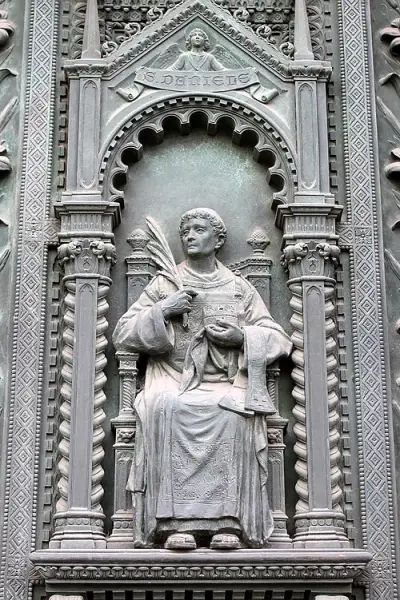
Daniel of Padua was never canonized by pope or council, because he belongs to the vast company of saints the Church honored from the moment of their deaths, the pre-congregation martyrs whose names passed from grave to altar to calendar without formal process. His cult was fixed in the city's stone by a solemn event of the high Middle Ages: on 3 January 1064 his relics were translated, raised from their resting place and borne to the Basilica Cattedrale di Santa Maria Assunta, the cathedral of Padua, where they remain. The date of the translation became the date of his feast, kept on 3 January in the Catholic Church and honored also in the Eastern Orthodox Church, which numbers him among the saints of the undivided first centuries. Medieval Padua gathered its apostolic founders, Prosdocimus the bishop and Daniel the deacon, around its cathedral, and the translation of 1064 gave the growing city a tangible link to its first Christian generation, nine centuries after their deaths. He is depicted on the bronze doors of the Basilica of Saint Anthony of Padua, so that the pilgrim who comes for the great doctor of the city meets the deacon of its first bishop at the threshold.
§ Life
Patron of Waiting Wives, Prisoners, and the Lost
The devotion that grew around Daniel is strikingly practical. The faithful call on him for wives whose husbands are away at war, an intercession that joins his own waiting church at Padua to every generation of families broken open by distant frontiers; the association may reflect his martyrdom at the hands of the military power of his day, suffered while his bishop was elsewhere. He is invoked also by those suffering confinement or imprisonment, perhaps because the crushing of his body spoke to those whose bodies are shut in, and by those seeking lost articles, a role he shares, unusually, with Anthony of Padua, the great finder of lost things, making him one of the few saints who divides that favor with the city's most famous son. His iconography fixed his identity for centuries: a deacon with towel and basin in hand, emblems of his service to the bishop, pointing back to the feet Jesus washed and to the ritual washings of traditional Judaism, the two streams of his inheritance. Jacopo da Montagnana's tempera of about 1495, Saints Daniel of Padua and Louis of Toulouse, now hangs in the Detroit Institute of Arts, and a chapel is dedicated to him in the Abbey Church of Santa Giustina.
§ Patronage
Timeline
- 168
Won the crown of martyrdom, dragged by a horse until his body was crushed, after aiding Prosdocimus in evangelizing the region
§ Life
- 3 Jan 1064
His relics were translated to the Basilica Cattedrale di Santa Maria Assunta, where they remain
§ Life
- 1495
Jacopo da Montagnana painted his tempera panel of Saints Daniel of Padua and Louis of Toulouse, now in Detroit
§ Iconography
- 1677
Antonio Zanchi executed the altarpiece of the Martyrdom of Saint Daniel for the chapel in Padua's Abbey Church of Santa Giustina
§ Iconography
- 1745
Francesco Bertos cast his bronze groups of the saint's martyrdom, held today by the Metropolitan Museum of Art
§ Iconography
The Record
- Patron of
- Invoked by women whose husbands are at war·Invoked by those suffering confinement or imprisonment·Invoked to find lost articles
- Symbols
- Depicted as a deacon holding a towel and laver
- Canonization
- Pre-congregation; venerated as a martyr since the early centuries of the Church
Prayer
Bibliography
Show 5 sources
- "Saint Daniel of Padua: Martyr", The Portugal News, January 28, 2024
- "Feast of St. Daniel of Padua", Chicago Catholic Social, January 3, 2022
- "Understanding the Washing of the Feet"
- "Saints Daniel of Padua and Louis of Toulouse", Detroit Institute of Arts
- "Francesco Bertos | Saint Daniel of Padua dragged by a horse before the Roman governor of Padua | Italian, Padua". Metropolitan Museum of Art. Retrieved 2023-06-19.
Profile text adapted from the Wikipedia article, licensed CC BY-SA 4.0.
Pray with this saint every day
Save St. Daniel of Padua to your favorites, read the full profile, and get feast-day reminders in the Saints app.
Get the Saints AppFree on the App Store for iPhone and iPad