
c. 409 – 493·Feast December 11
St. Daniel the Stylite
Pillar ascetic who stood thirty-three years near Constantinople
Overview
Daniel the Stylite, born around 409 in the Mesopotamian village of Maratha near Samosata, became the most celebrated pillar ascetic of the generation after Simeon the Stylite. Given to a monastery at the age of twelve, he remained there until he was thirty-eight, when a journey with his abbot to Antioch brought him into the presence and blessing of Simeon himself. After visiting the holy places and a spell in the ruins of a pagan temple, he established his pillar north of Constantinople around 460 and never deliberately left it for thirty-three years. The enterprise nearly ended at once, for the landowner who had not been consulted appealed to Emperor Leo I and Patriarch Gennadius, but the emperor's plans to remove him were deterred, and Gennadius instead ordained Daniel a priest, administering the Eucharist to him by ladder. Crowds came to touch the pillar and found healing, through rain, snow, and the Thracian winds that stripped his clothing; his feet, from continuous standing, were covered with sores and ulcers. Emperors Leo I and Zeno visited him, King Gubazes I of Lazica came in the emperor's train, and Daniel spoke against monophysitism. He died in 493, leaving his disciples a last exhortation to humility, obedience, and charity, and the Churches keep his feast on 11 December.
The Complete Life
From Maratha to the Blessing of Simeon
Daniel was born around 409 in Maratha, a village of Upper Mesopotamia near Samosata, in the borderlands where the Roman and Persian worlds met, in what is now Turkey. His parents gave him to God early: at the age of twelve he entered a monastery, and there he remained for twenty-six years, formed in the discipline of Syrian monasticism while the fame of the first pillar saints was rising to the east of him. The decisive turn came when he was thirty-eight. Traveling with his abbot to Antioch, he came to Telanissos, the settlement below Simeon's column, and there received the benediction and encouragement of the great ascetic himself, the meeting of one generation of stylites with its successor. Afterward Daniel made a pilgrimage through the Christian East, visiting various holy places and staying in various convents, absorbing the traditions of the desert before committing to one of his own. In 451, the very year of the Council of Chalcedon, he withdrew into the ruins of a pagan temple, the habitual gesture of Syrian holiness, occupying a place of the old gods for the new God. Within a few years he would leave even the ruined temple for the open air of a column.
§ Early life
A Pillar on Disputed Ground
The stylite life, of which Simeon had been the inventor and Daniel the most famous heir, took to its extreme the monk's renunciation of stability: to live standing on a capital of a column, exposed to weather and visible to every passerby, was to become a permanent public sign of the kingdom of heaven. Daniel established his pillar north of Constantinople, close enough to the capital that its quarrels and its emperors could not leave him alone. The beginning was nearly his end, for the man who owned the ground had never been asked, and he carried his complaint to Emperor Leo I and to the patriarch Gennadius of Constantinople. The emperor proposed to dislodge the intruder, but was deterred by means unknown, and the affair resolved instead into the strangest of ordinations: Gennadius, recognizing what stood on the pillar, ordained Daniel a priest, and once the rite was finished, Gennadius approached Communion by way of a ladder Daniel had ordered fetched, receiving the sacrament at the saint's elevated hands. From that contest began the three decades in which people came from everywhere to see him, touch the pillar, and find healing of body and soul.
§ Stylite
The Prayer of the Ascending Man
Two recorded utterances give the interior shape to Daniel's astonishing exterior life. The first is the prayer he made before mounting the pillar, a text in which the whole theology of his vocation is gathered: he yields glory to Jesus Christ his God for the blessings heaped upon him and for the grace to embrace this manner of life, and then confesses that in ascending the pillar he leans on God alone, looking to him alone for the happy issue of the undertaking. He asks not for comfort but for completion: that God accept his object, strengthen him to finish the painful course, and give him grace to end it in holiness. The second utterance came half a century later, when, just before his death, he gathered his disciples for a last instruction: hold fast to humility, be obedient, welcome the stranger, keep the fasts and the vigils, love poverty, and, above everything, let charity be maintained as the first and great commandment. He warned them to avoid the tares of the heretics and never to separate from the Church their Mother, promising that if they did these things their righteousness would be perfect. Between that first prayer and that last counsel lies the whole arc of a life of settled resolve.
§ Associated prayers
Thirty-Three Years of Standing
Daniel lived on the pillar for thirty-three years, a term that carried deliberate symbolism, matching the years of Christ's earthly life. The physical cost was part of the witness. Because of continuous standing, his feet, they said, were covered with sores, cuts, and ulcers; Thrace's winds sometimes tore away his scanty clothing; rain, snow, and freezing cold were his constant weather. Far from repelling pilgrims, the broken body proved the power of the prayer it carried, and crowds came from all over to touch the pillar, which healed the faithful. His isolation was in fact a kind of public office. Emperor Leo I the Thracian visited him, accompanied by King Gubazes I of Lazica, a foreign ruler come in the imperial train to the base of a column; Emperor Zeno came likewise in his turn. As a theologian Daniel took his stand against monophysitism, the teaching that diminished the full humanity of Christ, which the Church had condemned at Chalcedon in the year he entered the temple ruins. He died in 493, and the body that had stood so long was finally laid down, having completed, as he had asked, the painful course in holiness.
§ Stylite
Feast of 11 December in Three Traditions
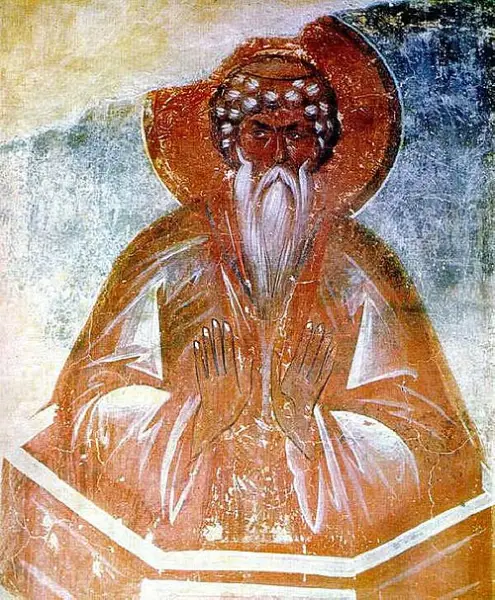
Daniel belongs to the pre-congregation saints, whose cult arose from the devotion of the pilgrims at his pillar rather than from any process. The life of an ascetic who drew emperors to a ladder and whose feet were remembered as ulcerated from standing was written while memory was fresh, and his vita became one of the classic texts of Byzantine hagiography, later rendered for English readers by Elizabeth Dawes and Norman Baynes among the Three Byzantine Saints. He is venerated as a saint in all three of the great traditions descended from the undivided Church: the Eastern Orthodox Church, the Roman Catholic Church, and the Eastern Catholic Churches, a breadth of recognition that reflects his geographical position between East and West, a Mesopotamian by birth, a Thracian by pillar, a Byzantine by allegiance. All three commemorate him on 11 December according to their liturgical calendars, the Western date of his death. In the East his image entered the imperial manuscripts: he appears among the saints in the eleventh-century Menologion of Basil II, and a fourteenth-century fresco by Theophanes the Greek preserves his likeness for the later Orthodox world, standing figure and column together, as his contemporaries knew him.
§ Introduction
The Heir of Simeon and the Model of Endurance
Daniel's historical importance is double. Within monastic history he is the great transmitter of the stylite ideal: blessed by Simeon the Stylite at Telanissos, he carried the practice from the Syrian hinterland to the neighborhood of Constantinople, where emperors, patriarchs, and crowds could not ignore it, and his long accepted presence at the capital fixed the pillar saint in the imagination of Byzantium. His opposition to monophysitism also gave the ascetic movement a doctrinal voice at a decisive moment, aligning the holiness of the pillar with the Chalcedonian faith. Within the history of devotion, his life became a measure of endurance, and his words outlasted his column. The prayer attributed to the beginning of his pillar life, leaning on God alone for the happy issue of an undertaking, and the deathbed counsel to his disciples, charity above all and never separate from the Church their Mother, circulated as spiritual reading for centuries, preserved in the sources cited by Cellier and Robertson. He is remembered alongside Simeon in the communion of stylites, the saints of the pole and the pillar, and his feast on 11 December keeps him in the calendars of East and West alike as the man who stood where he was placed and did not come down.
§ Notes
Timeline
- 409
Born at Maratha, a village of Upper Mesopotamia near Samosata in present-day Turkey
§ Early life
- 421
Entered a monastery at the age of twelve, remaining there for twenty-six years
§ Early life
- 447
Traveled with his abbot to Antioch at thirty-eight, receiving the blessing of Simeon the Stylite at Telanissos
§ Early life
- 451
After visiting holy places and convents, withdrew into the ruins of a pagan temple
§ Early life
- 460
Set up his pillar north of Constantinople, beginning the thirty-three years he would spend standing upon it
§ Stylite
- 493
Died after three decades and more on the pillar, leaving a parting exhortation to his disciples
§ Stylite
In Their Own Words
I yield Thee glory, Jesus Christ my God, for all the blessings which Thou hast heaped upon me, and for the grace which Thou hast given me that I should embrace this manner of life. But Thou knowest that in ascending this pillar, I lean on Thee alone, and that to Thee alone I look for the happy issue of mine undertaking. Accept, then, my object: strengthen me that I finish this painful course: give me grace to end it in holiness.
Hold fast humility, practice obedience, exercise hospitality, keep the fasts, observe the vigils, love poverty, and above all maintain charity, which is the first and great commandment; keep closely bound to all that regards piety, avoid the tares of the heretics. Separate never from the Church your Mother; if you do these things your righteousness shall be perfect.
The Record
- Symbols
- The pillar·Monastic habit exposed to the elements
- Canonization
- Pre-congregation; venerated in the Eastern Orthodox, Roman Catholic, and Eastern Catholic Churches
Prayer
Bibliography
Show 4 sources
- Dawes, Elizabeth & Baynes, Norman H. (1948), Three Byzantine Saints: Contemporary Biographies of St. Daniel the Stylite, St. Theodore of Sykeon and St. John the Almsgiver. London: B. Blackwell. Online version from Internet Medieval Sourcebook.
- "St. Daniel the Stylite - Saints & Angels - Catholic Online". Catholic Online. Retrieved 2016-08-19.
- Dawes & Baynes (1948), p. 79.
- Robertson, Christian History ii. 41-3, 274
Profile text adapted from the Wikipedia article, licensed CC BY-SA 4.0.
Pray with this saint every day
Save St. Daniel the Stylite to your favorites, read the full profile, and get feast-day reminders in the Saints app.
Get the Saints AppFree on the App Store for iPhone and iPad