
c. 1400 – 1496·Feast December 18
St. Daniil Sihastrul
Hesychast hermit and counsellor of Stephen the Great
Overview
Daniil Sihastrul, whose Romanian name means Daniel the Hesychast, stands among the most revered figures of medieval Moldavian Orthodoxy. Born near Rădăuți at the opening of the fifteenth century and baptized Dumitru, he received monastic tonsure at sixteen at Bogdana Monastery under the name David. Seeking deeper silence, he embraced the Great Schema and withdrew to a forested stretch of the Vițău valley near present-day Putna, where he hollowed a chapel and dwelling out of living rock. From that cave he exercised an influence far beyond his solitude: the young Stephen the Great visited him in 1451, after his father's assassination, and Daniil foretold his rise to the Moldavian throne. He urged the founding of Putna Monastery in 1466 and, after the Battle of Valea Albă in 1476, counseled the prince to persist against the Turks. When Voroneț Monastery rose in thanksgiving for victory, Daniil left his hermitage for it, became its hegumen, and died there in 1496. Honored as a saint since his own lifetime, he was formally canonized in 1992 by the Romanian Orthodox Church and is commemorated on December 18.
The Complete Life
The Boy Dumitru of Rădăuți
Northern Moldavia in the early fifteenth century was a frontier land of monasteries and forests, and into one of its villages near Rădăuți the future hesychast was born close to the century's opening years. The font gave him the name Dumitru, and of his family and childhood the sources preserve nothing further. What the record does show is a boy drawn early to monastic life: at sixteen he received the tonsure at Bogdana Monastery in Rădăuți, taking the religious name David. Yet stability did not satisfy a heart in search of stricter silence. After a time he moved on to the monastery of Saint Laurence near the village of Vicovu de Sus, deeper in the wooded north. There the pull of solitude proved irresistible. He bound himself with the Great Schema, the most demanding of monastic commitments, and with it received a new name, Daniil, the name by which he would be remembered. From Vicovu de Sus he pressed still further into wilderness, toward the dense forests of the Vițău valley near modern Putna, where the true work of his life would begin.
§ Biography
The Hesychast of the Vițău Valley
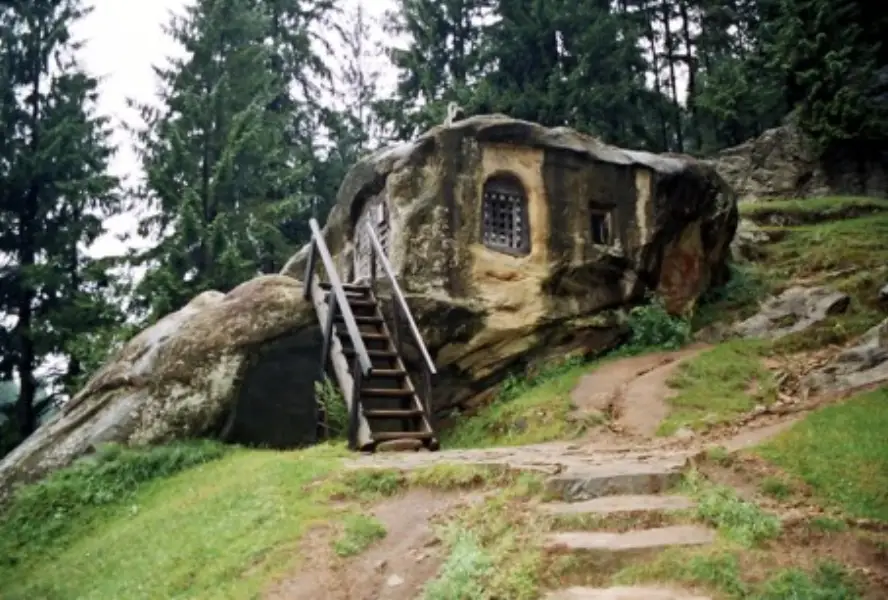
The Great Schema committed Daniil to unceasing prayer, and he sought a setting worthy of the vow. In the thickly wooded Vițău valley, near what is now Putna, he discovered a great rock and resolved to make it his church and his home. With his own hands he hollowed out a chapel complete with narthex, naos and altar, and beside them an underground chamber in which he dwelt. Pilgrims can still descend into those carved rooms today. Such a dwelling marked him as a hesychast in the fullest sense — one who flees the world in order to stand, in stillness, before God. Yet the hermit's cave became anything but a hiding place. Word of the holy man's discernment spread through Moldavia, and the forest silence filled with visitors seeking blessing and counsel; among them, in time, came the man whose destiny Daniil would foretell. The hermitage thus grew into a school of prayer for the novices who gathered in the surrounding woods, planting the seed of the hermit movement that would flourish across northern Moldavia in his later years and long after his death.
§ Biography
Prophet at the Prince's Side
A turning point in the political history of Daniil's age passed through his cave. In 1451 the boy prince Stephen, whose father Bogdan II had just been murdered at Reuseni, made his way to the hermit of the Vițău valley. Daniil received him and prophesied that the fugitive would return and rule Moldavia. The word was fulfilled in 1457, when Stephen the Great took the throne. The new prince did not forget his counselor. At Daniil's urging the prince raised Putna Monastery in 1466; when that church was hallowed, in 1470, the hermit relocated to Voroneț, in sight of Șoimului Rock where the river of the same name runs, and continued there the monastic life he had begun in the forest. Nearly a decade of war with the Ottoman Turks tested the principality, and in 1476, shaken by the Battle of Valea Albă, Stephen again sought out the holy man — this time at Voroneț. Daniil told him to keep fighting the invaders and foretold his triumph. When victory came, the prince marked it in stone: in 1488 he commissioned the church and monastery of Voroneț as a memorial of deliverance. Once that church was consecrated, Daniil left his hermitage for the monastery itself, exchanging the anchorite's solitude for the obedience of a common house.
§ Biography
Hegumen of Voroneț
The foundation of Voroneț closed the circle of Daniil's wanderings. Having spent his youth in the cloister and his maturity in the forest, he passed his remaining years within the monastery his counsel had raised on the Voroneț River. The community elected him its hegumen, and he governed it until his death in 1496. He was laid to rest in the monastery church, and over his tomb — at the express wish of Stephen the Great — a stone was carved whose inscription honors him under both his names, calling it the grave of their father David, the schema-monk Daniil. The double naming is a small theology in itself: Dumitru the boy of Rădăuți had become David the monk, and David had been transfigured into Daniil the bearer of the Great Schema, yet the epitaph holds them together in one confession of a single life given wholly to God. He died, as he had lived, in the shadow of the churches he had inspired — the rock chapel of the Vițău valley above, the princely foundations of Putna and Voroneț below — leaving behind a pattern of Moldavian holiness that others would follow for generations.
§ Biography
A Fire That Kindled a Hermit Movement
Daniil Sihastrul set a fire that spread far beyond his own cave. Around Voroneț he gathered many novices in the surrounding forests, and the hermitages and monasteries multiplying through the neighborhood owed their impulse to his example — a genuine hermit movement took root in northern Moldavia under his influence. Nor was his counsel confined to the cloister: he pressed the prince to take up the defense of Christendom in arms and to raise holy places across his realm, and the prince's extraordinary church-building owes more than a little to the hermit's exhortations. Honors of another kind gathered around his memory. He has been numbered among the saints since his own lifetime, and the faithful credited him with healing the sick, driving out demons, and lifting suffering from those who sought his prayers. Formal recognition followed in 1992, when the Romanian Orthodox Church canonized him, fixing his commemoration on December 18. His rock-hewn chapel near Putna remains a place of pilgrimage, its narthex, naos, altar and underground cell carved — as they were six centuries ago — from the living stone. In him Moldavia honors the contemplative whose silence steadied a kingdom at war.
§ Legacy
Timeline
- 1400
Born near the start of the fifteenth century in a village close to Rădăuți, receiving the baptismal name Dumitru.
§ Biography
- 1416
Tonsured a monk at sixteen under the name David at Bogdana Monastery in Rădăuți.
§ Biography
- 1451
Received Stephen the Great, newly orphaned by the murder of Bogdan II at Reuseni, in his forest hermitage and foretold his reign.
§ Biography
- 1457
His prophecy came true when Stephen the Great took the throne of Moldavia.
§ Biography
- 1466
At his urging, Stephen the Great founded Putna Monastery.
§ Biography
- 1470
Withdrew to Voroneț beneath Șoimului Rock after the consecration of Putna Monastery.
§ Biography
- 1476
Counseled Stephen after the Battle of Valea Albă to persist against the Turks, foretelling his triumph.
§ Biography
- 1488
Stephen commissioned Voroneț Monastery in commemoration of his victory; Daniil later moved there and was elected hegumen.
§ Biography
- 1496
Died and was laid to rest in the church of Voroneț Monastery, his tomb inscribed at Stephen's command.
§ Biography
- 1992
Canonized by the Romanian Orthodox Church; his commemoration falls on December 18.
§ Legacy
The Record
- Major works
- Rock-cut chapel and hermitage in the Vițău valley near Putna·Putna Monastery, founded by Stephen the Great at his urging·Voroneț Monastery, built by Stephen the Great on his counsel
- Canonization
- Canonized by the Romanian Orthodox Church in 1992
Prayer
Bibliography
Show 3 sources
- Mihai Săsăujan, “Sfinții români conturează identitatea locală ortodoxă, cu specificul ei național,” Ziarul Lumina, 6 June 2010
- Emil Preda, Dicționar al sfinților ortodocși (Ed. Lucman, București, 2000), pp. 71–72
- Michael Walsh, A New Dictionary of Saints: East and West, p. 146 (Liturgical Press, 2007), ISBN 0-8146-3186-X
Profile text adapted from the Wikipedia article, licensed CC BY-SA 4.0.
Pray with this saint every day
Save St. Daniil Sihastrul to your favorites, read the full profile, and get feast-day reminders in the Saints app.
Get the Saints AppFree on the App Store for iPhone and iPad