
c. 1270 – 1337·Feast January 2
St. Danilo II
Archbishop of Serbia and chronicler of the Nemanjić age
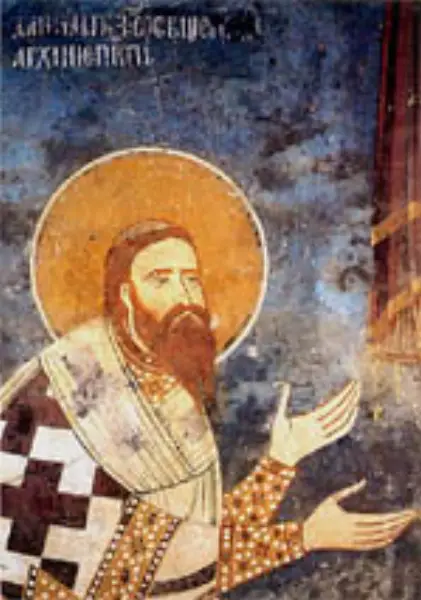
Overview
Danilo II served as archbishop of the Serbian Church from 1324 until 1337, shepherding it under kings Stephen Uroš III and Stefan Dušan at the height of Nemanjić power. He was born around 1270 in the župa of Pilot, in what is now northern Albania, into a Serbian noble family; his baptismal name went unrecorded. Educated by the most learned teachers of medieval Serbia and Byzantium, he first served at the court of King Stefan Milutin before withdrawing, around the year 1300, to Končul, a monastery standing on the banks of the Ibar. Archbishop Jevstatije then summoned him to Peć, where he was ordained a presbyter. Advancement followed steadily: abbot of Hilandar from about 1306 to 1311, bishop of Banjska from 1312 to 1315, and finally archbishop. His death came on 19 December 1337, and his body was laid to rest in the Church of Our Lady Hodegetria at Peć, a church of his own raising. Beyond his episcopal labors he was Serbia's great monastic chronicler, composing lives of kings and archbishops that Serbian folklore remembers as the “royal books.” The Serbian Orthodox Church numbers him among its saints, keeping his feast on January 2 alongside Saint Ignatius of Antioch.
The Complete Life
A Noble Birth in Pilot
Around the year 1270, in the župa of Pilot — a district corresponding to present-day Pult in what is now northern Albania — a son was born to a Serbian noble family. His baptismal name was never recorded; history would know him only by his monastic one. The sources note the qualities that set him apart even in youth: a fine intellect and a noble disposition, gifts that recommended him to the finest teachers of his day. His schooling, entrusted to the finest teachers medieval Serbia could supply and to masters of Byzantium, was of the first order, joining the learning of the imperial capital to the traditions of his own church. Few Serbs of his generation could claim such schooling, and it prepared him for the double career he would lead — first as a figure at the court of the Nemanjić kings and then as a hierarch of their church. The boy from the mountain valley would end his life as archbishop of all Serbia and as the literary voice of the dynasty whose rise he served and whose story he set down in writing for the centuries to come.
§ Life and work
From the King's Court to Končul
Education completed, the young noble took his place at the court of King Stefan Milutin, among the most powerful of the Nemanjić rulers. Service at court offered wealth and advancement, yet it did not hold him. Around the year 1300 he left the king's side and took up the monastic life at Končul, a small house beside the Ibar, as its novice. The move from palace to cloister proved decisive: whatever ambitions remained to him were redirected toward the service of the Church. His progress there was swift. After completing his novitiate he went, at the request of Archbishop Jevstatije, to Peć, the ecclesiastical center of Serbia, where he was ordained a presbyter priest. A summons from the archbishop himself shows how quickly his abilities were recognized. From the presbyterate the path opened before him — abbacy, episcopate, and in time the primatial throne of Peć itself — but it all began with the ordinary obedience of a monk who had exchanged a king's service for the discipline of a small monastery beside a mountain river.
§ Life and work
Shepherd of the Serbian Church
Danilo's rise through the hierarchy of the Serbian Orthodox Church was rapid and steady. From about 1306 to 1311 he served as abbot of Hilandar, an office that placed him at the head of the most prestigious community of Serbian monasticism. In 1312 he was called to the episcopate as bishop of Banjska, where he shepherded his flock until 1315. Nearly a decade later the summit came: in 1324 he was installed as archbishop, in succession to Nikodim I, bearing the title of Archbishop of All Serbia and of the Serbian Maritime Lands. His years as archbishop reached across two reigns — those of Stephen Uroš III (1321–1331) and of Stefan Dušan (1331–1355), who in 1345 took the imperial crown — and fell wholly within the golden age of the Nemanjić, when medieval Serbia stood at the height of its power. Danilo was no distant figurehead. Active in court as well as church politics, he guided the Church through years of ambition and conflict at the summit of the state, and when he laid down the office at his death in 1337, Joanikije II succeeded him in the see of Peć.
§ Life and work
The Shepherd Rests at Peć
Danilo held the archiepiscopal throne for thirteen years, from 1324 until 1337, long enough to see Stefan Dušan secure the throne and point Serbia toward an imperial crown. He did not live to witness the proclamation of the empire; his own work was finished earlier, and quietly. He died on 19 December 1337. The place of his burial was fitting: the Church of Our Lady Hodegetria in the monastery of Peć, one of the churches he himself had built. The hierarch who had governed the Serbian Church from Peć was laid to rest within its walls, in a church of his own raising, joining the memorials of the Serbian archbishops before him. There later generations would venerate the man whom the Church came to call Saint Danilo II. His death closed a life that had crossed the whole breadth of his society — from a mountain župa to a king's court, from the abbacy of a royal monastery to the first throne of the Serbian Church — and left that society the richer for what he had written and built.
§ Life and work
The Ancient Books and the Royal Books
Danilo's lasting fame rests on his pen as much as on his crozier. He composed biographies of the medieval Serbian kings and archbishops, including the life of Queen Jelena, wife of King Stephen Uroš I of Serbia (1243–1276). Serbian folklore came to speak of his monumental work as the knjige starostavne — the ancient books — and the knjige carostavne — the royal books. Through those lives a vast store of historical detail about the rulers of medieval Serbia and the Nemanjić dynasty passed safely to later generations; without them much of the dynasty's story would be dark. The Serbian Orthodox Church proclaimed him a saint, and he is celebrated on 2 January (O.S. 20 December), the same day as Saint Ignatius of Antioch. His countrymen have kept his memory in other registers as well: he is counted among the hundred most prominent Serbs, and a monument stands in his honor at Raška. Hierarch, hagiographer, and chronicler of the Nemanjić age, he remains the voice through which the kings and archbishops of medieval Serbia still speak to their descendants.
§ Life and work
Timeline
- 1270
Born around this year in the župa of Pilot, in present-day northern Albania, to a Serbian noble family.
§ Life and work
- 1300
Leaves the court of King Stefan Milutin and becomes a monk at Končul, a monastery on the Ibar.
§ Life and work
- 1306
Becomes abbot of Hilandar, serving in that office until about 1311.
§ Life and work
- 1312
Consecrated bishop of Banjska, an office he holds until 1315.
§ Life and work
- 1324
Installed as Serbian archbishop in succession to Nikodim I, an office he holds until 1337.
§ Life and work
- 19 Dec 1337
Dies and is buried in Our Lady Hodegetria at the monastery of Peć, a church of his own building.
§ Life and work
The Record
- Major works
- Biographies of the Serbian medieval kings and archbishops, folklore's “ancient books” and “royal books”·Life of Queen Jelena, wife of King Stephen Uroš I of Serbia·Church of Our Lady Hodegetria, built by him at the monastery of Peć
- Canonization
- Proclaimed a saint by the Serbian Orthodox Church
Prayer
Bibliography
Show 4 sources
- Gordon Lawrence McDaniel, “The ‘Lives of the Serbian Kings and Archbishops by Danilo II’: Textual History and Criticism” (PhD diss., University of Washington, 13 June 1980)
- Francis J. Thomson, “Archbishop Daniel II of Serbia Hierarch, Hagiographer, Saint. With Some Comments on the Vitae regum et archiepiscoporum Serbiae and the Cults of Mediaeval Serbian Saints,” Analecta Bollandiana 111, 1–2 (1993), pp. 103–134
- Episkop šumadijski Sava, “Sveti Danilo II arhiepiskop srpski,” in Srpski jerarsi od IX do XX veka (Projekat Rastko, 2001 [1996])
- Justin Popović, Žitija svetih (Izdanje Manastira sv. Ćelije kod Valjeva, 1976)
Profile text adapted from the Wikipedia article, licensed CC BY-SA 4.0.
Pray with this saint every day
Save St. Danilo II to your favorites, read the full profile, and get feast-day reminders in the Saints app.
Get the Saints AppFree on the App Store for iPhone and iPad