
died 20 November 303·Feast November 20
St. Dasius of Durostorum
Soldier-martyr who refused the kingship of Saturnalia
Overview
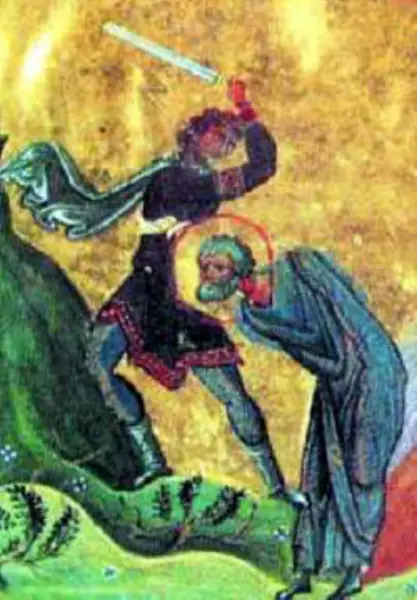
Dasius of Durostorum was a Roman soldier of Legio XI Claudiana stationed at Durostorum — modern Silistra on the Danube, in Bulgaria — who won the crown of martyrdom in the early fourth century. His garrison kept the Saturnalia, and each year one legionary was drawn by lot to reign a month as the festival's king; at the feast's end, so the tradition runs, this king was put to death before the altar of Saturn. When the lot fell on Dasius, his Christian faith made the honor a double condemnation: a month of idol worship crowned by death and the loss of his soul. He refused. Questioned by a legate named Bassus, he also declined to honor the imperial cult, was tortured, and was beheaded — the first of twelve martyrs of Durostorum in the Diocletianic persecution. A Greek Passion, the Acta Dasii, survives from an eleventh-century manuscript that Franz Cumont published in the 1890s. After Avar raiders overran lower Moesia in the sixth century his remains were carried to Ancona, where they rest in the Museo Diocesiano beside the cathedral. His feast is kept on November 20; in 2002 Pope John Paul II gave a relic of the saint to the church of Silistra.
The Complete Life
A Christian in the Eleventh Legion
Dasius served in Legio XI Claudiana, whose fortress at Durostorum — the Danube town that stands today as the Bulgarian city of Silistra — anchored the frontier of the province of Moesia Inferior. He was a Christian serving among legionaries who for the most part were not, and the Acta Dasii preserves the world in which his faith and his profession collided. Its pages devote roughly a third of their length to a description of the Saturnalia as the pagan garrison kept it, an unusual richness for a saint's passion. Each year the soldiers drew lots for a festival king who reigned for a month with extraordinary privileges and unrestricted licence; at the month's end, so the text claims, the king was sacrificed before the altar of Saturn. The emperor Nero himself, the tradition notes, had played the king in his youth. Historical opinion has divided over whether such a sacrifice was ever real practice: Cumont doubted it, judging the king required only to offer sacrifice to Saturn; Frazer accepted it as a survival of the most ancient custom; Parmentier saw in it fourth-century Christian propaganda painting pagan revelry in the darkest colors. Whatever the custom's truth, for a Christian the lot meant a month of idolatry crowned with death — a double condemnation no believer could accept.
§ Acta Dasii
The Refusal and the Passion
In the year of his martyrdom the lot fell on Dasius, and he refused the kingship outright. The Acta presents his interrogation by a legate named Bassus, in the course of which Dasius also refused to honor the imperial cult. The scene assumes the fourth decree of Diocletian, published in 304, obliging men under arms to offer sacrifice to the emperor; soldiers who had professed Christ openly through long careers suddenly confronted a stark alternative — apostasy or the executioner. Dasius chose death. After the questioning he was tortured and finally beheaded by one Johannes Aniketos — a name that troubled Cumont, since Johannes is a Christian name and its presence would suggest one Christian executing another; he conjectured that the Greek text mistranslated a Latin original stating that Dasius was buried by Johannes. Hagiographical tradition places the martyrdom slightly earlier, in 302 or 303, or in 292; the year 303 agrees best with the day and lunar phase the narrative records. Dasius was the first of twelve martyrs put to death at Durostorum under the persecution, and his passion finds a parallel in that of Julius the Veteran. The surviving Greek text, however, is later than the events it records: it shows the martyr professing the Neo-Nicene creed framed in 381, which fixes its composition no earlier than the late fourth century.
§ Acta Dasii
An Ancient and Widespread Cult
Dasius was honored as a martyr from the earliest centuries, long before any formal process of canonization existed. His veneration was widespread through the fifth, sixth, and seventh centuries. The Martyrologium Hieronymianum, compiled around the year 600, records his name under several forms — Bassus, Dassus, Taxius, and Dasus — together with commemorations on 5 August at Irakleio in Attica, on 21 December at Axiopolis in Moesia, and on 20 October at Puteoli; his principal feast remains 20 November. After Avar invaders overran lower Moesia in the sixth century, his relics were carried for safety to Ancona on the Adriatic, where they repose in a marble tomb preserved in the Museo Diocesiano beside the city's cathedral. The oldest surviving image of the saint appears in the Menologion of Basil II, the sumptuous manuscript of the late tenth or early eleventh century, which commemorates him under 20 November. Devotion has crossed borders and centuries alike: when Pope John Paul II visited Bulgaria in 2002, he bestowed on the church of Silistra a relic of the martyr — the right arm-bone drawn from the Ancona treasure — enclosed in a little marble casket fashioned after the appearance of the saint's sarcophagus. A martyr of the lower Danube thus lies honored in Italy while his feast is kept again in the land of his birth.
§ Veneration
A Passion That Divided the Scholars
The Acta Dasii owes its modern life to Franz Cumont, who discovered the text in the 1890s in an eleventh-century manuscript and published it in 1897; until then the saint had been known only from short entries in medieval martyrologies. Cumont dated the Greek Passion to the fifth or sixth century, arguing from its many Latinisms that it translated a Latin account written within a few decades of the events, and he judged that much of the text reflects a genuinely historical trial. His conclusions set off a debate that ran for years. A review by Léon Parmentier appeared as early as 1897; Parmentier denied that any human sacrifice occurred but held the claim genuine to the original text, an instance of Christian propaganda depicting pagan customs as abhorrent. James Frazer, in The Golden Bough, accepted the sacrifice's historicity and read the story of Dasius as preserving, in the wilds of Moesia, an institution of archaic antiquity, quoting the martyrdom at length and dating the beheading to Friday, 20 November 303. Modern scholarship has continued the examination: Renate Pillinger's edition of 1988 called several of Cumont's opinions into question, while Ivan Venedikov has traced the ceremony in the passio to the Kukeri New-Year processions of Bulgarian folklore — Bulgarian writers emphasizing continuity with living custom, western scholars reading the text chiefly as evidence for the Roman Saturnalia.
§ Saturnalia and human sacrifice
Timeline
- 20 Nov 303
Drawn by lot as Saturnalia king at Durostorum, he refuses the role, rejects the imperial cult, and is beheaded.
§ Acta Dasii
- 590
Following the Avar invasion of lower Moesia in the sixth century, his remains are carried to Ancona.
§ Veneration
- 600
The Martyrologium Hieronymianum, written about this time, lists his name under several forms and feast days.
§ Veneration
- 1000
The Menologion of Basil II, of the late tenth or early eleventh century, preserves the oldest known image of the saint.
§ Veneration
- 1897
Franz Cumont publishes the Greek Passion discovered in an eleventh-century manuscript in Analecta Bollandiana.
§ Acta Dasii
- 1988
Renate Pillinger brings out a new critical edition of the Acta Dasii, challenging parts of Cumont's reading.
§ Acta Dasii
- 2002
During a visit to Bulgaria, Pope John Paul II gives the saint's right humerus from Ancona to the church of Silistra.
§ Veneration
The Record
- Canonization
- Pre-congregation martyr of the early fourth century
Prayer
Bibliography
Show 5 sources
- Franz Cumont (ed.), “Passio S. Dasii,” Analecta Bollandiana 16 (1897), pp. 5–16; the manuscript edited is BnF ms. 1539, of the eleventh century
- Renate Pillinger (ed. and trans.), Das Martyrium des Heiligen Dasius (Vienna, 1988), ISBN 978-3-7001-1514-4
- Hanns Christof Brennecke, “‘An fidelis ad militiam converti possit?’ Frühchristliches Bekenntnis und Militärdienst im Widerspruch,” in D. Wyrwa (ed.), Beihefte zur Zeitschrift für die neutestamentliche Wissenschaft und die Kunde der älteren Kirche (Berlin, 1997), pp. 45–100
- Fanny Dolansky, “Celebrating the Saturnalia: Religious Ritual and Roman Domestic Life,” in A Companion to Families in the Greek and Roman Worlds (Wiley-Blackwell, 2011), p. 484
- Valentina Drumeva, Razkazi za bălgarskite svetii i za svetiite, svârzanite s Bălgariia, part I (Zograf Monastery, 2005)
Profile text adapted from the Wikipedia article, licensed CC BY-SA 4.0.
Pray with this saint every day
Save St. Dasius of Durostorum to your favorites, read the full profile, and get feast-day reminders in the Saints app.
Get the Saints AppFree on the App Store for iPhone and iPad