
c. 1221/1240 – 1299·Feast May 20
St. Daumantas of Pskov
Lithuanian Duke Turned Warrior Prince of Pskov
Overview
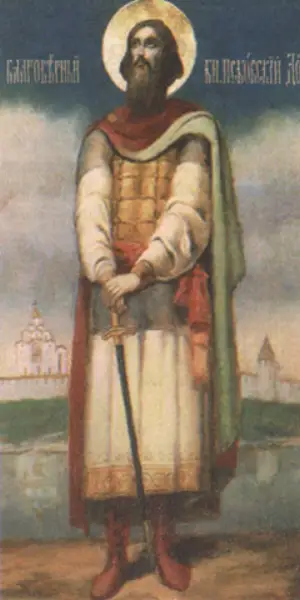
Daumantas, known in Russian as Dovmont and in baptism as Timothy, was a Lithuanian nobleman who became Prince of Pskov and one of the most honored defenders of medieval Russia. Born a duke of Nalšia in the Lithuanian realm and a brother-in-law of King Mindaugas, he was drawn into the deadly politics of the young Lithuanian state: after the king took his wife following Queen Morta's death, Daumantas joined the conspiracy against him and killed him in 1263. When Mindaugas's son Vaišelga returned to power and began destroying his enemies, Daumantas fled with his family and three hundred warriors to Pskov. There he was baptized into Eastern Orthodoxy, married into the house of Alexander Nevsky, and was elected prince by the Pskovians, whom he led to repeated victories over the Livonian Knights and the Lithuanians. Under his rule Pskov asserted an autonomy that amounted to de facto independence from Novgorod. The Pskovian Chronicles say no ruler was loved more. A plague carried him off at Pskov on 20 May 1299, was buried in the Trinity Cathedral, and has been venerated ever since as the chief patron saint of Pskov and of the Russian army.
The Complete Life
A Duke of Nalšia
Nothing in Daumantas's first decades bound him to the Rus' lands. Born a Lithuanian, he held Nalšia as its duke, a province in the north of the realm Mindaugas was forging into a kingdom. He first surfaces in the sources around 1252, described as the king's brother-in-law and a participant in the defense of the royal castle of Voruta. Young and loyal, he rose into the king's own family circle, taking as wife the sister of Mindaugas's second wife, Queen Morta. The relationship turned bitter. The bond soured after Morta's death in 1262, when Mindaugas grossly slighted his kinsman: he summoned Daumantas's wife to weep for the departed queen, then refused to let her go, keeping her in his household to bring up his small children, so the story goes, at Morta's own dying wish. In that same season of court intrigue, two of Mindaugas's kinsmen, his cousin Treniota, duke of Samogitia, and his brother Tautvilas, duke of Polotsk, were secretly seeking the throne. Daumantas, nursing his grievance, joined their conspiracy. In the autumn of 1263 he killed Mindaugas and the king's sons Ruklys and Repeikis, and Treniota ruled Lithuania in fact, if not in name.
§ Early life in Lithuania
Fugitive at the Baptismal Font
The assassin's revenge brought Daumantas only a brief security. Treniota was soon assassinated by supporters of the murdered king, and in 1264 Mindaugas's son Vaišelga marched home with soldiers from Novogrudok and Pinsk and the alliance of Duke Shvarn of Galicia–Volhynia to recover his father's crown and hunt down the foes of his house in Nalšia and Deltuva. Daumantas escaped with his household and three hundred fighting men. He negotiated with Pskov in 1265 and arrived in the city the following year, after his defeat by Vaišelga. The sudden appearance of so many armed Lithuanians alarmed and enraged the Novgorodians, who went so far as to plot the strangers' deaths. Prince Sviatoslav, son of Prince Yaroslav of Novgorod, defended them and baptized them into the Eastern Orthodox faith. Daumantas was christened Timothy and took to wife a daughter of Dmitry of Pereslavl, himself a son of Alexander Nevsky. The exile and the regicide thus became, through the font, a new man in a new land, beginning the second life that would make him a saint of the city that received him. In the eyes of the Rus' world he arrived as a dangerous stranger, and left the font a kinsman of its greatest princely house.
§ Prince of Pskov
Sword of Pskov
His talent for war convinced the men of Pskov to choose him as knyaz, the commander of their armies, and he spent the rest of his life repaying their trust. Settled in Pskov, he led its armies against the Lithuanians and drove them back to the banks of the Daugava, then turned his revenge on Gerdenis, the new duke of Nalšia loyal to Vaišelga, ravaging north-eastern Lithuania three times in 1266 and 1267 and carrying off Gerdenis's wife and two sons. In January 1268 he joined several Russian princes in invading Danish Estonia, fighting the Livonian Knights and the local militia at the Battle of Rakvere on 18 February. The next year the master of the Livonian Order, Otto von Lutterberg, burned Izborsk and laid siege to Pskov itself; Daumantas, reinforced by the Novgorodians, held the walls and concluded a truce. When Yaroslav tried in 1270 to replace him with another Lithuanian prince, the Pskovians stood by their defender and forced the plan's abandonment. On 8 June 1272 he defeated the Livonians near Pskov and devastated their Estonian lands, in 1278 he campaigned against the Karelians and beat the Livonians again, and in 1285 he led a campaign against Tver, suffering capture but winning a quick release. Under his leadership Pskov achieved a de facto independence from Novgorod it had never known.
§ Prince of Pskov
The Prince Who Laid Down His Sword
Baptized as Timothy upon his arrival in Pskov, Daumantas made the Orthodox faith of his adopted city his own, and the chroniclers remembered a gesture that fused his piety with his profession: before each campaign the prince deposited his sword upon the altar of the Holy Trinity church, giving his weapons over to God before he took them up again. An image of this act, preserved in the sixteenth-century Illustrated Chronicle of Ivan the Terrible, became one of the defining scenes of his life. His devotion found material expression as well: the fortifications he raised in Pskov's downtown, afterward called the Daumantas Walls, sheltered the churches and shrines of the city, and his family was portrayed with the Virgin in the Our Lady of Mirozh icon of the Mirozhsky Monastery. In the 1280s and 1290s he aligned Pskov loyally with the grand princes Dmitry and Andrey of Vladimir, and in 1293 gave refuge in Pskov to Dmitry himself when Dyuden's campaign overwhelmed north-eastern Russia. The man who had once murdered a king ended his life as a prince whose strength was placed, altar by altar, at the service of the Christian city he defended.
§ Prince of Pskov
The Last Victory and a Quiet Death
Daumantas's final years brought both one more battlefield triumph and the quiet end of a plague. On 4 March 1299 the Livonian Order burst without warning into north-western Russia and blockaded Pskov. The aged prince answered with one last victory, beating the attackers in combat beside the Velikaya and dispatching his prisoners to Grand Prince Andrey in Vladimir. Weeks later, in a plague that swept the region, Daumantas died at Pskov on 20 May 1299. His supposed son David of Grodno outlived him, and the prince found his grave in the Trinity Cathedral, that same church before whose altar he had so often set down his sword. His personal effects and his sword remained on exhibit there until the twentieth century, tangible relics of the prince whom the citizens loved above every ruler the chronicles recorded, praising above all his military skill and his wisdom. The reign that had begun with three hundred exiled warriors ended with a city secure behind walls, a treasury of victories, and a grave at the heart of its spiritual life. In the decades that followed, the memory of that resting place drew generation after generation of Pskovians back to the cathedral where their prince slept.
§ Prince of Pskov
Saint of Pskov
Veneration of Daumantas began at his death, without any formal process: from the time of his burial he was honored as a local saint of the city he had defended. According to the Pskovian Chronicles, among all who governed the city none won the townspeople's love as Daumantas did, the chronicle praising his generalship and wisdom above all. In 1460, when Yury, son of Grand Prince Vasily II of Moscow, took up rule over Pskov, the townspeople enthroned the new prince in the Holy Trinity cathedral and placed in his hand the sword of Daumantas, a ceremony that shows how deeply the sainted prince remained the model of Pskovian rulership a century and a half after his death. The Russian Orthodox Church formally canonized him in the sixteenth century, ranking him with Alexander Nevsky as a defender of Orthodox Russia, and a church dedicated to the princely saint rose in Pskov in 1567. His feast is kept on 20 May, the day of his death, and his remains rest in the Trinity Cathedral. Few medieval rulers received so immediate and so durable an honor from the city they governed.
§ Legacy
The Walls and the Memory
Daumantas left his name on the city he governed. The fortifications he erected in Pskov's downtown became known as the Daumantas Walls, a permanent feature of the city's defenses and a daily reminder of the prince who built them. Russian writers ranked him alongside Alexander Nevsky as a champion of Orthodox Rus', and he was acknowledged in time as Pskov's chief heavenly patron and as guardian of the Russian army, an unusual double patronage for a former Lithuanian duke and regicide who found his true vocation only in exile. His story has drawn the attention of historians of both nations: modern studies by Artūras Dubonis and Edvardas Gudavičius trace his Lithuanian career, while Russian reference works from the Brockhaus and Efron dictionary to the Great Russian Encyclopedia and the Orthodox Encyclopedia preserve the record of his reign. In Pskov itself his memory was embodied in fresco, in icon, in the church of 1567, and in the sword that lay by the cathedral altar; his remains are still held in the Trinity Cathedral, and his feast keeps alive the memory of the exile who became a city's beloved prince and saint.
§ Legacy
Timeline
- 1252
First mentioned in sources around this year as King Mindaugas's brother-in-law, defending the royal castle of Voruta
§ Early life in Lithuania
- 1255
Reigns as Duke of Nalšia, a northern province of the Lithuanian realm
§ Early life in Lithuania
- 1262
Queen Morta dies; Mindaugas takes Daumantas's wife to raise the royal children
§ Early life in Lithuania
- 1263
Kills Mindaugas and his sons in revenge; Treniota becomes de facto king of Lithuania
§ Early life in Lithuania
- 1264
Flees Lithuania with his family and 300 men when Vaišelga returns and purges the duchies of Nalšia and Deltuva
§ Early life in Lithuania
- 1266
Arrives in Pskov, is baptized as Timothy, marries a daughter of Dmitry of Pereslavl, and is elected prince
§ Prince of Pskov
- 1267
Leads three attacks into north-eastern Lithuania and captures the family of Duke Gerdenis
§ Prince of Pskov
- 18 Feb 1268
Joins the Russian princes in invading Danish Estonia and fights the Livonian Knights at the Battle of Rakvere
§ Prince of Pskov
- 1269
Withstands the Livonian siege of Pskov after Izborsk is burned, then concludes a truce
§ Prince of Pskov
- 1271
Restored as prince in the spring after the Pskovians resist Yaroslav's attempt to replace him
§ Prince of Pskov
- 8 Jun 1272
Defeats Livonian forces near Pskov and then devastates their Estonian territories
§ Prince of Pskov
- 8 Jun 1278
Campaigns against the Karelians with Dmitry and again beats the Livonians near Pskov
§ Prince of Pskov
- 1282
Rides into Ladoga to recover Dmitry's captured treasury and frees his daughters and boyars; marries Maria
§ Prince of Pskov
- 1285
Launches a campaign against the Principality of Tver; defeated and taken prisoner, but soon released
§ Prince of Pskov
- 4 Mar 1299
Routs the invading Livonian Order on the banks of the Velikaya River after they besiege Pskov
§ Prince of Pskov
- 20 May 1299
Dies of plague at Pskov and is buried in the Trinity Cathedral, beginning his veneration as the city's patron
§ Prince of Pskov
- 1460
The Pskovites enthrone Prince Yury beside the sword of Daumantas in the Holy Trinity cathedral
§ Legacy
- 1550
The Russian Orthodox Church formally canonizes him in the sixteenth century, ranking him with Alexander Nevsky
§ Legacy
- 1567
A church dedicated to Daumantas is built in Pskov
§ Legacy
In Their Own Words
seated him on the table in the Holy Trinity and placed a sword in the hand of his prince Daumantas
The Record
- Major works
- Fortifications of Pskov, later known as the Daumantas Walls
- Patron of
- Pskov·the Russian army·against invasion
- Symbols
- Sword laid before the altar·Princely armor·Fresco in the Trinity Cathedral·Our Lady of Mirozh icon with him and his wife Maria
- Canonization
- Canonized by the Russian Orthodox Church in the 16th century; venerated from the time of his death
Prayer
Bibliography
Show 8 sources
- Dejevsky, Nikolai (1978). "Dovmont". In Wieczynski, Joseph L. (ed.). The Modern Encyclopedia of Russian and Soviet History. Vol. 9. Academic International Press. p. 240. ISBN 978-0-87569-064-3
- Kuzmin, A. V. (2007). "Довмонт". In Kravets, S. L. (ed.). Большая российская энциклопедия. Том 9. Большая российская энциклопедия. pp. 172–173. ISBN 978-5-85270-339-2
- Okhotnikova, V. I.; Kuzmin, A. V. (2007). "Довмонт". Православная энциклопедия. Т. XV. Moscow: Православная энциклопедия. pp. 519–527. ISBN 978-5-89572-026-4
- Rowland, Daniel Bruce (1 January 1984). Medieval Russian Culture. University of California Press. p. 139. ISBN 978-0-520-08638-8
- Murray, Alan V. (5 July 2017). Crusade and Conversion on the Baltic Frontier 1150–1500. Taylor & Francis. p. 168. ISBN 978-1-351-94715-2
- Langer, Lawrence N. (15 September 2021). Historical Dictionary of Medieval Russia. Rowman & Littlefield. p. 173. ISBN 978-1-5381-1942-6
- Dubonis, Artūras. "Bastūnas Daumantas Pskoviškis". ldkistorija.lt. Vilnius University. Retrieved 29 July 2025
- Gudavičius, Edvardas. "Daumantas". vle.lt. Science and Encyclopaedia Publishing Centre. Retrieved 29 July 2025
Profile text adapted from the Wikipedia article, licensed CC BY-SA 4.0.
Pray with this saint every day
Save St. Daumantas of Pskov to your favorites, read the full profile, and get feast-day reminders in the Saints app.
Get the Saints AppFree on the App Store for iPhone and iPad