
c. 500 – c. 589·Feast March 1
St. David
Bishop of Mynyw and Patron Saint of Wales
Overview
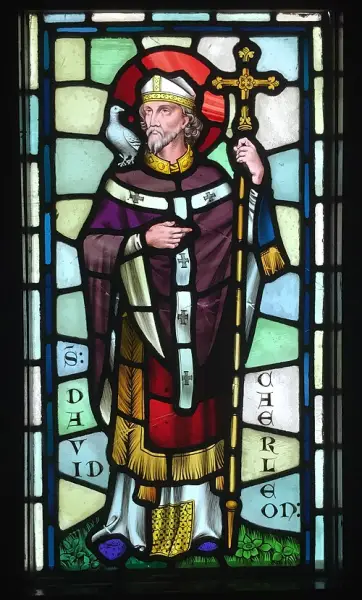
David, known in Welsh as Dewi Sant and in Latin as Davidus, was a Welsh prelate of the sixth century who served as Bishop of Mynyw and became the patron saint of Wales. Born around 500, by tradition the child of Saint Non and descended from Ceredig ap Cunedda, who ruled as king of Ceredigion, he rose from obscure Welsh origins to be renowned as a teacher and preacher, planting monastic settlements and churches across Wales, Dumnonia, and Brittany. Around 550 his preaching against Pelagianism at the Synod of Brefi, marked by the rising of the ground beneath his feet and the settling of a white dove on his shoulder, won him election as primate of the region. The monastic rule he prescribed made his communities legendary for austerity: monks pulled the plough without oxen, ate bread with salt and herbs, drank only water, and owned nothing, even in common speech. From his own monastery in the valley of Glyn Rhosyn, where St David's Cathedral stands today, missionaries went out to evangelize Wales, Ireland, Cornwall, and Brittany. He died on 1 March, most commonly dated 589, and was canonically recognized by Pope Callixtus II in 1120. His feast of 1 March is kept as Saint David's Day, the national day of Wales.
The Complete Life
A Saint of Welsh Royal Blood
David was a native of Wales, and although his birth date remains uncertain, with suggestions ranging from 462 to 512, tradition has guarded the memory of his origins with unusual care. He is honored as the child of Saint Non, a holy woman who received a cult of her own, and as descending from Ceredig ap Cunedda, the king who ruled Ceredigion, so that the apostle of Wales drew his blood from the royal lines of the western kingdom. The tradition that he first saw the light at Henfynyw, the Vetus-Menevia of Latin writers in Ceredigion, is judged not improbable by scholars. Nearly everything else known of his early years comes through the Buchedd Dewi, the Life of David composed by Rhygyfarch around 1090, who claimed to draw on documents preserved in the cathedral archives. Modern historians approach that text with caution: Rhygyfarch wrote with a purpose: to advance the claim of the Welsh church, which had declined the Roman rite until the 700s, to a metropolitan standing equal to Canterbury. Some of the Life's claims, including the tale of a pilgrimage to Jerusalem ending in episcopal anointing by the patriarch, are read as arguments of that cause. Within the hagiography, however, the outlines of a genuinely Welsh saint stand firm: a bishop of Mynyw, rooted in Dyfed, whose holiness made him the father of a nation.
§ Hagiography
Teacher, Preacher, and Primate
David became renowned as a teacher and preacher, and his vocation expressed itself first in foundation: monastic settlements and churches rose across Wales, in Dumnonia, and in Brittany at his word. The crowning scene of his public life came around the year 550 at the Synod of Brefi, an assembly summoned to confront the Pelagian heresy that was again troubling the British church. Preaching in the midst of a vast crowd, David saw the ground beneath him rise into a small hill so that all might hear the word of God, while a white dove, which became his enduring emblem, settled upon his shoulder. The village of Llanddewi Brefi stands, the tradition says, on that very spot. His denunciation of Pelagianism carried the assembly, and according to Rhygyfarch he was declared archbishop by popular acclaim, an elevation that brought about the retirement of Dubricius from the primatial see. As primate he presided over the Synod of Caerleon, remembered as the Synod of Victory, around 569, consolidating the orthodox settlement his eloquence had won. Later advocates of St David's metropolitan dignity, among them Bernard its bishop, Geoffrey of Monmouth, and Gerald of Wales, built upon the memory of that acclamation, and the cathedral of St Davids in Pembrokeshire still marks the monastery he planted in the valley of Glyn Rhosyn.
§ Hagiography
Foundations from Glyn Rhosyn to Glastonbury
The missionary reach of David extended far beyond his Welsh valley. The Roman Martyrology of 2004 honors him as the bishop of Menevia who governed his monastery on the pattern of the Eastern Fathers and sent forth many monks to evangelize Wales, Ireland, Cornwall, and Armorica, the Brittany of the Celtic world; Breton place names such as Saint-Divy, Saint-Yvi, and Landivy still recall his passage. His connections with Glastonbury became a celebrated chapter of English and Welsh church history alike. Rhygyfarch counted Glastonbury Abbey among David's foundations, but William of Malmesbury, writing some forty years later and convinced the abbey was far older, gave a different account: David came not to found but to rededicate the ancient church, and received a vision of Jesus, who declared that he had dedicated it himself long before in honor of his Mother and that human hands should not repeat the work. David instead commissioned an extension east of the Old Church and donated a travelling altar adorned with a great sapphire. William's dimensions for that extension were confirmed by excavation in 1921, and a sapphire altar was among the treasures Henry VIII seized from the abbey at the Dissolution a thousand years after the saint's gift.
§ Connections to Glastonbury
The Watermen and the Little Things
The Monastic Rule of David made his communities the most austere in the British Isles. It prescribed that the monks pull the plough themselves, without draught animals, so that the labor of the fields fell upon the shoulders that prayed; it allowed them only bread with salt and herbs to eat, and water to drink, a severity so characteristic that the brotherhood earned the nickname "watermen". No personal possessions were permitted, and the prohibition reached even into speech: to say "my book" was counted an offence against the common life. The evenings of the community were spent in prayer, reading, and writing, so that the day's sweat was offered back to God in the night's contemplation. David himself lived austerely and instructed his monks to abstain from flesh meat and from ale, a discipline so unvarying that he is honored today as a patron of vegetarians. The Roman Martyrology summarizes the spirit of his government in a single phrase: he steered his community by the pattern of the Fathers of the East, wedding the desert tradition of the Christian East to the young church of the West. From such discipline came his famous last charge, that his people do the little things they had seen him do, a spirituality of small, faithful acts that Welsh piety has never forgotten.
§ Hagiography
The Last Sermon and the Angels
Tradition fixes the death of David on 1 March, the date now kept as Saint David's Day, though the year is disputed: the Welsh annals placed it 569 years after the birth of Christ, Phillimore's revision moved it to 601, and 589 is the year most commonly given alongside it. The same record makes the day a Tuesday, a detail on which later scholars have built their attempts to fix the chronology. On the Sunday before his death he preached his final sermon to his followers, and the Welsh Life preserves his words: he bade his lords, brothers, and sisters be joyful, to hold fast the faith and creed they had received, to perform the small acts they had watched him do and heard from him, while for himself he would walk the road their fathers had trodden before. That Welsh charge, "Gwnewch y pethau bychain mewn bywyd", has entered the language as one of its most familiar sayings, the distilled wisdom of the saint's ascetic gospel. When he died, the tradition tells that angels filled the monastery when Christ came to claim his soul. He was buried at St David's in Pembrokeshire, where his shrine would draw pilgrims for a thousand years.
§ Death
Recognition at Rome and Beyond
David's cult long outlived the age of the saints before receiving formal Roman recognition. He was officially acknowledged at the Holy See by Pope Callixtus II in 1120, the fruit of the labor of Bernard, Bishop of St David's, who championed both his saint and his see; other sources place the recognition in 1123. The Eastern Orthodox Church also enrolled him among the saints at a date now unknown. His liturgical memory took deep root: music for his Liturgy of the Hours, surviving in a medieval Welsh office, has been edited by O. T. Edwards from National Library of Wales MS 20541 E, and his feast of 1 March is kept in the Church of England as a Lesser Festival and on the Episcopal Church calendar in the United States. The Roman Martyrology of 2004 assigns him to 1 March under the Latin name Dávus, remembering the bishop of Menevia whose monastery, governed on the model of the Eastern Fathers, sent monks to evangelize Wales, Ireland, Cornwall, and Armorica. His earliest attestation in written sources is similarly liturgical: after a possible unnamed rebuke by Gildas, the first explicit reference to David comes in the Irish Martyrology of Tallaght in the early ninth century.
§ Veneration
The Leek, the Dove, and a Nation's Day
No other British saint commands a nation's calendar as David commands that of Wales. Saint David's Day on 1 March has been the patriotic feast of the Welsh for centuries: a broadside ballad of about 1630 explained that the Welsh, fighting a battle on that day, plucked leeks from a garden to tell friend from foe and wore them to victory, a custom Shakespeare wove into Henry V, where Fluellen and King Henry honor the leek as the badge of Welsh service. The leek and the dove on his shoulder remain his emblem and, in the leek's case, the symbol of Wales itself. His shrine at St David's Cathedral made the site the goal of medieval pilgrimage until Viking raiders of the tenth and eleventh centuries repeatedly stripped it; a new shrine rose in 1275, received the prayers of Edward I in 1284, was plundered again by Bishop Barlow in the Reformation, and was finally restored and rededicated by Bishop Wyn Evans on Saint David's Day 2012. The Armes Prydein of about 930 prophesied that the Welsh would rally beneath the pure banner of Dewi; over fifty pre-Reformation churches in South Wales bore his name, others stand at Baltimore, Maryland, and near Wayne, Pennsylvania, and Welsh composers from Arwel Hughes, whose 1950 oratorio is named Dewi Sant, to Karl Jenkins have set his life to music. Even Welsh folklore keeps him: the corpse candles that warn of approaching death are said to burn by his intercession.
§ Reputation
Timeline
- 500
Born in Wales around this year, by tradition the son of Non and grandson of Ceredig ap Cunedda; suggested dates range from 462 to 512.
§ Saint David
- 550
Attended the Synod of Brefi around this year, where his preaching against Pelagianism won him election as primate of the region.
§ Hagiography
- 569
Presided over the Synod of Caerleon, the "Synod of Victory", around this year.
§ Hagiography
- 1 Mar 589
Died at Mynyw on 1 March, traditionally a Tuesday, after preaching his final sermon the previous Sunday.
§ Death
- 1090
Rhygyfarch composed the Buchedd Dewi, the hagiography that preserved most traditional tales of David's life, around this year.
§ Hagiography
- 1120
Officially recognised at the Holy See by Pope Callixtus II, thanks to the work of Bernard, Bishop of St David's.
§ Veneration
- 1275
A new shrine for the saint was constructed at St David's Cathedral; its ruined stone base remains.
§ Death
- 1284
King Edward I came to pray at the shrine of St David in the cathedral.
§ Death
- 1921
The dimensions of the Glastonbury extension attributed to David were verified by archaeology.
§ Connections to Glastonbury
- 1950
Arwel Hughes's oratorio Dewi Sant, honoring the saint, was composed in Wales.
§ Reputation
- 2004
Listed in the Roman Martyrology under 1 March as Dávus, bishop of Menevia, whose monks evangelized Wales, Ireland, Cornwall and Armorica.
§ Veneration
- 1 Mar 2012
Bishop Wyn Evans unveiled and rededicated the restored shrine of the saint at a Choral Eucharist kept on Saint David's Day.
§ Veneration
In Their Own Words
Lords, brothers and sisters, Be joyful, and keep your faith and your creed, and do the little things that you have seen me do and heard about. And as for me, I will walk the path that our fathers have trod before us.
The Record
- Major works
- Monastery at Glyn Rhosyn, Pembrokeshire (site of St David's Cathedral)·The Monastic Rule of David·Monastic settlements and churches in Wales, Dumnonia, and Brittany·Extension to Glastonbury Abbey, east of the Old Church
- Patron of
- Wales·Pembrokeshire·Naas·vegetarians·poets
- Symbols
- bishop with a dove on his shoulder·standing on a raised hillock·leek
- Canonization
- Officially recognised at the Holy See by Pope Callixtus II in 1120, through the advocacy of Bernard, Bishop of St David's
Prayer
Bibliography
Show 5 sources
- Toke, Leslie (1908). "St. David". In Herbermann, Charles (ed.). The Catholic Encyclopedia. New York: Robert Appleton Company.
- Davies, John (2007) [1993]. A History of Wales. London: Penguin, p. 74.
- Evans, J. Wyn; Wooding, Jonathan M. (2007). St David of Wales: Cult, Church and Nation. Boydell Press.
- Roberts, Holly (2004). Vegetarian Christian Saints. Anjeli Press, p. 131.
- Wooding, Jonathan (2017). "Dewi Sant/St. David". In Echard, Sian; Rouse, Robert (eds.). The Encyclopedia of Medieval Literature in Britain. John Wiley & Sons.
Profile text adapted from the Wikipedia article, licensed CC BY-SA 4.0.
Pray with this saint every day
Save St. David to your favorites, read the full profile, and get feast-day reminders in the Saints app.
Get the Saints AppFree on the App Store for iPhone and iPad