
c. 1084 – 1153·Feast May 24
St. David I of Scotland
King and Monastic Founder Who Made Scotland
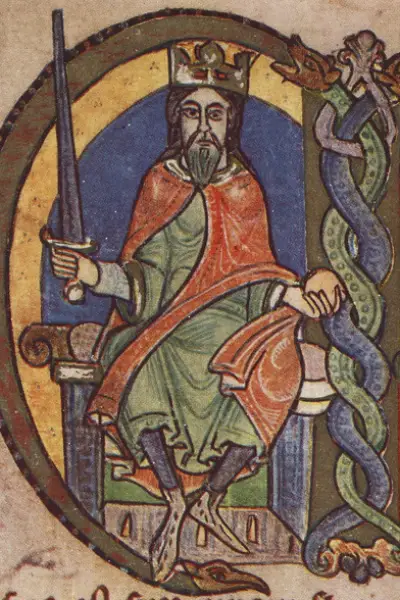
Overview
David I, son of King Malcolm III and St. Margaret of Wessex, reigned as King of Scotland from 1124 to 1153 after a decade as Prince of the Cumbrians. Driven into exile as a boy after his father's death in 1093, he was formed at the court of Henry I of England, whose protégé, brother-in-law and creature he became. He claimed the throne on Alexander I's death and spent roughly ten years suppressing his nephew Máel Coluim mac Alaxandair and the rising of Óengus of Moray before his kingdom was secure. On the continent of English politics he backed his niece Empress Matilda against King Stephen, carrying war into northern England even after the setback at the Standard in 1138, and closing with his son holding the earldom of Northumberland. His deepest importance, however, lies in the transformation historians call the Davidian Revolution: the founding of burghs and Scotland's first silver coinage, the introduction of feudal institutions and sheriffdoms, the reform of the Scottish church along Gregorian lines, and the foundation of more than a dozen monasteries, including Melrose and Kinloss. Medieval writers praised his piety and justice; he washed the feet of the poor and longed to join a crusade. He died at Carlisle on 24 May 1153 and is honored as a saint, with churches in Scotland under his patronage.
The Complete Life
The Youngest Son of Margaret
David first saw the light in Scotland in 1084, likely the eighth of King Malcolm III's sons and beyond doubt the last of the six children the king's second wife bore him, the queen whom the church would later canonize. His grandfather was King Duncan I. His childhood ended abruptly in 1093, when his father and his brother Edward were killed at Alnwick during a raid into Northumberland. David and his brothers Alexander and Edgar were probably at their mother's side when she died soon afterwards. Their paternal uncle Donald seized the throne, and tradition holds that the three boys were besieged in Edinburgh and then driven into exile in England, an escape later writers credited to their maternal uncle Edgar Ætheling. The years from 1093 to 1103 are shadowy, but David appears to have passed much of the decade in England. When Henry Beauclerc took the English throne in 1100 and married David's sister Matilda, David became brother-in-law to the king of England and, from that point, a figure of consequence at his court. Despite his Gaelic blood, he emerged from those years a fully Normanised prince; William of Malmesbury sneered that he had polished away his Scottish roughness through friendship with the English, a judgment that captures how completely the exile had been remade at Henry's side.
§ Early years
Prince of the Cumbrians
David's political vocation began with an inheritance. His brother King Edgar, having visited William Rufus in 1099, left David extensive territory south of the Forth. Edgar died on 8 January 1107, and Alexander took the throne of the north; David's possession of his southern lands is clearly attested only from late 1113, when he founded Selkirk Abbey for the Tironensians, perhaps the first act of his rule. Henry I's backing compelled Alexander to recognize the claim, probably without bloodshed. A resentful Gaelic quatrain of the period complained that Máel Coluim's son had divided Alba from Alexander and opened it to plunder, evidence of the bitterness his aggression stirred among native Scots. The principality comprised Roxburghshire, Selkirkshire, Berwickshire, Peeblesshire and Lanarkshire, and David's charters style him princeps Cumbrensis, Prince of the Cumbrians. In the latter part of 1113 Henry gave him the hand of Matilda of Huntingdon, heiress of Waltheof, Earl of Northumbria, bringing the Honour of Huntingdon and raising David among the greatest magnates of England. Two sons followed: Malcolm, who did not survive childhood, and Henry, christened in honor of the English king. David also planted marcher lordships, granting Annandale to Robert de Brus, Cunningham to Hugh de Morville, and perhaps Strathgryfe to Walter Fitzalan.
§ Early rule (1113–1124)
King of Scots: War and Statecraft
When Alexander I died on 23 April 1124, David, backed by Henry I, took the Kingdom of Alba for himself. His nephew Máel Coluim mac Alaxandair chose war, and according to Orderic Vitalis fought two fierce battles before David, loftier in understanding, power and wealth, overcame him. The struggle consumed roughly a decade. David's position outside his southern principality was at first so fragile that, in one historian's phrase, he ruled the Scots in name hardly at all. In 1130, while David was in England, the rebellion flared again under Óengus of Moray, his most powerful vassal, whose own royal descent gave him a claim to the throne; Óengus died at Stracathro with four thousand of his men. Four more years of civil war followed, ending only when Máel Coluim was captured and imprisoned at Roxburgh Castle in 1134. David then turned his drive for control to the far north, appointing the first Bishop of Caithness and installing his young cousin Harald Maddadsson in Orkney. South of the border he championed his niece the Empress Matilda against Stephen, occupying the castles of northern England, victorious at Clitheroe, beaten on the field of the Standard in 1138, and securing by the treaties of Durham what he could not wholly win by arms: Northumberland for his son, Carlisle and Cumberland for himself, and the silver of Alston with which to mint Scotland's first coinage.
§ Political and military events in Scotland during David's kingship
The Devotion of a Reforming King
David's contemporaries agreed that his kingship was saturated with piety. Aelred of Rievaulx, who had known him at court, recorded that David so disliked the unchristian acts of homage practiced at Scottish coronations that the bishops could scarcely compel him to receive them. William of Newburgh extolled the holy practices of a ruler who again and again knelt to wash paupers' feet, a devotion his canonized mother had famously shared. His religious program embraced the ideals of Gregorian Reform: he defended the independence of the Scottish church against the archbishops of York and Canterbury, secured the consecration of Robert of Scone at St Andrews, restored the bishopric of Glasgow under his reforming chaplain John, moved the see of Mortlach to Old Aberdeen, and forced semi-monastic communities at Brechin, Dunkeld, Aberdeen and Dunblane into a proper diocesan system. Above all he ranked among the most generous benefactors of monastic life medieval Scotland knew, planting over a dozen new houses, from Selkirk's Tironensians to the Cistercians of Melrose and Kinloss, whose labor turned southern Scotland into one of northern Europe's great sources of wool. Tradition adds a crusader's heart: Bower wrote that he always hoped to take the cross, Aelred hinted he wished to join the Second Crusade and was dissuaded by his subjects, and in 1128 he had welcomed Hugues de Payens, first Grand Master of the Knights Templar, granting the Order a seat at Balantrodoch.
§ Monastic patronage
Sorrow and Death at Carlisle
The last years of David's reign were darkened by failure in the north and grief at home. His plans to draw Orkney permanently into the Scottish sphere collapsed in 1151 when King Eystein II of Norway forced young Harald Maddadsson to pay fealty, and his bid for a Scottish archbishopric died when the papacy instead created Trondheim, absorbing the bishoprics of the Isles and Orkney. His attempts to control the bishopric of Durham and the archbishopric of York likewise came to nothing; Stephen's garrison at York in 1149 ended, in Richard Oram's judgment, the chance to redraw the political map of the British Isles. Then came the heaviest blow. On 12 July 1152 David's son Henry, Earl of Northumberland and heir to the throne, died after a long illness. The aging king had less than a year to live and seems to have known it. He moved swiftly, arranging for his grandson Malcolm IV to succeed and for the younger grandson William to receive Northumberland, while Donnchad I, Mormaer of Fife, was appointed rector and took the eleven-year-old heir around the Gaelic heartland to receive its homage. In the spring of 1153 his strength gave way, and on 24 May he passed away at Carlisle Castle. The Annals of Tigernach called him, in its obituary, king of Scotland and England, and in early June he was buried before the high altar of Dunfermline Abbey.
§ Succession and death
A Saint on the Throne
David I is recognized as a saint of the Catholic Church, his feast kept on 24 May, the day of his death, though it appears he was never formally canonized. His sanctity rested on the testimony of the generations who remembered him. The earliest English writers portrayed a pious king and reforming civilizer: William of Newburgh styled him a ruler far from barbarous governing a barbarous people, and commended his custom of kneeling to wash paupers' feet, while Aelred of Rievaulx, his one-time courtier, celebrated his justice and gentleness in a eulogy so long that Walter Bower later copied it wholesale, fixing the traditional image of David for centuries. Scottish historians of the late Middle Ages, from Fordun and Wyntoun to Bower, transcribed and amplified this portrait, and by the eighteenth century a settled picture had emerged of a pious, justice-loving state-builder and steadfast guardian of Scottish independence. Churches in Scotland honor him as patron, and his cult stands in the family of saints that produced his mother, Margaret of Scotland, canonized in 1249, and his descendant and namesake David. Among the kings of medieval Europe, few have been claimed so confidently by both the historian and the hagiographer.
§ Veneration
The Davidian Revolution
Scholars summarise the changes of David's reign in the phrase the Davidian Revolution, and no historian doubts that the transformation was real. He founded burghs, planned trading towns that were Scotland's first, at Roxburgh and Berwick as Prince of the Cumbrians and about fifteen in all, planted regional markets, introduced feudalism through immigrant Anglo-Norman knights and Flemish settlers, created sheriffdoms and the justiciarship on the Anglo-Norman model, and rebuilt the government of the kingdom around royal agents and written charters. His reign likewise fixed the shape of the Scottish church for the Middle Ages. Modern historians have moderated the older claim that he invented Scotland's parishes and sees, but the scale of his reform remains unquestioned: what Aelred counted as nine bishops where there had been three or four. Twentieth-century scholarship, from Ritchie and Duncan to the essays of G. W. S. Barrow, first stressed the Normanisation of Scotland, then sought a balance of new and old; Michael Lynch and Richard Oram have shown that David's kingship grew more Gaelic as it matured, even as its institutions carried Scotland into the mainstream of Latin Europe. The silver penny, the burgh, the abbey and the sheriffdom: the machinery of the later medieval kingdom was largely his making.
§ Davidian Revolution
Timeline
- 1084
Born in Scotland, probably the eighth son of King Malcolm III and his second wife, Margaret of Wessex
§ Early years
- 1093
His father and brother Edward fall at the Battle of Alnwick; David is forced into exile in England by his uncle Donald III
§ Early years
- 1100
Henry Beauclerc seizes the English throne and marries David's sister Matilda, making David brother-in-law to the king
§ Early years
- 8 Jan 1107
King Edgar dies, having bequeathed to David extensive lands south of the river Forth
§ Early rule (1113–1124)
- 1113
Claims his southern Scottish inheritance, founds Selkirk Abbey for the Tironensians, and marries Matilda of Huntingdon
§ Early rule (1113–1124)
- 1124
On Alexander I's death David takes the kingdom and is crowned at Scone in April or May; war follows with his nephew Máel Coluim
§ Coronation and struggle for the kingdom
- 1127
Becomes the first layman to swear the oath upholding the succession of Empress Matilda to the English throne
§ Usurpation of Stephen and First Treaty of Durham
- 1128
Receives Hugues de Payens, first Grand Master of the Knights Templar, in Scotland; the Order later settles at Balantrodoch
§ Historiography
- 1130
His wife Matilda of Huntingdon dies; Óengus of Moray rises in arms and is killed at the Battle of Stracathro
§ Coronation and struggle for the kingdom
- 1134
Máel Coluim mac Alaxandair is captured and imprisoned in Roxburgh Castle, ending the decade-long struggle
§ Coronation and struggle for the kingdom
- 1135
After Henry I dies and Stephen seizes the English crown, David invades northern England and agrees the First Treaty of Durham
§ Usurpation of Stephen and First Treaty of Durham
- 1137
Founds Melrose Abbey, the first Cistercian house in Scotland and one of his greatest legacies
§ Monastic patronage
- 10 Jun 1138
William fitz Duncan routs an English force at the battle of Clitheroe during David's invasion
§ Battle of the Standard and Second Treaty of Durham
- 22 Aug 1138
His much larger army is defeated by the English at the Battle of the Standard near Northallerton
§ Battle of the Standard and Second Treaty of Durham
- 1139
His five-year-old cousin Harald Maddadsson is made Earl of half of Orkney along with Scottish Caithness
§ Dominating the north
- 9 Apr 1139
Meets Queen Matilda of Boulogne at Durham and agrees a settlement giving his son Henry the earldom of Northumberland
§ Battle of the Standard and Second Treaty of Durham
- 1141
Travels south to join Empress Matilda and is present at her expected coronation at Westminster, which never takes place
§ Arrival of Matilda and the renewal of conflict
- 1150
Founds Kinloss Abbey in Moray for a colony of Melrose Cistercians
§ Dominating the north
- 1151
Requests a pallium to make St Andrews an archbishopric; Cardinal John Paparo does not raise the matter with the papacy
§ Ecclesiastical disputes
- 12 Jul 1152
His heir Henry, Earl of Northumberland, dies; David arranges the succession of his grandson Malcolm IV
§ Succession and death
- 24 May 1153
Dies at Carlisle Castle and is buried before the high altar of Dunfermline Abbey in early June
§ Succession and death
In Their Own Words
King not barbarous of a barbarous nation
he was frequent in washing the feet of the poor
he found three or four bishops in the whole Scottish kingdom ... when he died, he left nine
The Record
- Major works
- Foundation of Selkirk Abbey (1113)·Foundation of Melrose Abbey (1137)·Foundation of Kinloss Abbey (1150)·Foundation of around fifteen burghs, including Roxburgh and Berwick·Scotland's first silver coinage, minted from the Alston mines·Restoration of the bishopric of Glasgow and creation of the see of Caithness
- Patron of
- Scotland·against barbarism
- Symbols
- Crown and scepter·Abbey church·Silver penny·Basin and towel for washing the feet of the poor
- Canonization
- Recognized as a saint of the Catholic Church by long devotion; never formally canonized; feast kept on 24 May
Prayer
Bibliography
Show 10 sources
- Oram, Richard. David: The King Who Made Scotland. Gloucestershire, 2004.
- Barrow, G. W. S. "David I (c. 1085–1153)", in the Oxford Dictionary of National Biography, Oxford University Press, September 2004; online ed., January 2006
- Duncan, A. A. M. Scotland: The Making of the Kingdom. Edinburgh, 1975.
- Lynch, Michael. Scotland: A New History. Edinburgh, 1991.
- Barrow, G. W. S. "David I of Scotland: The Balance of New and Old", in Scotland and Its Neighbours in the Middle Ages. London, 1992, pp. 45–65.
- Stringer, Keith J. The Reign of Stephen: Kingship, Warfare and Government in Twelfth-Century England. London, 1993.
- Huntington, Joanna. "David of Scotland: Virum tam necessarium mundo", in Saints' Cults in the Celtic World. Woodbridge, Boydell Press, 2009.
- Anderson, Alan Orr (ed.). Scottish Annals from English Chroniclers: AD 500–1286. London, 1908.
- Bernard Burke, Ashworth Burke. A Genealogical and Heraldic History of the Peerage and Baronetage. London, 1934.
- Macquarrie, Alan (1997). Scotland and the Crusades, 1095–1560. John Donald. ISBN 9780859764452
Profile text adapted from the Wikipedia article, licensed CC BY-SA 4.0.
Pray with this saint every day
Save St. David I of Scotland to your favorites, read the full profile, and get feast-day reminders in the Saints app.
Get the Saints AppFree on the App Store for iPhone and iPad